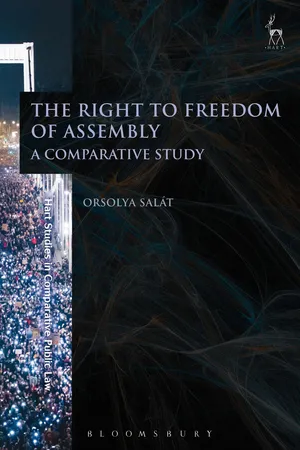
In legal decisions and commentary, freedom of assembly is widely cherished as a precious human right and as indispensable for the preservation of democratic governance. But despite this rhetoric assemblies are subject to extensive regulation, such as prior restraints, and restrictions on the time, place and manner of assemblies.
This comparative study examines five influential jurisdictions and reveals similarities and inconsistencies between them. It finds that freedom of assembly is often subjugated to freedom of expression in a way that disregards the expressive potential of assemblies. The shortcomings include the misconstrued content neutrality and public forum doctrines in the US, blanket bans and other restrictions based on intangible and distant harm in the UK, preventative restrictions and viewpoint discrimination in Germany, and the uncertain status of freedom of assembly and opaque judicial reasoning in France. Such inconsistencies also present challenges for the European Court of Human Rights in developing a coherent assembly doctrine. The book argues that it is time for jurisprudence to move away from a narrowly focused concept of expression, and recognise the creative and expressive value of freedom of assembly.
- 316 pages
- English
- PDF
- Available on iOS & Android
eBook - PDF
About this book
Information
Table of contents
- Cover
- Half-title
- Title
- Copyright
- Acknowledgements
- Contents
- Introduction
- Chapter 1: Origins, Forms and Values
- Chapter 2: Prior Restraints, Exemptions and Bargain
- Chapter 3: From Violence to Public Disorder to Crime Prevention
- Chapter 4: From Coercion to Direct Action to Disruption
- Chapter 5: Dignity as Peace, Truth and Love
- Chapter 6: Restrictions on the Time
- Chapter 7: Restrictions on the Manner
- Chapter 8: Restrictions on the Place
- Conclusion
- Index
Trusted by 375,005 students
Access to over 1.5 million titles for a fair monthly price.
Study more efficiently using our study tools.
Frequently asked questions
Yes, you can cancel anytime from the Subscription tab in your account settings on the Perlego website. Your subscription will stay active until the end of your current billing period. Learn how to cancel your subscription
No, books cannot be downloaded as external files, such as PDFs, for use outside of Perlego. However, you can download books within the Perlego app for offline reading on mobile or tablet. Learn how to download books offline
Perlego offers two plans: Essential and Complete
- Essential is ideal for learners and professionals who enjoy exploring a wide range of subjects. Access the Essential Library with 800,000+ trusted titles and best-sellers across business, personal growth, and the humanities. Includes unlimited reading time and Standard Read Aloud voice.
- Complete: Perfect for advanced learners and researchers needing full, unrestricted access. Unlock 1.5M+ books across hundreds of subjects, including academic and specialized titles. The Complete Plan also includes advanced features like Premium Read Aloud and Research Assistant.
We are an online textbook subscription service, where you can get access to an entire online library for less than the price of a single book per month. With over 1.5 million books across 990+ topics, we’ve got you covered! Learn about our mission
Look out for the read-aloud symbol on your next book to see if you can listen to it. The read-aloud tool reads text aloud for you, highlighting the text as it is being read. You can pause it, speed it up and slow it down. Learn more about Read Aloud
Yes! You can use the Perlego app on both iOS and Android devices to read anytime, anywhere — even offline. Perfect for commutes or when you’re on the go.
Please note we cannot support devices running on iOS 13 and Android 7 or earlier. Learn more about using the app
Please note we cannot support devices running on iOS 13 and Android 7 or earlier. Learn more about using the app
Yes, you can access The Right to Freedom of Assembly by Orsolya Salát in PDF and/or ePUB format, as well as other popular books in Law & Public Law. We have over 1.5 million books available in our catalogue for you to explore.