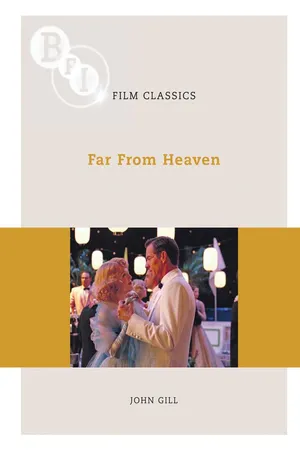
Todd Haynes's 2002 film Far From Heaven has been hailed as a homage to 1950s Hollywood melodrama, although anyone tempted to take the film at face value should be warned that it aims to subvert as much as celebrate that genre. Impeccably constructed, with a care for detail unknown in films from the era, it sets out to make key themes from the genre – romance across racial barriers and class lines, and perhaps the period's greatest taboo, romance between members of the same sex – utterly explicit, when half a century ago those themes had to be encoded in allusion and metaphor. Haynes took as his main source Douglas Sirk's 1955 classic, All That Heaven Allows, although Far From Heaven also references Rainer Werner Fassbinder's bleak portrayal of inter-racial love, Fear Eats the Soul (1974). In the context of Haynes's background in the New Queer Cinema movement, with films such as Superstar, Poison and [safe], this admixture makes Far From Heaven a rather more complex film than just another well-dressed period pastiche.
John Gill provides a revealing insight into how Haynes confronts issues of race, sexuality and class in a suburban 1950s American neighbourhood. Haynes has been evasive when pressed for a definitive explanation of his film, although as Gill contends, he has left enough evidence lying around on screen for the keen viewer to pick up on numerous disturbing strands at work beneath the glossy surface of this sumptuously presented weepie. While it may affect to pass as a classic of the genre, Haynes's ultimate aim, Gill contends, is to undermine the nature and notion of cinema and storytelling.
eBook - PDF
Far From Heaven
About this book
Information
Table of contents
- Cover
- Series Page
- Title
- Copyright
- Contents
- ‘Far From Heaven’
- Notes
- Credits
- Bibliography
Trusted by 375,005 students
Access to over 1.5 million titles for a fair monthly price.
Study more efficiently using our study tools.
Frequently asked questions
Yes, you can cancel anytime from the Subscription tab in your account settings on the Perlego website. Your subscription will stay active until the end of your current billing period. Learn how to cancel your subscription
No, books cannot be downloaded as external files, such as PDFs, for use outside of Perlego. However, you can download books within the Perlego app for offline reading on mobile or tablet. Learn how to download books offline
Perlego offers two plans: Essential and Complete
- Essential is ideal for learners and professionals who enjoy exploring a wide range of subjects. Access the Essential Library with 800,000+ trusted titles and best-sellers across business, personal growth, and the humanities. Includes unlimited reading time and Standard Read Aloud voice.
- Complete: Perfect for advanced learners and researchers needing full, unrestricted access. Unlock 1.5M+ books across hundreds of subjects, including academic and specialized titles. The Complete Plan also includes advanced features like Premium Read Aloud and Research Assistant.
We are an online textbook subscription service, where you can get access to an entire online library for less than the price of a single book per month. With over 1.5 million books across 990+ topics, we’ve got you covered! Learn about our mission
Look out for the read-aloud symbol on your next book to see if you can listen to it. The read-aloud tool reads text aloud for you, highlighting the text as it is being read. You can pause it, speed it up and slow it down. Learn more about Read Aloud
Yes! You can use the Perlego app on both iOS and Android devices to read anytime, anywhere — even offline. Perfect for commutes or when you’re on the go.
Please note we cannot support devices running on iOS 13 and Android 7 or earlier. Learn more about using the app
Please note we cannot support devices running on iOS 13 and Android 7 or earlier. Learn more about using the app
Yes, you can access Far From Heaven by John Gill in PDF and/or ePUB format, as well as other popular books in Media & Performing Arts & Film History & Criticism. We have over 1.5 million books available in our catalogue for you to explore.