What comes after 'postmodernism'? A buzzword which began as an energising, radical critique became, by the 20th Century's end, a byword for fracture, eclecticism, political apathy and intellectual exhaustion.
The last few years have seen a growing interest in critical realism as a possible, alternative way of moving forward. The virtues of critical realism lie in its successful provision of a philosophical grounding for the social sciences and humanities and of a methodology applicable to many different fields of analysis.
After Postmodernism brings together some of the best-known names in the field to present the first truly interdisciplinary introduction to critical realism. The book presents the reader with a compendium of accessible essays illustrating the connection between meta-theory, theory and substantive research across Sociology, Philosophy, Literary Studies, Politics, Media Studies, Psychology and Science Studies.
The flexibility of critical realism is illustrated in the range of topics discussed - ranging from quantum mechanics to cyberspace, to literary theory, nature, smoking, the future fo Marx, the unconscious and, of course, postmodernsim and the future of theory itself.
Contributors: Allison Assiter, Ted Benton, Francis Barker, Roy Bhaskar, Jean Bricmont, Sue Clegg, Andrew Collier, Justin Cruickshank, Robert Fine, David Ford, Tim Forsyth, Rom Harre, Pam Higham, Philip Hodgkiss, Jose Lopez, Christopher Norris, Bertell Ollman, Jenneth Parker, Frank Pearce, Douglas V. Porpora, Garry Potter, John Scott, Philip Tew, Charles R Varela, Anthony Woodiwiss
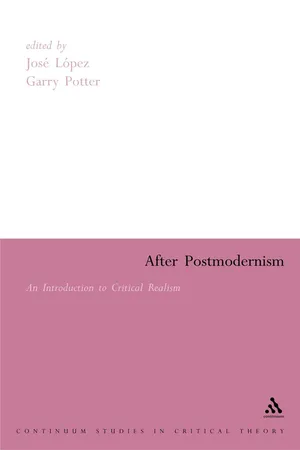
eBook - PDF
After Postmodernism
An Introduction to Critical Realism
- 348 pages
- English
- PDF
- Available on iOS & Android
eBook - PDF
After Postmodernism
An Introduction to Critical Realism
About this book
Information
Table of contents
- Contents
- GENERAL INTRODUCTION
- After Postmodernism: The Millennium
- PART I: VARIETIES OF REALISM
- PART II: ‘LOOKING FOR’ AND ‘LOOKING AT’ SOCIAL STRUCTURE
- PART III: PHYSICISTS AND PHILOSOPHERS
- PART IV: THEORY, NATURE AND SOCIETY
- PART V: COMPUTING POWER: DE-GENDERED BODIES AND GENDERED MINDS?
- PART VI: CULTURE AND CRITICISM
- PART VII: PRAGMATICISM AND POLITICS; PHILOSOPHY AND PUBLIC POLICY
- PART VIII: WAYS OF KNOWING
- PART IX: DIALECTICS
- Guide to Further Readings
- Bibliography
- Contributors
- Index
Trusted by 375,005 students
Access to over 1.5 million titles for a fair monthly price.
Study more efficiently using our study tools.
Frequently asked questions
Yes, you can cancel anytime from the Subscription tab in your account settings on the Perlego website. Your subscription will stay active until the end of your current billing period. Learn how to cancel your subscription
No, books cannot be downloaded as external files, such as PDFs, for use outside of Perlego. However, you can download books within the Perlego app for offline reading on mobile or tablet. Learn how to download books offline
Perlego offers two plans: Essential and Complete
- Essential is ideal for learners and professionals who enjoy exploring a wide range of subjects. Access the Essential Library with 800,000+ trusted titles and best-sellers across business, personal growth, and the humanities. Includes unlimited reading time and Standard Read Aloud voice.
- Complete: Perfect for advanced learners and researchers needing full, unrestricted access. Unlock 1.5M+ books across hundreds of subjects, including academic and specialized titles. The Complete Plan also includes advanced features like Premium Read Aloud and Research Assistant.
We are an online textbook subscription service, where you can get access to an entire online library for less than the price of a single book per month. With over 1.5 million books across 990+ topics, we’ve got you covered! Learn about our mission
Look out for the read-aloud symbol on your next book to see if you can listen to it. The read-aloud tool reads text aloud for you, highlighting the text as it is being read. You can pause it, speed it up and slow it down. Learn more about Read Aloud
Yes! You can use the Perlego app on both iOS and Android devices to read anytime, anywhere — even offline. Perfect for commutes or when you’re on the go.
Please note we cannot support devices running on iOS 13 and Android 7 or earlier. Learn more about using the app
Please note we cannot support devices running on iOS 13 and Android 7 or earlier. Learn more about using the app
Yes, you can access After Postmodernism by Jose Lopez, Garry Potter, Jose Lopez,Garry Potter in PDF and/or ePUB format, as well as other popular books in Letteratura & Teoria della critica letteraria. We have over 1.5 million books available in our catalogue for you to explore.