eBook - PDF
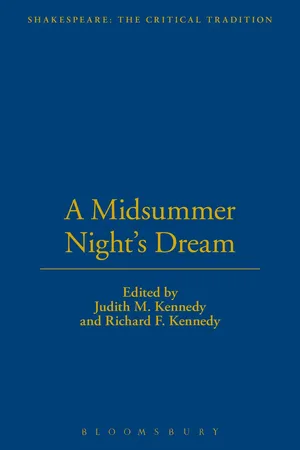
A Midsummer Night's Dream
Shakespeare: The Critical Tradition, Volume 7
- 484 pages
- English
- PDF
- Available on iOS & Android
eBook - PDF
A Midsummer Night's Dream
Shakespeare: The Critical Tradition, Volume 7
About this book
This study traces the response to "A Midsummer Night's Dream" from Shakespeare's day to the present, including critics from Britain, Europe and America.
Information
Table of contents
- CONTENTS
- GENERAL EDITOR'S PREFACE
- PREFACE
- INTRODUCTION
- 1 Moral conventions and human sympathy, 1775
- 2 Artists’ interpretations of dramatic effects, 1787
- 3 Commentary on A Midsummer Night’s Dream, 1790
- 4 Bottom as coxcomb, 1792
- 5 Response to Malone, 1793
- 6 Illustrations of some passages, 1794
- 7 His fertile and creative fancy, 1800
- 8 On metre, invention, and a unified whole, 1815
- 9 Unity of feeling and of imagery, and the fairies, 1817
- 10 Bottom, Puck, and the incompatibility of poetry and the stage, 1817
- 11 Malone’s last words, 1821
- 12 Mainly on the fairies, 1824
- 13 The fairy world, the clowns, the poetry, 1828
- 14 New actors on the mimic scene–the fairies, 1828
- 15 Marginalia and other notes, 1836
- 16 Bottom the lucky man, 1837
- 17 Critics refuted, 1838
- 18 Originality in structure, machinery, and language, 1839
- 19 The Pictorial Edition of A Midsummer Night’s Dream, 1839
- 20 The poet’s dream, 1840
- 21 Anachronisms, Nick Bottom as Midas, and stage representation, 1841
- 22 Oberon’s Vision allegorized, 1843
- 23 Fairy drama and human nature, 1843
- 24 Poet of the Fairies, 1844
- 25 A comment, with some explanatory notes, 1845
- 26 The theme of self-parody, 1846
- 27 Introductory remarks, 1847
- 28 The sister arts, and the play’s structural balance, 1848
- 29 A festival of dainties, 1851
- 30 The Dream and Art, 1851, 1872, 1883, 1884
- 31 A most charming entertainment of the stage, 1853
- 32 Samuel Phelps's Bottom, 1853
- 33 Dramatic and poetic art, 1854
- 34 Dialogue with a sceptic, 1854
- 35 Critical remarks on the play, 1856
- 36 Celtic elements, 1859
- 37 Genre and inner purpose, 1863
- 38 Intuitive power of characterization, 1863
- 39 The play’s limitations, 1864
- 40 The sacred mysteries in the play, 1865
- 41 The secret meaning of the Interlude, 1865
- 42 The perfection of imbecilic clowns, 1866
- 43 Not critics, but lowly worshippers of the Beautiful, 1869
- 44 The theme is love, 1871
- 45 Bottom – an ass, but no fool, 1873
- 46 A Midsummer Night’s Dream as masque, 1874
- 47 Self-reflexive structure: the Real, the Ideal, and the Representation, 1874
- 48 Shakespeare differentiated from Bacon, 1875
- 49 Theseus as the central figure, 1875
- 50 A comedy of incident, 1875
- 51 Consummation of Shakespeare’s lyrical genius, 1876
- 52 Bottom, a self-made man, 1876
- 53 The full glow of fancy and fun, 1877
- 54 The wood is the world, 1879
- 55 Titania and Ovid, 1880
- 56 A Platonic reading, 1884
- 57 Interpreting the spoken verse, 1885
- 58 Observations on the lovers and the mechanicals, 1886
- 59 Poet rather than dramatist, 1888
- 60 Source of the play’s popularity, 1888
- 61 Classical and modern, 1890
- 62 Reason and desire in Oberon and Titania, 1890
- 63 The development of morality and art, 1891
- 64 A true work of art, 1894
- 65 The duration of the action, 1895
- 66 Life and art, 1895
- 67 Daly and the idea of titivation, 1895
- 68 Remarks on the play and modern education, 1895
- 69 Theseus, Bottom, and the Interlude, 1896
- 70 The central idea, 1897
- 71 The airy dream, 1898
- 72 Illusion, realism, and imagination, 1900
- 73 Dream visions, 1903
- 74 A comedy of situation and enchantment, 1903
- 75 Shakespeare’s working classes, 1903
- 76 The atmosphere of the play, 1904
- 77 Love, dreamland, and Helena, 1905
- 78 The theme of illusion, 1907
- 79 The nature and sources of the play, 1908
- 80 The most beautiful work of man, 1909
- 81 Shakespeare's conception of his art, 1911
- 82 Screeds of word-music, 1914
- 83 Three types of fairies: Puck, Oberon and Titania, 1916
- 84 The dream’s validity, 1917
- 85 Comedy of love, 1920
- NOTES
- SELECT BIBLIOGRAPHY
- INDEX
Trusted by 375,005 students
Access to over 1.5 million titles for a fair monthly price.
Study more efficiently using our study tools.
Frequently asked questions
Yes, you can cancel anytime from the Subscription tab in your account settings on the Perlego website. Your subscription will stay active until the end of your current billing period. Learn how to cancel your subscription
No, books cannot be downloaded as external files, such as PDFs, for use outside of Perlego. However, you can download books within the Perlego app for offline reading on mobile or tablet. Learn how to download books offline
Perlego offers two plans: Essential and Complete
- Essential is ideal for learners and professionals who enjoy exploring a wide range of subjects. Access the Essential Library with 800,000+ trusted titles and best-sellers across business, personal growth, and the humanities. Includes unlimited reading time and Standard Read Aloud voice.
- Complete: Perfect for advanced learners and researchers needing full, unrestricted access. Unlock 1.5M+ books across hundreds of subjects, including academic and specialized titles. The Complete Plan also includes advanced features like Premium Read Aloud and Research Assistant.
We are an online textbook subscription service, where you can get access to an entire online library for less than the price of a single book per month. With over 1.5 million books across 990+ topics, we’ve got you covered! Learn about our mission
Look out for the read-aloud symbol on your next book to see if you can listen to it. The read-aloud tool reads text aloud for you, highlighting the text as it is being read. You can pause it, speed it up and slow it down. Learn more about Read Aloud
Yes! You can use the Perlego app on both iOS and Android devices to read anytime, anywhere — even offline. Perfect for commutes or when you’re on the go.
Please note we cannot support devices running on iOS 13 and Android 7 or earlier. Learn more about using the app
Please note we cannot support devices running on iOS 13 and Android 7 or earlier. Learn more about using the app
Yes, you can access A Midsummer Night's Dream by Judith M. Kennedy, Richard F. Kennedy, Judith M. Kennedy,Richard F. Kennedy in PDF and/or ePUB format, as well as other popular books in Literature & Shakespeare Drama. We have over 1.5 million books available in our catalogue for you to explore.