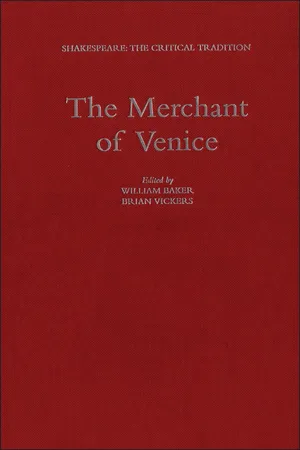
eBook - PDF
The Merchant of Venice
Shakespeare: The Critical Tradition
- 480 pages
- English
- PDF
- Available on iOS & Android
eBook - PDF
The Merchant of Venice
Shakespeare: The Critical Tradition
About this book
The Merchant of Venice has always been regarded as one of Shakespeare's most interesting plays. Before the nineteenth century critical reaction is relatively fragmentary. However between then and the late twentieth century the critical tradition reveals the tremendous vitality of the play to evoke emotion in the theatre and in the study. Since the middle of the twentieth century reactions to the drama have been influenced by the Nazi destruction of European Jewry. The first volume to document the full tradition of criticism of The Merchant of Venice includes an extensive introduction which charts the reactions to the play up to the beginning of the twenty first century and reflects changing reactions to prejudice in this period. Material by a variety of critics appears here for the first time since initial publication. Reactions are included from: Malone, Hazlitt, Jameson, Heine, Knight, Lewes, Halliwell-Phillips, Furnivall, Irving, Ruskin, Swinburne, Masefield, Gollancz and Quiller-Couch.
Trusted by 375,005 students
Access to over 1.5 million titles for a fair monthly price.
Study more efficiently using our study tools.
Information
Table of contents
- CONTENTS
- ACKNOWLEDGEMENTS
- GENERAL EDITOR'S PREFACE
- INTRODUCTION
- 1 On Macklin's Shylock, 1775
- 2 An 'apology' for Shylock, 1796
- 3 'One of Shakespeare's most perfect works', 1815
- 4 Kean's debut as Shylock, 1816
- 5 Sympathy for Shylock, but not for Portia, 1817
- 6 The major sources, 1824
- 7 In defence of Shylock, 1833
- 8 Portia, 1833
- 9 Shylock 'ill-used', 1838
- 10 Shakespeare justifies'an unfortunate race', 1838
- 11 Summa jus summa injuria, 1839
- 12 Lessons of charity, 1849
- 13 Shylock's humanity, 1850
- 14 Shakespeare's evenhandedness, 1851
- 15 Human rights and religious belief, 1856
- 16 Sympathetic liberality versus murderous avarice, 1856
- 17 In praise of Portia, 1859
- 18 'A just estimate of things', 1862
- 19 Shakespeare's love of justice, 1863
- 20 'The relation of man to property', 1863
- 21 Shylock 'the corrupted merchant', 1873
- 22 Portia the central character, 1875
- 23 Shylock 'the hero of the piece', 1877
- 24 A Hegelian reading, 1877
- 25 A plea for toleration, 1879
- 26 Shylock: an actor's view, 1879
- 27 Not a doctrinal play, 1879
- 28 'Not about Jewish grievances', 1879
- 29 Shylock's 'nobility and distinction', 1879
- 30 Shylock 'a product of history', 1879
- 31 A sonnet to Portia, 1879
- 32 'The Lopez case' and Shakespeare's Jew, 1880
- 33 A critique of Irving and Terry, 1881
- 34 Shylock from a Jewish point of view, 1882
- 35 An interview with Henry Irving, 1884
- 36 Shakespeare's interweaving of plots, 1885
- 37 On acting Portia, 1885
- 38 Portia's womanliness, 1885
- 39 Privileged Christian, proscribed Jew, 1885
- 40 Staging the play, 1887
- 41 Shylock's 'revengeful selfishness', 1888
- 42 'The first of his [Shakespeare's] great comedies', 1888
- 43 Shylock's character determined by the plot, 1894
- 44 Shakespeare's concession to bigotry, 1896
- 45 Shylock 'a monster of passionate hatred, not avarice', 1898
- 46 Shylock and modern criticism, 1898
- 47 'Two communities which meet but never mingle', 1900
- 48 'Some faint sympathy' for Shylock, 1905
- 49 Shylock 'a man of one idea', 1905
- 50 Shylock's language, 1905
- 51 Shylock more sinned against than sinning, 1907
- 52 'Untrammelled' as against 'plot-ridden' characters, 1907
- 53 The opposing principles of Love and Hate, 1908
- 54 Shylock less sinned against than sinning, 1909
- 55 Shakespeare's Jew and Marlowe's Christians, 1909
- 56 Shylock a comic villain, 1911
- 57 Shylock and his interpreters, 1911
- 58 'Man is what man had made him', 1916
- 59 Shakespeare's 'stage-cleverness' and the story's 'monstrous absurdity', 1916
- 60 Shylock's anal-erotic tendencies, 1921
- 61 Shylock not an authentic Jew, 1921
- 62 Shylock's self-revelation in soliloquy, 1922
- 63 Shakespeare's intentions and the dynamics of comedy, 1927
- 64 The 'alien' question, 1929
- 65 Shakespeare's attention to character and story, 1930
- 66 Shylock the Venetian, 1933
- 67 Antonio a depressive homosexual, 1934
- 68 Shylock a London usurer, 1935
- 69 The distribution of imagery within the play, 1935
- 70 The idea of riches, true and false, 1936
- 71 Shakespeare's 'matter-of-fact fairy tale', 1936
- 72 The two Shylocks, 1938
- 73 Anti-Semitism, ancient and modern, 1938
- 74 No hint 'where Shakespeare's sympathies lay', 1939
- NOTES
- SELECT BIBLIOGRAPHY
- INDEX
Frequently asked questions
Yes, you can cancel anytime from the Subscription tab in your account settings on the Perlego website. Your subscription will stay active until the end of your current billing period. Learn how to cancel your subscription
No, books cannot be downloaded as external files, such as PDFs, for use outside of Perlego. However, you can download books within the Perlego app for offline reading on mobile or tablet. Learn how to download books offline
Perlego offers two plans: Essential and Complete
- Essential is ideal for learners and professionals who enjoy exploring a wide range of subjects. Access the Essential Library with 800,000+ trusted titles and best-sellers across business, personal growth, and the humanities. Includes unlimited reading time and Standard Read Aloud voice.
- Complete: Perfect for advanced learners and researchers needing full, unrestricted access. Unlock 1.5M+ books across hundreds of subjects, including academic and specialized titles. The Complete Plan also includes advanced features like Premium Read Aloud and Research Assistant.
We are an online textbook subscription service, where you can get access to an entire online library for less than the price of a single book per month. With over 1.5 million books across 990+ topics, we’ve got you covered! Learn about our mission
Look out for the read-aloud symbol on your next book to see if you can listen to it. The read-aloud tool reads text aloud for you, highlighting the text as it is being read. You can pause it, speed it up and slow it down. Learn more about Read Aloud
Yes! You can use the Perlego app on both iOS and Android devices to read anytime, anywhere — even offline. Perfect for commutes or when you’re on the go.
Please note we cannot support devices running on iOS 13 and Android 7 or earlier. Learn more about using the app
Please note we cannot support devices running on iOS 13 and Android 7 or earlier. Learn more about using the app
Yes, you can access The Merchant of Venice by William Baker, Brian Vickers, William Baker,Brian Vickers in PDF and/or ePUB format, as well as other popular books in Literature & Shakespeare Drama. We have over 1.5 million books available in our catalogue for you to explore.