- 158 pages
- English
- PDF
- Available on iOS & Android
eBook - PDF
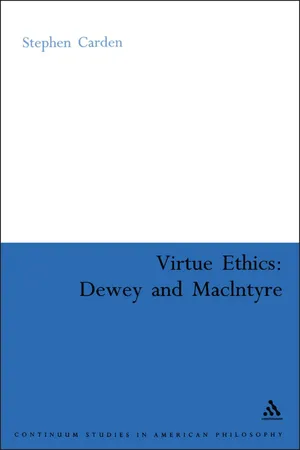
Virtue Ethics: Dewey and MacIntyre
About this book
Modern ethical theory has experienced a resurgence of interest in the virtues. Long relegated to the ancient and medieval past, virtue theory is now considered by many to be a viable alternative to the otherwise dominant Kantian and Utilitarian ethical theories. Alasdair MacIntyre is a central figure in this movement, whose work forms an expanding yet consistent and influential project to address fundamental issues in ethical theory and American culture. However, many of his ideas were anticipated by John Dewey, who also has a great deal to say about the virtues in a moral life. This book offers, as it were, a critique of MacIntyre by Dewey that allows these two philosophers to converse about the nature and origins of the virtues and their importance for living a good life. Stephen Carden argues that Dewey has the more comprehensive view of the virtues and that a close comparison of their ideas reveals several significant weaknesses in MacIntyre's position.
Information
Table of contents
- Contents
- Acknowledgements
- Introduction
- 1 Rediscovery of the virtues
- 2 Reconstruction of ethics
- 3 Origins of the virtues
- 4 Human flourishing
- 5 The ethical life
- Conclusion
- Bibliography
- Index
Trusted by 375,005 students
Access to over 1.5 million titles for a fair monthly price.
Study more efficiently using our study tools.
Frequently asked questions
Yes, you can cancel anytime from the Subscription tab in your account settings on the Perlego website. Your subscription will stay active until the end of your current billing period. Learn how to cancel your subscription
No, books cannot be downloaded as external files, such as PDFs, for use outside of Perlego. However, you can download books within the Perlego app for offline reading on mobile or tablet. Learn how to download books offline
We are an online textbook subscription service, where you can get access to an entire online library for less than the price of a single book per month. With over 1.5 million books across 990+ topics, we’ve got you covered! Learn about our mission
Look out for the read-aloud symbol on your next book to see if you can listen to it. The read-aloud tool reads text aloud for you, highlighting the text as it is being read. You can pause it, speed it up and slow it down. Learn more about Read Aloud
Yes! You can use the Perlego app on both iOS and Android devices to read anytime, anywhere — even offline. Perfect for commutes or when you’re on the go.
Please note we cannot support devices running on iOS 13 and Android 7 or earlier. Learn more about using the app
Please note we cannot support devices running on iOS 13 and Android 7 or earlier. Learn more about using the app
Yes, you can access Virtue Ethics: Dewey and MacIntyre by Stephen Carden in PDF and/or ePUB format, as well as other popular books in Philosophy & Ethics & Moral Philosophy. We have over 1.5 million books available in our catalogue for you to explore.