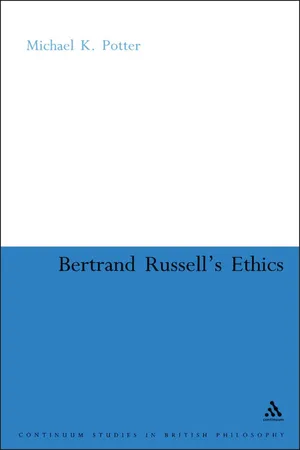
Bertrand Russell was not only one of the greatest philosophers of the twentieth century; he was also a humanitarian and activist who fought for many moral, social, and political causes. During his lifetime, the general public knew him for his activism and popular works, in which he tackled such diverse topics as sexual ethics, religion, war, and nuclear disarmament.
Besides the great achievements in mathematical logic on which his reputation rests, Russell was a pioneer in moral philosophy, and his work in this area informed and guided his activism. Russell created one of the first versions of a meta-ethical theory known as emotivism (sometimes also called the 'boo-hooray' theory, later popularized by A.J. Ayer and C.L. Stevenson) which maintains that ethical statements cannot be true or false - they are simply expressions of emotional attitudes. That Russell could hold such a theory while being at the same time an ardent activist is one feat. That his version was superior to more popular versions of emotivism is another.
Yet, despite the fact that Russell held on to some form of emotivism for most of his professional life, and despite the fact that the theory is present in some of his best-known books, it was virtually ignored until the late 1990s. Michael K. Potter's book brings an important new dimension to our understanding of Russell's life, his activism, and his contribution to moral philosophy.
eBook - PDF
Bertrand Russell's Ethics
About this book
Information
Table of contents
- Contents
- Acknowledgements
- Preface
- 1 Descent Into Emotivism
- 2 A Critique of Basic Emotivism
- 3 Enlightened Emotivism
- 4 Impulse and Desire
- 5 Final Thoughts
- Bibliography
- Index
Trusted by 375,005 students
Access to over 1.5 million titles for a fair monthly price.
Study more efficiently using our study tools.
Frequently asked questions
Yes, you can cancel anytime from the Subscription tab in your account settings on the Perlego website. Your subscription will stay active until the end of your current billing period. Learn how to cancel your subscription
No, books cannot be downloaded as external files, such as PDFs, for use outside of Perlego. However, you can download books within the Perlego app for offline reading on mobile or tablet. Learn how to download books offline
Perlego offers two plans: Essential and Complete
- Essential is ideal for learners and professionals who enjoy exploring a wide range of subjects. Access the Essential Library with 800,000+ trusted titles and best-sellers across business, personal growth, and the humanities. Includes unlimited reading time and Standard Read Aloud voice.
- Complete: Perfect for advanced learners and researchers needing full, unrestricted access. Unlock 1.5M+ books across hundreds of subjects, including academic and specialized titles. The Complete Plan also includes advanced features like Premium Read Aloud and Research Assistant.
We are an online textbook subscription service, where you can get access to an entire online library for less than the price of a single book per month. With over 1.5 million books across 990+ topics, we’ve got you covered! Learn about our mission
Look out for the read-aloud symbol on your next book to see if you can listen to it. The read-aloud tool reads text aloud for you, highlighting the text as it is being read. You can pause it, speed it up and slow it down. Learn more about Read Aloud
Yes! You can use the Perlego app on both iOS and Android devices to read anytime, anywhere — even offline. Perfect for commutes or when you’re on the go.
Please note we cannot support devices running on iOS 13 and Android 7 or earlier. Learn more about using the app
Please note we cannot support devices running on iOS 13 and Android 7 or earlier. Learn more about using the app
Yes, you can access Bertrand Russell's Ethics by Michael K. Potter in PDF and/or ePUB format, as well as other popular books in Philosophy & Philosophy History & Theory. We have over 1.5 million books available in our catalogue for you to explore.