The reform of the European Constitution continues to dominate news headlines and has provoked a massive debate, unprecedented in the history of EU law. Against this backdrop Monica Claes' book offers a "bottom up" view of how the Constitution might work, taking the viewpoint of the national courts as her starting point, and at the same time returning to fundamental principles in order to interrogate the myths of Community law. Adopting a broad, comparative approach, she analyses the basic doctrines of Community law from both national constitutional perspectives as well as the more usual European perspective. It is only by combining the perspectives of the EU and national constitutions, she argues, that a complete picture can be obtained, and a solid theoretical base (constitutional pluralism) developed. Her comparative analysis encompasses the law in France, Belgium, Denmark, the Netherlands, Germany, Ireland, Italy and the United Kingdom and in the course of her inquiry discusses a wide variety of prominent problems.
The book is structured around three main themes, coinciding with three periods in the development of the judicial dialogue between the ECJ and the national courts. The first focuses on the ordinary non-constitutional national courts and how they have successfully adapted to the mandates developed by the ECJ in Simmenthal and Francovich. The second examines the constitutional and other review courts and discusses the gradual transformation of the ECJ into a constitutional court, and its relationship to the national constitutional courts. The contrast is marked; these courts are not specifically empowered by the case law of the ECJ and have reacted quite differently to the message from Luxembourg, leaving them apparently on collision course with the ECJ in the areas of judicial Kompetenz Kompetenz and fundamental rights. The third theme reprises the first two and places them in the context of the current debate on the Constitution for Europe and the Convention, taking the perspective of the national courts as the starting point for a wide-ranging examination of EU's constitutional fundamentals. In so doing it argues that the new Constitution must accommodate the national perspective if it is to prove effective.
- 818 pages
- English
- PDF
- Available on iOS & Android
eBook - PDF
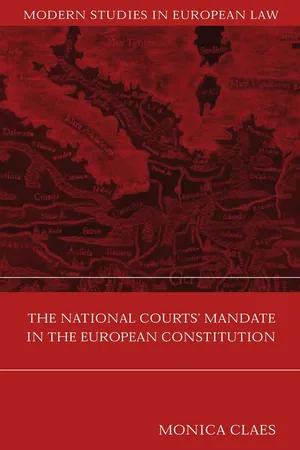
The National Courts' Mandate in the European Constitution
About this book
Information
Table of contents
- Half Title Page
- Half Title verso
- Title Page
- Title verso
- Acknowledgements
- Contents
- Table of Cases
- Introduction: The Judge, his Mandate, the National Constitution and European Union Law
- Part 1: The National Courts as Common Courts of European Law
- Part 2: The Court of Justice and National Constitutional Jurisdiction: La Guerre des Juges?
- Part 3: The National Courts' Mandate and the Future of the European Union
- Bibliography
Trusted by 375,005 students
Access to over 1.5 million titles for a fair monthly price.
Study more efficiently using our study tools.
Frequently asked questions
Yes, you can cancel anytime from the Subscription tab in your account settings on the Perlego website. Your subscription will stay active until the end of your current billing period. Learn how to cancel your subscription
No, books cannot be downloaded as external files, such as PDFs, for use outside of Perlego. However, you can download books within the Perlego app for offline reading on mobile or tablet. Learn how to download books offline
Perlego offers two plans: Essential and Complete
- Essential is ideal for learners and professionals who enjoy exploring a wide range of subjects. Access the Essential Library with 800,000+ trusted titles and best-sellers across business, personal growth, and the humanities. Includes unlimited reading time and Standard Read Aloud voice.
- Complete: Perfect for advanced learners and researchers needing full, unrestricted access. Unlock 1.5M+ books across hundreds of subjects, including academic and specialized titles. The Complete Plan also includes advanced features like Premium Read Aloud and Research Assistant.
We are an online textbook subscription service, where you can get access to an entire online library for less than the price of a single book per month. With over 1.5 million books across 990+ topics, we’ve got you covered! Learn about our mission
Look out for the read-aloud symbol on your next book to see if you can listen to it. The read-aloud tool reads text aloud for you, highlighting the text as it is being read. You can pause it, speed it up and slow it down. Learn more about Read Aloud
Yes! You can use the Perlego app on both iOS and Android devices to read anytime, anywhere — even offline. Perfect for commutes or when you’re on the go.
Please note we cannot support devices running on iOS 13 and Android 7 or earlier. Learn more about using the app
Please note we cannot support devices running on iOS 13 and Android 7 or earlier. Learn more about using the app
Yes, you can access The National Courts' Mandate in the European Constitution by Monica Claes in PDF and/or ePUB format, as well as other popular books in Law & International Law. We have over 1.5 million books available in our catalogue for you to explore.