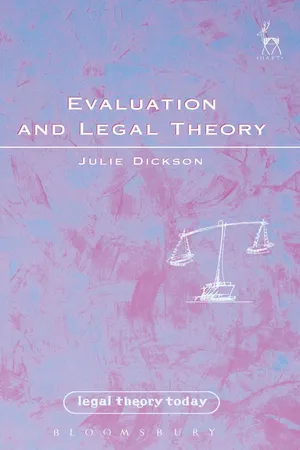
If Raz and Dworkin disagree over how law should be characterised,how are we, their jurisprudential public, supposed to go about adjudicating between the rival theories which they offer us? To what considerations would those theorists themselves appeal in order to convince us that their accounts of law are accurate and successful? Moreover, what is it that makes an account of law successful? Evaluation and Legal Theory tackles methodological or meta-theoretical issues such as these, and does so via attempting to answer the question: to what extent, and in what sense, must a legal theorist make value judgements about his data in order to construct a successful theory of law? Dispelling the obfuscatory myth that legal positivism seeks a 'value-free' account of law, the author attempts to explain and defend Joseph Razs position that evaluation is essential to successful legal theory, whilst refuting John Finnis and Ronald Dworkins contentions that the legal theorist must morally evaluate and morally justify the law in order to properly explain its nature.
The book does not claim to solve the many mysteries of meta-legal theory but does seek to contribute to and engender rigorous and focused debate on this topic.
eBook - PDF
Evaluation and Legal Theory
About this book
Information
Table of contents
- Half Title Page
- Half Title verso
- Title Page
- Title verso
- General Editor's Preface
- Contents
- Acknowledgements
- 1. What's the Point of Jurisprudence?
- 2. Introducing the Moral Evaluation Thesis
- 3. Indirectly Evaluative Legal Theory: Meeting Finnis' Challenge
- 4. Finnis and the Moral Justification Thesis
- 5. The Beneficial Moral Consequences Thesis and an Introduction to Dworkinian Methodology
- 6. What's the Point of Law? Dworkinian Methodology and the Argument from Law's Function
- 7. Carrying on the Conversation
- Index
Trusted by 375,005 students
Access to over 1.5 million titles for a fair monthly price.
Study more efficiently using our study tools.
Frequently asked questions
Yes, you can cancel anytime from the Subscription tab in your account settings on the Perlego website. Your subscription will stay active until the end of your current billing period. Learn how to cancel your subscription
No, books cannot be downloaded as external files, such as PDFs, for use outside of Perlego. However, you can download books within the Perlego app for offline reading on mobile or tablet. Learn how to download books offline
Perlego offers two plans: Essential and Complete
- Essential is ideal for learners and professionals who enjoy exploring a wide range of subjects. Access the Essential Library with 800,000+ trusted titles and best-sellers across business, personal growth, and the humanities. Includes unlimited reading time and Standard Read Aloud voice.
- Complete: Perfect for advanced learners and researchers needing full, unrestricted access. Unlock 1.5M+ books across hundreds of subjects, including academic and specialized titles. The Complete Plan also includes advanced features like Premium Read Aloud and Research Assistant.
We are an online textbook subscription service, where you can get access to an entire online library for less than the price of a single book per month. With over 1.5 million books across 990+ topics, we’ve got you covered! Learn about our mission
Look out for the read-aloud symbol on your next book to see if you can listen to it. The read-aloud tool reads text aloud for you, highlighting the text as it is being read. You can pause it, speed it up and slow it down. Learn more about Read Aloud
Yes! You can use the Perlego app on both iOS and Android devices to read anytime, anywhere — even offline. Perfect for commutes or when you’re on the go.
Please note we cannot support devices running on iOS 13 and Android 7 or earlier. Learn more about using the app
Please note we cannot support devices running on iOS 13 and Android 7 or earlier. Learn more about using the app
Yes, you can access Evaluation and Legal Theory by Julie Dickson in PDF and/or ePUB format, as well as other popular books in Law & Jurisprudence. We have over 1.5 million books available in our catalogue for you to explore.