- 390 pages
- English
- PDF
- Available on iOS & Android
eBook - PDF
About this book
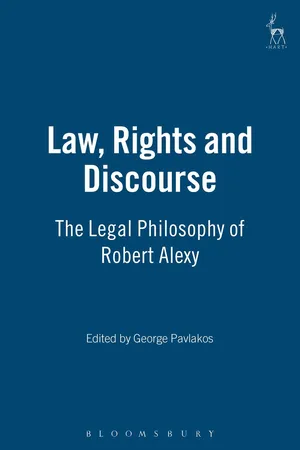
A philosophical system is not what one would expect to find in the work of a contemporary legal thinker. Robert Alexy's work counts as a striking exception. Over the past 28 years Alexy has been developing, with remarkable clarity and consistency, a systematic philosophy covering most of the key areas of legal philosophy. Kantian in its inspiration, his work admirably combines the rigour of analytical philosophy with a repertoire of humanitarian ideals reflecting the tradition of the Geisteswissenschaften, rendering it one of the most far-reaching and influential legal philosophies in our time. This volume has been designed with two foci in mind: the first is to reflect the breadth of Alexy's philosophical system, as well as the varieties of jurisprudential and philosophical scholarship in the last three decades on which his work has had an impact. The second objective is to provide for a critical exchange between Alexy and a number of specialists in the field, with an eye to identifying new areas of inquiry and offering a new impetus to the discourse theory of law. To that extent, it was thought that a critical exchange such as the one undertaken here would most appropriately reflect the discursive and critical character of Robert Alexy's work. The volume is divided into four parts, each dealing with a key area of Alexy's contribution. A final section brings together concise answers by Robert Alexy. In composing these, Alexy has tried to focus on points and criticisms that address new aspects of discourse theory or otherwise point the way to future developments and applications. With its range of topics of coverage, the number of specialists it engages and the originality of the answers it provides, this collection will become a standard work of reference for anyone working in legal theory in general and the discourse theory of law in particular.
Information
Table of contents
- Preface
- Contents
- List of Contributors
- Introduction
- Part IA Debate on Legal Positivism
- 1The Argument from Justice, or HowNot to Reply to Legal Positivism
- 2An Answer to Joseph Raz
- Part IILaw and Morality
- 3Why Law Makes No Claims
- 4How Non-Positivism CanAccommodate Legal Certainty
- 5Two Concepts of Objectivity
- 6Discourse Ethics, Legal Positivismand the Law
- Part IIIConstitutional Rights
- 7Political Liberalism and theStructure of Rights: On the Placeand Limits of the ProportionalityRequirement
- 8Proportionality, Discretion and theSecond Law of Balancing
- 9Human Rights and the Claim toCorrectness in the Theory of RobertAlexy
- 10Three-Person Justification
- Part IVDiscourse and Argumentation
- 11Law’s Claim to Correctness
- 12A Teleological Approach to LegalDialogues
- 13The Claim to Correctness andInferentialism: Alexy’s Theory ofPractical Reason Reconsidered
- 14The Concept of Validity in a Theoryof Social Action
- 15The Weight Formula andArgumentation
- Part VComments and Responses
- 16Thirteen Replies
- Index
Trusted by 375,005 students
Access to over 1.5 million titles for a fair monthly price.
Study more efficiently using our study tools.
Frequently asked questions
Yes, you can cancel anytime from the Subscription tab in your account settings on the Perlego website. Your subscription will stay active until the end of your current billing period. Learn how to cancel your subscription
No, books cannot be downloaded as external files, such as PDFs, for use outside of Perlego. However, you can download books within the Perlego app for offline reading on mobile or tablet. Learn how to download books offline
Perlego offers two plans: Essential and Complete
- Essential is ideal for learners and professionals who enjoy exploring a wide range of subjects. Access the Essential Library with 800,000+ trusted titles and best-sellers across business, personal growth, and the humanities. Includes unlimited reading time and Standard Read Aloud voice.
- Complete: Perfect for advanced learners and researchers needing full, unrestricted access. Unlock 1.5M+ books across hundreds of subjects, including academic and specialized titles. The Complete Plan also includes advanced features like Premium Read Aloud and Research Assistant.
We are an online textbook subscription service, where you can get access to an entire online library for less than the price of a single book per month. With over 1.5 million books across 990+ topics, we’ve got you covered! Learn about our mission
Look out for the read-aloud symbol on your next book to see if you can listen to it. The read-aloud tool reads text aloud for you, highlighting the text as it is being read. You can pause it, speed it up and slow it down. Learn more about Read Aloud
Yes! You can use the Perlego app on both iOS and Android devices to read anytime, anywhere — even offline. Perfect for commutes or when you’re on the go.
Please note we cannot support devices running on iOS 13 and Android 7 or earlier. Learn more about using the app
Please note we cannot support devices running on iOS 13 and Android 7 or earlier. Learn more about using the app
Yes, you can access Law, Rights and Discourse by George Pavlakos in PDF and/or ePUB format, as well as other popular books in Law & Jurisprudence. We have over 1.5 million books available in our catalogue for you to explore.