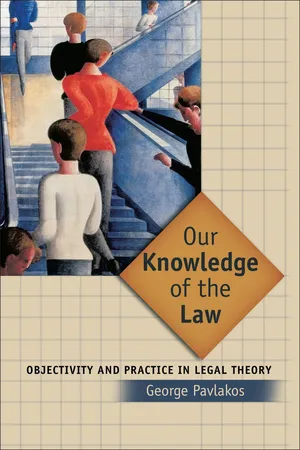
In the long-standing debate between positivism and non-positivism, legal validity has always been a subject of controversy. While positivists deny that moral values play any role in the determination of legal validity, non-positivists affirm the opposite thesis. In departing from this narrow point of view, the book focuses on the notion of legal knowledge. Apart from what one takes to constitute the grounds of legal validity, there is a more fundamental issue about cognitive validity: how do we acquire knowledge of whatever is assumed to constitute the elements of legal validity? When the question is posed in this form a fundamental shift takes place. Given that knowledge is a philosophical concept, for anything to constitute an adequate ground for legal validity it must satisfy the standards set by knowledge. In exploring those standards the author argues that knowledge is the outcome of an activity of judging, which is constrained by reasons (reflexive). While these reasons may vary with the domain of judging, the reflexive structure of the practice of judging imposes certain constraints on what can constitute a reason for judging. Amongst these constraints are found not only general metaphysical limitations but also the fundamental principle that one with the capacity to judge is autonomous or, in other words, capable of determining the reasons that form the basis of action. One sees, as soon as autonomy has been introduced into the parameters of knowledge, that law is necessarily connected with every other practical domain. The author shows, in the end, that the issue of knowledge is orthogonal to questions about the inclusion or exclusion of morality, for what really matters is whether the putative grounds of legal validity are appropriate to the generation of knowledge. The outcome is far more integral than much work in current theory: neither an absolute deference to either universal moral standards or practice-independent values nor a complete adherence to conventionality and institutional arrangements will do. In suggesting that the current positivism versus non-positivism debate, when it comes to determining law's nature, misses the crux of the matter, the book aims to provoke a fertile new debate in legal theory.
"George Pavlakos' engaging book tackles the fundamental question of what makes legal knowledge possible. Since all articulate thought has to conform to implicit rules of grammar, it is necessarily normatively structured. Thus normativity cannot be something external to human thinking that we study from the outside, but is intrinsic to all human practices (including the natural sciences). This insight opens up fascinating new lines of inquiry into the character of law and its relations to other normative domains."
Professor Sir Neil MacCormick, Edinburgh University
"With admirable analytical acumen, George Pavlakos underscores the practical character of legal knowledge as well as the importance of argumentation in legal theory. He rejects those approaches to the nature of law that rest on conventional criteria as well as those that turn on factors altogether independent of practice, developing instead the thesis that objectivity and knowledge emerge from practical activity reflecting the spontaneity of human reason. In light of this notion of legal cognition as a practical activity directed and constrained by reason, the law is seen as an enduring institution, jurisprudence as a humanistic discipline. A truly important work."
Professor Dr. Robert Alexy, Christian-Albrechts-Universität zu Kiel
- 278 pages
- English
- PDF
- Available on iOS & Android
eBook - PDF
About this book
Information
Table of contents
- Acknowledgements
- Contents
- Introduction
- The Problem
- The Practice Theory of Law
- The Philosophy of Pragmatic Rationalism
- Plan of the Book
- Part OneThe Grounds of Knowledge
- 1Knowledge and Objectivity
- 1.1 Introduction
- 1.2 Objectivity as Asymmetry
- 1.3 Conceptions of Objectivity
- 1.4 Wittgenstein’s Idea of Grammar
- 2Objectivity and Grammar
- 2.1 Introduction
- 2.2 Intentional Realism
- 2.3 An Anti-representationalist Theory of Content
- 2.4 Mind-independence and Realism
- 2.5 Inferentialism and Truth
- 2.6 Grammar, Criteria and the Need for Practice
- 3Grammar and Rule-following
- 3.1 Introduction
- 3.2 Rule-following and Content
- 3.3 Conceptions of Practice
- 3.4 Beyond Mind-World Dualism
- 3.5 Meaning, Use and Truth
- 4Practice, Normativity and Reasons
- 4.1 Introduction
- 4.2 Reasons and the Reflexive Character of Practice
- 4.3 Grammar as the Fundamental Practice
- 4.4 Grammar, Persons and Autonomy
- 4.5 Pragmatic Rationalism
- 4.6 Where does Law Fit in All This?
- Part TwoKnowledge and Legal Theory
- 5Conventionalism and the Grammarof Law
- 5.1 Introduction
- 5.2 Conceptual Analysis and the Grammar of Law
- 5.3 The External and the Internal Aspect of Rules: LegalTheory’s Split Personality
- 5.4 Two Criticisms
- 5.5 Conclusion
- 6Interpretivism and the Menace ofEssentialism
- 6.1 Introduction
- 6.2 Interpretivism and the Depth of Practice
- 6.3 Rationalist Objectivity
- 6.4 Anti-rationalism and the Rejection of Grammar
- 6.5 Normativity of Practice
- 7The Practice Theory of Law
- 7.1 Introduction
- 7.2 Failure of Conventionalism and Interpretivism
- 7.3 Law as a Constraint-generating Concept
- 7.4 Conditions of Normativity
- 7.5 Depicting Legal Norms I: the General Rules ofDiscourse
- 7.6 Depicting Legal Norms II: Law as a Special Case ofMorality
- Concluding Remarks
- The Practice Theory of Law in a Nutshell
- Outcomes and Some Applications
- Bibliography
- Index
Trusted by 375,005 students
Access to over 1.5 million titles for a fair monthly price.
Study more efficiently using our study tools.
Frequently asked questions
Yes, you can cancel anytime from the Subscription tab in your account settings on the Perlego website. Your subscription will stay active until the end of your current billing period. Learn how to cancel your subscription
No, books cannot be downloaded as external files, such as PDFs, for use outside of Perlego. However, you can download books within the Perlego app for offline reading on mobile or tablet. Learn how to download books offline
Perlego offers two plans: Essential and Complete
- Essential is ideal for learners and professionals who enjoy exploring a wide range of subjects. Access the Essential Library with 800,000+ trusted titles and best-sellers across business, personal growth, and the humanities. Includes unlimited reading time and Standard Read Aloud voice.
- Complete: Perfect for advanced learners and researchers needing full, unrestricted access. Unlock 1.5M+ books across hundreds of subjects, including academic and specialized titles. The Complete Plan also includes advanced features like Premium Read Aloud and Research Assistant.
We are an online textbook subscription service, where you can get access to an entire online library for less than the price of a single book per month. With over 1.5 million books across 990+ topics, we’ve got you covered! Learn about our mission
Look out for the read-aloud symbol on your next book to see if you can listen to it. The read-aloud tool reads text aloud for you, highlighting the text as it is being read. You can pause it, speed it up and slow it down. Learn more about Read Aloud
Yes! You can use the Perlego app on both iOS and Android devices to read anytime, anywhere — even offline. Perfect for commutes or when you’re on the go.
Please note we cannot support devices running on iOS 13 and Android 7 or earlier. Learn more about using the app
Please note we cannot support devices running on iOS 13 and Android 7 or earlier. Learn more about using the app
Yes, you can access Our Knowledge of the Law by George Pavlakos in PDF and/or ePUB format, as well as other popular books in Law & Jurisprudence. We have over 1.5 million books available in our catalogue for you to explore.