This book deals with the nature of international organisations and the tension between their legal nature and the system of classic, state-based international law. This tension is important in theory and practice, particularly when organisations are brought under the rule of international law and have to be conceptualised as legal subjects, for example in the context of accountability.
The position of organisations is complicated by what the author terms 'the institutional veil', comparable to the corporate veil found in corporate law. The book focuses on the law of treaties, as this pre-eminently 'horizontal' branch of international law brings out the problem particularly clearly. The first part of the book addresses the legal phenomenon of international organisations, their legal features as independent concepts, the history of international organisations and of legal thought in respect of them, and the development of contemporary law on international organisations. The second part deals with the practice of international organisations and treaty-making. It discusses treaty-making practice within organisations, judicial practice in interpretation of organisations' constitutive treaties, and the practice of treaty-making by organisations. The third and final part analyses the process by which international organisations have been brought under the rule of the written law of treaties, offering a practical application of the conceptual framework as previously set out. Part three is at the same time an analytic overview of the drafting history of the 1986 Vienna Convention on the Law of Treaties between States and International Organizations or between International Organizations. This is a profound and penetrating examination of the character of international organisations and their place in international law, and will be an important source for anyone interested in the future role of organisations in the international legal system.
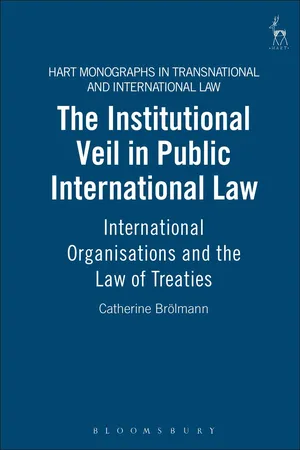
eBook - PDF
The Institutional Veil in Public International Law
International Organisations and the Law of Treaties
- 330 pages
- English
- PDF
- Available on iOS & Android
eBook - PDF
The Institutional Veil in Public International Law
International Organisations and the Law of Treaties
About this book
Information
Table of contents
- Acknowledgments
- Summary Contents
- Contents
- List of Abbreviations
- 1Introduction
- Part OneInternational Organisations asInternational Legal Actors
- 2The Nature of InternationalOrganisations
- 2.1 PRELIMINARY REMARKS
- 2.2 FORMAL ASPECTS
- 2.3 MATERIAL ASPECTS
- 3Conceptions of a New Legal Actor
- 3.1 THE STATE
- 3.2 THE RISE OF INTERNATIONAL ORGANISATIONS: THENINETEENTH CENTURY
- 3.3 THE LEAGUE OF NATIONS ERA
- 4The United Nations Era
- 4.1 INSTITUTIONS
- 4.2 LEGAL IMAGES
- Concluding Remarks to Part One
- Part TwoInternational Organisations andTreaty Practice
- 5International Organisations as aForum for Treaty-making
- 5.1 CENTRALISATION IN UNITED NATIONS PRACTICE
- 5.2 CENTRALISATION IN TECHNICAL ORGANISATIONS
- 6Constitutive Treaties of InternationalOrganisations
- 6.1 TREATY OR CONSTITUTION?
- 6.2 THE LAW OF TREATIES APPLIED TO CONSTITUTIVEINSTRUMENTS
- 7Treaty-Making by InternationalOrganisations
- 7.1 IGO TREATIES IN PRACTICE
- 7.2 IGO TREATIES IN DOCTRINE
- Concluding Remarks to Part Two
- Part ThreeInternational Organisations and theConventional Law of Treaties
- 8Towards a Codified Law of Treatiesfor International Organisations
- 8.1 PREPARATORY WORK BY THE INTERNATIONAL LAWCOMMISSION
- 8.2 RECEPTION OF THE ILC DRAFT AND THE 1968–1969 VIENNACONFERENCE
- 8.3 INTERNATIONAL ORGANISATIONS IN THE FIRST STAGE OFTHE CODIFICATION PROCESS
- 9The 1986 Vienna Convention:Preliminary Questions andProcedural Aspects
- 9.1 QUESTIONS OF METHODOLOGY
- 9.2 THE PROCEDURAL POSITION OF INTERNATIONALORGANISATIONS
- 9.3 DIPLOMATIC FORTUNE OF THE CONVENTION
- 9.4 CONCLUSION: THE STATUS OF ORGANISATIONS IN METHODAND PROCEDURE
- 10The 1986 Vienna Convention on theLaw of Treaties Between States andInternational Organizations orBetween International Organizations
- 10.1 ISSUES OF DOCTRINE
- 10.2 ISSUES OF PRACTICE
- 10.3 ISSUES OF PRINCIPLE
- Concluding Remarks to Part Three
- General Conclusions
- 11The Invisible Continent: ConcludingRemarks
- 11.1 PROPOSITIONS ON THE INSTITUTIONAL VEIL
- 11.2 THE INSTITUTIONAL VEIL IN THE CONVENTIONAL LAW OFTREATIES
- 11.3 THE INSTITUTIONAL VEIL AND INTERNATIONALRESPONSIBILITY
- 11.4 THE INSTITUTIONAL VEIL IN GENERAL INTERNATIONAL LAW
- 11.5 THE POSITIVIST PERSPECTIVE ON THE INSTITUTIONAL VEIL
- Annexes
- Annex I. TABLE OF COMPARISON: ARTICLES 1986 CONVENTIONAND ARTICLES 1969 CONVENTION
- Annex II. TABLE OF COMPARISON: ARTICLES 1986 CONVENTIONAND DRAFT ARTICLES 1982
- Annex III. ARTICLES OF THE 1969 CONVENTION MARKED AS‘PROBLEMATIC’ FOR THE PURPOSE OF THE 1986 VIENNACONFERENCE
- Annex IV. SOME PARALLEL PROVISIONS OF THE 1986 CONVENTIONAND THE 1969 CONVENTION
- Select Bibliography of Authors
- Index
Trusted by 375,005 students
Access to over 1.5 million titles for a fair monthly price.
Study more efficiently using our study tools.
Frequently asked questions
Yes, you can cancel anytime from the Subscription tab in your account settings on the Perlego website. Your subscription will stay active until the end of your current billing period. Learn how to cancel your subscription
No, books cannot be downloaded as external files, such as PDFs, for use outside of Perlego. However, you can download books within the Perlego app for offline reading on mobile or tablet. Learn how to download books offline
Perlego offers two plans: Essential and Complete
- Essential is ideal for learners and professionals who enjoy exploring a wide range of subjects. Access the Essential Library with 800,000+ trusted titles and best-sellers across business, personal growth, and the humanities. Includes unlimited reading time and Standard Read Aloud voice.
- Complete: Perfect for advanced learners and researchers needing full, unrestricted access. Unlock 1.5M+ books across hundreds of subjects, including academic and specialized titles. The Complete Plan also includes advanced features like Premium Read Aloud and Research Assistant.
We are an online textbook subscription service, where you can get access to an entire online library for less than the price of a single book per month. With over 1.5 million books across 990+ topics, we’ve got you covered! Learn about our mission
Look out for the read-aloud symbol on your next book to see if you can listen to it. The read-aloud tool reads text aloud for you, highlighting the text as it is being read. You can pause it, speed it up and slow it down. Learn more about Read Aloud
Yes! You can use the Perlego app on both iOS and Android devices to read anytime, anywhere — even offline. Perfect for commutes or when you’re on the go.
Please note we cannot support devices running on iOS 13 and Android 7 or earlier. Learn more about using the app
Please note we cannot support devices running on iOS 13 and Android 7 or earlier. Learn more about using the app
Yes, you can access The Institutional Veil in Public International Law by Catherine Brölmann in PDF and/or ePUB format, as well as other popular books in Law & International Law. We have over 1.5 million books available in our catalogue for you to explore.