Today there are more than 2,500 bilateral investment treaties (BITs) around the world. Most of these investment protection treaties offer foreign investors a direct cause of action to claim damages against host-states before international arbitral tribunals. This procedure, together with the requirement of compensation in indirect expropriations and the fair and equitable treatment standard, have transformed the way we think about state liability in international law.
We live in the BIT generation, a world where BITs define the scope and conditions according to which states are economically accountable for the consequences of regulatory change and administrative action. Investment arbitration in the BIT generation carries new functions which pose unprecedented normative challenges, such as the arbitral bodies established to resolve investor/state disputes defining the relationship between property rights and the public interest. They also review state action for arbitrariness, and define the proper tests under which that review should proceed.
State Liability in Investment Treaty Arbitration is an interdisciplinary work, aimed at academics and practitioners, which focuses on five key dimensions of BIT arbitration. First, it analyses the past practice of state responsibility for injuries to aliens, placing the BIT generation in historical perspective. Second, it develops a descriptive law-and-economics model that explains the proliferation of BITs, and why they are all worded so similarly. Third, it addresses the legitimacy deficits of this new form of dispute settlement, weighing its potential advantages and democratic shortfalls. Fourth, it gives a comparative overview of the universal tension between property rights and the public interest, and the problems and challenges associated with liability grounded in illegal and arbitrary state action. Finally, it presents a detailed legal study of the current state of BIT jurisprudence regarding indirect expropriations and the fair and equitable treatment clause.
This title is included in Bloomsbury Professional's International Arbitration online service.
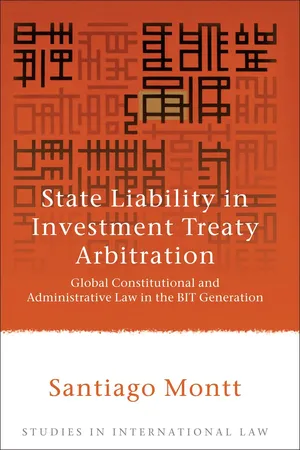
eBook - PDF
State Liability in Investment Treaty Arbitration
Global Constitutional and Administrative Law in the BIT Generation
- 460 pages
- English
- PDF
- Available on iOS & Android
eBook - PDF
State Liability in Investment Treaty Arbitration
Global Constitutional and Administrative Law in the BIT Generation
About this book
Information
Table of contents
- Cover
- Prelims
- Foreword
- Acknowledgements
- Table of Contents
- Table of Cases
- Table of Legislation
- Table of International Agreements and Draft International Agreements
- Introduction
- First Part A Framework of Analysis
- 1 The Latin American Position on State Responsibility: Looking into the Past for Lessons on the Future
- 2 The BIT Generation’s Emergence as a Collective Action Problem: Prisoner’s Dilemma or Network Effects?
- 3 Trading off Sovereignty for Credibility: Questions of Legitimacy in the BIT Generation
- Second Part An Assessment of the Present State of Investment Treaty Arbitration Jurisprudence
- 4 Property Rights v the Public Interest: A Comparative Approach to a Global Puzzle
- 5 Investments, Indirect Expropriations and the Regulatory State
- 6 Controlling Arbitrariness through the Fair and Equitable Treatment Standard
- Conclusions: Future of the BIT Generation: For a Global Legal Order Committed to the Rule of Law and Human Welfare
- Bibliography
- Index
Trusted by 375,005 students
Access to over 1.5 million titles for a fair monthly price.
Study more efficiently using our study tools.
Frequently asked questions
Yes, you can cancel anytime from the Subscription tab in your account settings on the Perlego website. Your subscription will stay active until the end of your current billing period. Learn how to cancel your subscription
No, books cannot be downloaded as external files, such as PDFs, for use outside of Perlego. However, you can download books within the Perlego app for offline reading on mobile or tablet. Learn how to download books offline
Perlego offers two plans: Essential and Complete
- Essential is ideal for learners and professionals who enjoy exploring a wide range of subjects. Access the Essential Library with 800,000+ trusted titles and best-sellers across business, personal growth, and the humanities. Includes unlimited reading time and Standard Read Aloud voice.
- Complete: Perfect for advanced learners and researchers needing full, unrestricted access. Unlock 1.5M+ books across hundreds of subjects, including academic and specialized titles. The Complete Plan also includes advanced features like Premium Read Aloud and Research Assistant.
We are an online textbook subscription service, where you can get access to an entire online library for less than the price of a single book per month. With over 1.5 million books across 990+ topics, we’ve got you covered! Learn about our mission
Look out for the read-aloud symbol on your next book to see if you can listen to it. The read-aloud tool reads text aloud for you, highlighting the text as it is being read. You can pause it, speed it up and slow it down. Learn more about Read Aloud
Yes! You can use the Perlego app on both iOS and Android devices to read anytime, anywhere — even offline. Perfect for commutes or when you’re on the go.
Please note we cannot support devices running on iOS 13 and Android 7 or earlier. Learn more about using the app
Please note we cannot support devices running on iOS 13 and Android 7 or earlier. Learn more about using the app
Yes, you can access State Liability in Investment Treaty Arbitration by Santiago Montt in PDF and/or ePUB format, as well as other popular books in Law & International Trade Law. We have over 1.5 million books available in our catalogue for you to explore.