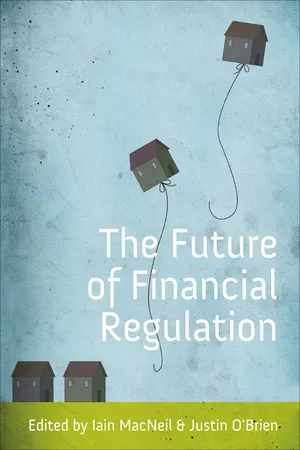
The Future of Financial Regulation is an edited collection of papers presented at a major conference at the University of Glasgow in spring 2009, co-sponsored by the Economic and Social Research Council World Economy and Finance Programme and the the Australian Research Council Governance Research Network. It draws together a variety of different perspectives on the international financial crisis which began in August 2007 and later turned into a more widespread economic crisis following the collapse of Lehman Brothers in the autumn of 2008. Spring 2009 was in many respects the nadir since valuations in financial markets had reached their low point and crisis management rather than regulatory reform was the main focus of attention. The conference and book were deliberately framed as an attempt to re-focus attention from the former to the latter.
The first part of the book focuses on the context of the crisis, discussing the general characteristics of financial crises and the specific influences that were at work this time round. The second part focuses more specifically on regulatory techniques and practices implicated in the crisis, noting in particular an over-reliance on the capacity of regulators and financial institutions to manage risk and on the capacity of markets to self-correct. The third part focuses on the role of governance and ethics in the crisis and in particular the need for a common ethical framework to underpin governance practices and to provide greater clarity in the design of accountability mechanisms. The final part focuses on the trajectory of regulatory reform, noting the considerable potential for change as a result of the role of the state in the rescue and recuperation of the financial system and stressing the need for fundamental re-appraisal of business and regulatory models.
eBook - PDF
The Future of Financial Regulation
- 484 pages
- English
- PDF
- Available on iOS & Android
eBook - PDF
The Future of Financial Regulation
About this book
Information
Table of contents
- Prelims
- Contents
- Introduction: The Future of Financial Regulation
- 1 Adam Smith’s Dinner
- 2 US Mortgage Markets: A Tale of Self-correcting Markets, Parallel Lives and Other People’s Money
- 3 The Current Financial Crisis and the Economic Impact of Future Regulatory Reform
- 4 Financial Engineering or Legal Engineering? Legal Work, Legal Integrity and the Banking Crisis
- 5 The Future of Financial Regulation: The Role of the Courts
- 6 The Financial Crisis: Regulatory Failure or Systems Failure?
- 7 Beyond ‘Light Touch’ Regulation of British Banks after the Financial Crisis
- 8 What Next for Risk-based Financial Regulation?
- 9 Risk Control Strategies: An Assessment in the Context of the Credit Crisis
- 10 Revisiting the Lender of Last Resort— The Role of the Bank of England
- 11 The Global Credit Crisis and Regulatory Reform
- 12 What Future for Disclosure as a Regulatory Technique? Lessons from Behavioural Decision Theory and the Global Financial Crisis
- 13 Credit Crisis Solutions: Risk Symmetric Criteria for the Reconstruction of Socially Fair Asset-backed Securities
- 14 ‘Corporate Governance’ an Oxymoron? The Role of Corporate Governance in the Current Banking Crisis
- 15 Board Composition and Female Non-executive Directors
- 16 Has the Financial Crisis Revealed the Concept of the ‘Responsible Owner’ to be a Myth?
- 17 The Institutional Investor’s Role in ‘Responsible Ownership’
- 18 Trust and Transparency: The Need for Early Warning
- 19 Regulation, Ethics and Collective Investments
- 20 Financial Crisis and Economist Pretensions: A Critical Theological Approach
- 21 Dealing Fairly with the Costs to the Poor of the Global Financial Crisis
- 22 Professions, Integrity and the Regulatory Relationship: Defending and Reconceptualising Principles-based Regulation and Associational Democracy
- 23 Financial Services Providers, Reputation and the Virtuous Triangle
- 24 Toward A ‘Responsible’ Future: Reframing and Reforming the Governance of Financial Markets
- 25 Re-regulating Wall Street: Substantive Change or the Politics of Symbolism Revisited?
- 26 Banking Crisis: Regulation and Supervision
- 27 Macro-prudential Regulation
- 28 The Regulatory Cycle: From Boom to Bust
- Index
Trusted by 375,005 students
Access to over 1.5 million titles for a fair monthly price.
Study more efficiently using our study tools.
Frequently asked questions
Yes, you can cancel anytime from the Subscription tab in your account settings on the Perlego website. Your subscription will stay active until the end of your current billing period. Learn how to cancel your subscription
No, books cannot be downloaded as external files, such as PDFs, for use outside of Perlego. However, you can download books within the Perlego app for offline reading on mobile or tablet. Learn how to download books offline
Perlego offers two plans: Essential and Complete
- Essential is ideal for learners and professionals who enjoy exploring a wide range of subjects. Access the Essential Library with 800,000+ trusted titles and best-sellers across business, personal growth, and the humanities. Includes unlimited reading time and Standard Read Aloud voice.
- Complete: Perfect for advanced learners and researchers needing full, unrestricted access. Unlock 1.5M+ books across hundreds of subjects, including academic and specialized titles. The Complete Plan also includes advanced features like Premium Read Aloud and Research Assistant.
We are an online textbook subscription service, where you can get access to an entire online library for less than the price of a single book per month. With over 1.5 million books across 990+ topics, we’ve got you covered! Learn about our mission
Look out for the read-aloud symbol on your next book to see if you can listen to it. The read-aloud tool reads text aloud for you, highlighting the text as it is being read. You can pause it, speed it up and slow it down. Learn more about Read Aloud
Yes! You can use the Perlego app on both iOS and Android devices to read anytime, anywhere — even offline. Perfect for commutes or when you’re on the go.
Please note we cannot support devices running on iOS 13 and Android 7 or earlier. Learn more about using the app
Please note we cannot support devices running on iOS 13 and Android 7 or earlier. Learn more about using the app
Yes, you can access The Future of Financial Regulation by Iain G MacNeil, Justin O'Brien, Iain G MacNeil,Justin O'Brien in PDF and/or ePUB format, as well as other popular books in Jura & Finanzrecht. We have over 1.5 million books available in our catalogue for you to explore.