The right to demonstrate is considered fundamental to any democratic system of government, yet in recent years it has received little academic attention. However, events following the recent G20 protests in April 2009 make this a particularly timely work.
Setting out and explaining in detail the domestic legal framework that surrounds the right of peaceful protest, the book provides the first extensive analysis of the Strasbourg jurisprudence under Articles 10 and 11 of the European Convention on Human Rights, offering a critical look at recent cases such as Öllinger, Vajnai, Bukta, Oya Ataman, Patyi and Ziliberberg, as well as the older cases that form its bedrock. The principles drawn from this case-law are then synthesised into the remainder of the book to see how the right of protest enshrined in the Human Rights Act 1998 now operates. The five central chapters show how the right is defined: the restrictions on the choice of location of a protest; the constraints imposed on peaceful, persuasive protest; the near total intolerance of any form of obstructive or disruptive protest; the scope of preventive action by the police; and the extent to which commercial targets can avail themselves of private law remedies. This contemporary landscape is highlighted by critical analysis of the principles and case law -- including the leading decisions in Laporte, Austin, Jones and Lloyd and Kay. The book also highlights and develops themes that are currently under-theorised or ignored, including the interplay of the public and the private in regulating protest; the pivotal role played by land ownership rules; and the disjuncture between the law in the books and the law in action.
While the book will appeal primarily to scholars, students and practitioners of law – as well as to campaigners and interest groups – it also offers political and socio-legal insights, which will be of interest equally to non-specialists.
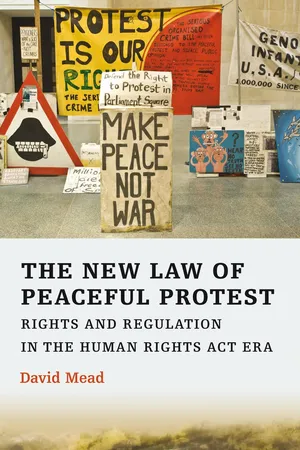
eBook - PDF
The New Law of Peaceful Protest
Rights and Regulation in the Human Rights Act Era
- 530 pages
- English
- PDF
- Available on iOS & Android
eBook - PDF
About this book
Information

What
is
likely
to
be
of
greatest
significance
would
be
the
positive
endorsement
of
human
rights
at
the
heart
of
all
policing
interactions.
As
the
Home
Officer
Minister
with
responsi-
bility
for
policing,
Vernon
Coker,
told
the
JCHR:
‘You
do
not
have
to
choose
between
strong
and
effective
policing
or
the
human
rights
approach.
You
can
marry
the
two’.
116
We
seem
to
be
a
long
way
away,
even
after
10
years
of
the
HRA,
from
such
a
state
of
wedded
bliss.
The
regulation
of
the
right
of
peaceful
protest
in
the
Human
Rights
Act
era
might
best
be
described
as
bickering
courtship.
The
next
two
to
three
years
will
see
if
this
becomes
a
fully-fledged
betrothal,
remains
a
love-hate
relationship
or
is
cuckolded
by
increasing
reliance
on
private
law
remedies
and
interactions.
An
Agenda
for
Change
425
116
JCHR
report,
above
n
2,
Q51.
Table of contents
- Cover
- Prelims
- Preface
- Contents
- Table of Cases
- Table of UK Legislation
- 1 Introduction
- 2 Protecting Human Rights in the Human Rights Act Era
- 3 Strasbourg Case Law on the Right to Peaceful Protest
- 4 The Locus of Protest
- 5 Peaceful Persuasion and Communicating Dissent
- 6 Taking Direct Action
- 7 Preventive Action by the Police
- 8 Private Law Remedies and Proceedings
- 9 Conclusion
- Appendix I
- Appendix II
- Appendix III
- Appendix IV
- Bibliography
- Index
Trusted by 375,005 students
Access to over 1.5 million titles for a fair monthly price.
Study more efficiently using our study tools.
Frequently asked questions
Yes, you can cancel anytime from the Subscription tab in your account settings on the Perlego website. Your subscription will stay active until the end of your current billing period. Learn how to cancel your subscription
No, books cannot be downloaded as external files, such as PDFs, for use outside of Perlego. However, you can download books within the Perlego app for offline reading on mobile or tablet. Learn how to download books offline
Perlego offers two plans: Essential and Complete
- Essential is ideal for learners and professionals who enjoy exploring a wide range of subjects. Access the Essential Library with 800,000+ trusted titles and best-sellers across business, personal growth, and the humanities. Includes unlimited reading time and Standard Read Aloud voice.
- Complete: Perfect for advanced learners and researchers needing full, unrestricted access. Unlock 1.5M+ books across hundreds of subjects, including academic and specialized titles. The Complete Plan also includes advanced features like Premium Read Aloud and Research Assistant.
We are an online textbook subscription service, where you can get access to an entire online library for less than the price of a single book per month. With over 1.5 million books across 990+ topics, we’ve got you covered! Learn about our mission
Look out for the read-aloud symbol on your next book to see if you can listen to it. The read-aloud tool reads text aloud for you, highlighting the text as it is being read. You can pause it, speed it up and slow it down. Learn more about Read Aloud
Yes! You can use the Perlego app on both iOS and Android devices to read anytime, anywhere — even offline. Perfect for commutes or when you’re on the go.
Please note we cannot support devices running on iOS 13 and Android 7 or earlier. Learn more about using the app
Please note we cannot support devices running on iOS 13 and Android 7 or earlier. Learn more about using the app
Yes, you can access The New Law of Peaceful Protest by David Mead in PDF and/or ePUB format, as well as other popular books in Law & Public Law. We have over 1.5 million books available in our catalogue for you to explore.