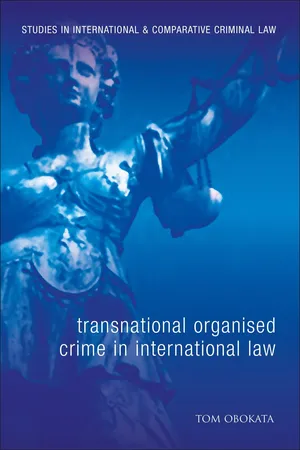
There is extensive and detailed academic literature on the legal development of international crimes such as war crimes and crime against humanity. However, not much attention has been paid to other serious crimes, including narcotics-related offences, human trafficking and money laundering, which do not necessarily amount to international crimes in the traditional sense. The purpose of this monograph is to fill this gap and offer a critical analysis of developments in the field of transnational organised crime under international law. The book is divided into two parts. Part I is entitled "Norms, Principles, and Concepts." It traces the history of organised crime and explores key concepts and norms relating to the practice from a multi-disciplinary perspective. It then looks at legal obligations imposed upon States as well as non-State actors in relation to transnational organised crime. Part II illustrates how these norms, principles and obligations are translated and enforced in practice. This will be done through case studies at the level of national law (Thailand, Serbia and the UK), regional law (European Union) and international law (United Nations).
"A book of many parts, its thematic coherence comes from its devotion to identifying the social threat posed by organised crime and the legal steps taken at the international and national levels against that threat. Rich with example and illustration and written in a light, direct, style, it will provide a lucid guide for practitioners, policy-makers and students to the largely untraversed territory of the international legal system set up to suppress transnational organised crime."
Professor Neil Bolster, University of Canterbury, New Zealand.
"...the international law governing organized crime is a close relative of the body of law applicable to the International Criminal Court and similar institutions. It provides a forum to address issues of more general concern, such as the scope of universal jurisdiction, immunities, statutory limitation and extradition. Tom Obokata's study, with its original and in some ways unique perspective, enriches our knowledge of the field".
Professor William Schabas, Irish Centre for Human Rights.
"The book is well written, its documentation is quite exhaustive, and its thesis is timely and compelling."
Professor M. Cherif Bassiouni, DePaul University College of Law.
- 278 pages
- English
- PDF
- Available on iOS & Android
eBook - PDF
Transnational Organised Crime in International Law
About this book
Information
Table of contents
- Cover
- Prelims
- Foreword
- Acknowledgements
- Contents
- Abbreviations
- Table of Cases
- Table of Regional and International Instruments
- 1 Introduction
- Part I Concepts, Norms and Principles
- 2 Understanding Organised Crime from a Multi-Disciplinary Perspective
- 3 Obligations of States under International Law
- 4 The Role of Non-state Actors in Suppression and Prevention of Organised Crime
- Part II Enforcement of Norms and Principles
- 5 National Case Studies of Thailand, Serbia, Kosovo and the UK
- 6 The EU and Transnational Organised Crime
- 7 International Responses to Transnational Organised Crime
- 8 Conclusion
- Selected Bibliography
- Index
Trusted by 375,005 students
Access to over 1.5 million titles for a fair monthly price.
Study more efficiently using our study tools.
Frequently asked questions
Yes, you can cancel anytime from the Subscription tab in your account settings on the Perlego website. Your subscription will stay active until the end of your current billing period. Learn how to cancel your subscription
No, books cannot be downloaded as external files, such as PDFs, for use outside of Perlego. However, you can download books within the Perlego app for offline reading on mobile or tablet. Learn how to download books offline
Perlego offers two plans: Essential and Complete
- Essential is ideal for learners and professionals who enjoy exploring a wide range of subjects. Access the Essential Library with 800,000+ trusted titles and best-sellers across business, personal growth, and the humanities. Includes unlimited reading time and Standard Read Aloud voice.
- Complete: Perfect for advanced learners and researchers needing full, unrestricted access. Unlock 1.5M+ books across hundreds of subjects, including academic and specialized titles. The Complete Plan also includes advanced features like Premium Read Aloud and Research Assistant.
We are an online textbook subscription service, where you can get access to an entire online library for less than the price of a single book per month. With over 1.5 million books across 990+ topics, we’ve got you covered! Learn about our mission
Look out for the read-aloud symbol on your next book to see if you can listen to it. The read-aloud tool reads text aloud for you, highlighting the text as it is being read. You can pause it, speed it up and slow it down. Learn more about Read Aloud
Yes! You can use the Perlego app on both iOS and Android devices to read anytime, anywhere — even offline. Perfect for commutes or when you’re on the go.
Please note we cannot support devices running on iOS 13 and Android 7 or earlier. Learn more about using the app
Please note we cannot support devices running on iOS 13 and Android 7 or earlier. Learn more about using the app
Yes, you can access Transnational Organised Crime in International Law by Tom Obokata in PDF and/or ePUB format, as well as other popular books in Diritto & Diritto internazionale. We have over 1.5 million books available in our catalogue for you to explore.