eBook - PDF
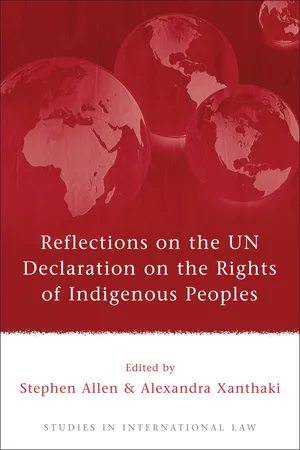
Reflections on the UN Declaration on the Rights of Indigenous Peoples
- 620 pages
- English
- PDF
- Available on iOS & Android
eBook - PDF
Reflections on the UN Declaration on the Rights of Indigenous Peoples
About this book
The adoption of the Declaration on the Rights of Indigenous Peoples by the United Nations General Assembly on 13 September 2007 was acclaimed as a major success for the United Nations system given the extent to which it consolidates and develops the international corpus of indigenous rights. This is the first in-depth academic analysis of this far-reaching instrument. Indigenous representatives have argued that the rights contained in the Declaration, and the processes by which it was formulated, obligate affected States to accept the validity of its provisions and its interpretation of contested concepts (such as 'culture', 'land', 'ownership' and 'self-determination'). This edited collection contains essays written by the main protagonists in the development of the Declaration; indigenous representatives; and field-leading academics. It offers a comprehensive institutional, thematic and regional analysis of the Declaration. In particular, it explores the Declaration's normative resonance for international law and considers the ways in which this international instrument could catalyse institutional action and influence the development of national laws and policies on indigenous issues.
Information

From
Advocacy
to
Implementation
59
do
not
recognise
the
principle
of
free,
prior
and
informed
consent.
Thus,
these
policies
require
adjustments
to
ensure
their
compatibility
with
inter-
national
standards.
The
Declaration
is
a
culmination
of
an
extraordinary
international
effort
on
the
part
of
indigenous
peoples
to
gain
international
recognition,
and,
as
both
the
proponents
and
the
beneficiaries
of
these
standards,
they
are
the
driving
force
behind
their
implementation.
However,
while
the
Declaration
is
a
significant
achievement,
it
comes
at
a
time
when
indig-
enous
peoples’
lands
and
resources
are
subject
to
threats
as
potentially
destructive
as
the
process
of
historical
colonialism.
The
accelerating
search
for
resources
and
the
pressures
on
land
and
living
spaces
due
to
global
warming
puts
indigenous
peoples
at
the
front
line.
While
this
rep-
resents
an
ever-present
danger,
it
also
offers
an
unprecedented
opportu-
nity
for
indigenous
peoples
to
link
up
with
proponents
of
a
more
benign
and
equitable
form
of
development.

Table of contents
- Prelims
- Contents
- Biographies
- Introduction
- Section A Institutional Perspectives
- 1 The UN Declaration on the Rights of Indigenous Peoples: Background and Appraisal
- 2 The UN Declaration on the Rights of Indigenous Peoples: From Advocacy to Implementation
- 3 Integrating the UN Declaration on the Rights of Indigenous Peoples into CERD Practice
- 4 The International Labour Organization and the Internationalisation of the Concept of Indigenous Peoples
- 5 Using the United Nations Declaration on the Rights of Indigenous Peoples in Litigation
- Section B Thematic Perspectives
- 6 Making the Declaration on the Rights of Indigenous Peoples Work: The Challenge Ahead
- 7 The Three Ironies of the UN Declaration on the Rights of Indigenous Peoples
- 8 Beyond the Indigenous/Minority Dichotomy?
- 9 Voting in the General Assembly as Evidence of Customary International Law?
- 10 The UN Declaration on the Rights of Indigenous Peoples and the Limits of the International Legal Project
- Section C Substantive Perspectives
- 11 The UN Declaration on the Rights of Indigenous Peoples: New Directions for Self-Determination and Participatory Rights?
- 12 A New Dawn over the Land: Shedding Light on Collective Ownership and Consent
- 13 The Controversial Issue of Natural Resources: Balancing States’ Sovereignty with Indigenous Peoples’ Rights
- 14 Indigenous Rights and the Right to Development: Emerging Synergies or Collusion?
- 15 Taking Cultural Rights Seriously: The Vision of the UN Declaration on the Rights of Indigenous Peoples
- 16 The UN Declaration on the Rights of Indigenous Peoples and Collective Rights: What’s the Future for Indigenous Women?
- 17 Community Rights to Culture: The UN Declaration on the Rights of Indigenous Peoples
- Section D Regional Perspectives
- 18 The Inter-American System and the UN Declaration on the Rights of Indigenous Peoples: Mutual Reinforcement
- 19 The UN Declaration on the Rights of Indigenous Peoples in Africa: The Approach of the Regional Organisations to Indigenous Peoples
- 20 Reflections on the UN Declaration on the Rights of Indigenous Peoples: An Arctic Perspective
- 21 The UN Declaration on the Rights of Indigenous Peoples: Recent Developments regarding the Saami People of the North
- 22 Between the Devil and the Deep Blue Sea: Indigenous Peoples as the Pawns in the US ‘War on Terror’ and the Jihad of Osama Bin Laden
- The United Nations Declaration on the Rights of Indigenous Peoples
- Index
Trusted by 375,005 students
Access to over 1.5 million titles for a fair monthly price.
Study more efficiently using our study tools.
Frequently asked questions
Yes, you can cancel anytime from the Subscription tab in your account settings on the Perlego website. Your subscription will stay active until the end of your current billing period. Learn how to cancel your subscription
No, books cannot be downloaded as external files, such as PDFs, for use outside of Perlego. However, you can download books within the Perlego app for offline reading on mobile or tablet. Learn how to download books offline
Perlego offers two plans: Essential and Complete
- Essential is ideal for learners and professionals who enjoy exploring a wide range of subjects. Access the Essential Library with 800,000+ trusted titles and best-sellers across business, personal growth, and the humanities. Includes unlimited reading time and Standard Read Aloud voice.
- Complete: Perfect for advanced learners and researchers needing full, unrestricted access. Unlock 1.5M+ books across hundreds of subjects, including academic and specialized titles. The Complete Plan also includes advanced features like Premium Read Aloud and Research Assistant.
We are an online textbook subscription service, where you can get access to an entire online library for less than the price of a single book per month. With over 1.5 million books across 990+ topics, we’ve got you covered! Learn about our mission
Look out for the read-aloud symbol on your next book to see if you can listen to it. The read-aloud tool reads text aloud for you, highlighting the text as it is being read. You can pause it, speed it up and slow it down. Learn more about Read Aloud
Yes! You can use the Perlego app on both iOS and Android devices to read anytime, anywhere — even offline. Perfect for commutes or when you’re on the go.
Please note we cannot support devices running on iOS 13 and Android 7 or earlier. Learn more about using the app
Please note we cannot support devices running on iOS 13 and Android 7 or earlier. Learn more about using the app
Yes, you can access Reflections on the UN Declaration on the Rights of Indigenous Peoples by Stephen Allen, Alexandra Xanthaki, Stephen Allen,Alexandra Xanthaki in PDF and/or ePUB format, as well as other popular books in Law & International Law. We have over 1.5 million books available in our catalogue for you to explore.