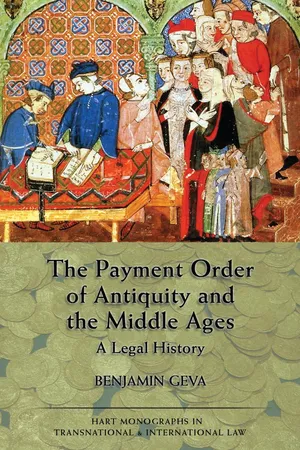
Examining the legal history of the order to pay money initiating a funds transfer, the author tracks basic principles of modern law to those that governed the payment order of Antiquity and the Middle Ages. Exploring the legal nature of the payment order and its underpinning in light of contemporary institutions and payment mechanisms, the book traces the evolution of money, payment mechanisms and the law that governs them, from developments in Ancient Mesopotamia, Ancient Greece, Rome, and Greco-Roman Egypt, through medieval Europe and post-medieval England. Doctrine is examined in Jewish, Islamic, Roman, common and civil laws.
Investigating such diverse legal systems and doctrines at the intersection of laws governing bank deposits, obligations, the assignment of debts, and negotiable instruments, the author identifies the common denominator for the evolving legal principles and speculates on possible reciprocity. At the same time he challenges the idea of 'law merchant' as a mercantile creation.
The book provides an account of the evolution of payment law as a distinct cohesive body of legal doctrine applicable to funds transfers. It shows how principles of law developed in tandem with the evolution of banking and in response to changing circumstances and proposes a redefinition of 'law merchant'.
The author points to deposit banking and emerging technologies as embodying a great potential for future non-cash payment system growth. However, he recommends caution in predicting both the future of deposit banking and the overall impact of technology. At the same time he expresses confidence in the durability of legal doctrine to continue to evolve and accommodate future payment system developments.
- 784 pages
- English
- PDF
- Available on iOS & Android
eBook - PDF
About this book
Information
Table of contents
- Cover
- Prelims
- Preface
- Summary of Contents
- Table of Contents
- List of Illustrations
- Table of Cases
- Table of Legislation
- International and Miscellaneous Legislation
- Prologue
- 1. Money, Payment in Money, and the Order to Pay Money
- 2. Money and Monetary Legal Theory in Antiquity and the Middle Ages
- 3. Funds Transfers in Antiquity: Instruments, Institutions and Mechanisms
- 4. Deriving History from Law: Are Cheques Traceable to the Talmud?
- 5. The Payment Order under Roman Law
- 6. The Medieval Hawale: The Legal Nature of the Suftaj and Other Islamic Payment Instruments
- 7. Funds Transfers under Talmudic Law: Orthodoxy and Adaptation
- 8. Payment Orders in Medieval Continental Europe: Book Transfers and Bills of Exchange
- 9. Payment Orders under English Common Law: The Bailment of Money and the 'Reception' of the Bill of Exchange
- 10. Evolution and Transformation: The Birth of the Modern Payment System in Post-Medieval England
- 11. Turning the Wheels of Post-Medieval Change: Paper Circulation and Negotiability under English Law
- 12. Staying on Course: The Footprint of Ancient and Medieval Doctrine and Practice on Modern Payment Laws
- Epilogue: From Barter to Electronic Funds Transfers and the Role of Law
- Illustrations
- Bibliography
- Index
Trusted by 375,005 students
Access to over 1.5 million titles for a fair monthly price.
Study more efficiently using our study tools.
Frequently asked questions
Yes, you can cancel anytime from the Subscription tab in your account settings on the Perlego website. Your subscription will stay active until the end of your current billing period. Learn how to cancel your subscription
No, books cannot be downloaded as external files, such as PDFs, for use outside of Perlego. However, you can download books within the Perlego app for offline reading on mobile or tablet. Learn how to download books offline
Perlego offers two plans: Essential and Complete
- Essential is ideal for learners and professionals who enjoy exploring a wide range of subjects. Access the Essential Library with 800,000+ trusted titles and best-sellers across business, personal growth, and the humanities. Includes unlimited reading time and Standard Read Aloud voice.
- Complete: Perfect for advanced learners and researchers needing full, unrestricted access. Unlock 1.5M+ books across hundreds of subjects, including academic and specialized titles. The Complete Plan also includes advanced features like Premium Read Aloud and Research Assistant.
We are an online textbook subscription service, where you can get access to an entire online library for less than the price of a single book per month. With over 1.5 million books across 990+ topics, we’ve got you covered! Learn about our mission
Look out for the read-aloud symbol on your next book to see if you can listen to it. The read-aloud tool reads text aloud for you, highlighting the text as it is being read. You can pause it, speed it up and slow it down. Learn more about Read Aloud
Yes! You can use the Perlego app on both iOS and Android devices to read anytime, anywhere — even offline. Perfect for commutes or when you’re on the go.
Please note we cannot support devices running on iOS 13 and Android 7 or earlier. Learn more about using the app
Please note we cannot support devices running on iOS 13 and Android 7 or earlier. Learn more about using the app
Yes, you can access The Payment Order of Antiquity and the Middle Ages by Benjamin Geva in PDF and/or ePUB format, as well as other popular books in Law & International Trade Law. We have over 1.5 million books available in our catalogue for you to explore.