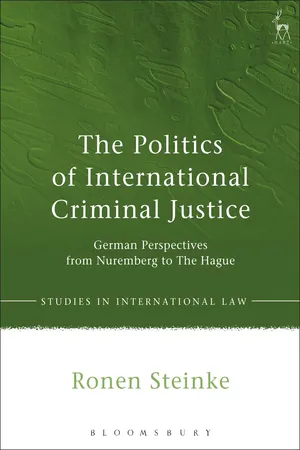
eBook - PDF
The Politics of International Criminal Justice
German Perspectives from Nuremberg to The Hague
- 160 pages
- English
- PDF
- Available on iOS & Android
eBook - PDF
The Politics of International Criminal Justice
German Perspectives from Nuremberg to The Hague
About this book
To anyone setting out to explore the entanglement of international criminal justice with the interests of States, Germany is a particularly curious, exemplary case. Although a liberal democracy since 1949, its political position has altered radically in the last 60 years. Starting from a position of harsh scepticism in the years following the Nuremberg Trials, and opening up to the rationales of international criminal justice only slowly - and then mainly in the context of domestic trials against functionaries of the former East German regime after 1990 - Germany is today one of the most active supporters of the International Criminal Court. The climax of this is its campaigning to make the ICC independent of the UN Security Council - a debate in which Germany took a position in stark contrast to the United States. This book offers new insight into the debates leading up to such policy shifts. Drawing on government documents and interviews with policymakers, it enriches a broader debate on the politics of international criminal justice which has to date often been focused primarily on the United States.
Information
Table of contents
- Cover
- Prelims
- Acknowledgements
- Table of Contents
- Introduction
- 1. The Politics of 'Historical Truth': An Outline
- 2. German Objections to the Nuremberg Trials after 1949
- 3. Germany's Own GDR Trials after 1989
- 4. German Support for the UN Ad Hoc Tribunals in the 1990s
- 5. Germany's Role (and Stake) in the Creation of the ICC
- 6. Cosmopolitan Ideals and National Interests: Concluding Remarks
- Bibliography
- Index
Trusted by 375,005 students
Access to over 1.5 million titles for a fair monthly price.
Study more efficiently using our study tools.
Frequently asked questions
Yes, you can cancel anytime from the Subscription tab in your account settings on the Perlego website. Your subscription will stay active until the end of your current billing period. Learn how to cancel your subscription
No, books cannot be downloaded as external files, such as PDFs, for use outside of Perlego. However, you can download books within the Perlego app for offline reading on mobile or tablet. Learn how to download books offline
Perlego offers two plans: Essential and Complete
- Essential is ideal for learners and professionals who enjoy exploring a wide range of subjects. Access the Essential Library with 800,000+ trusted titles and best-sellers across business, personal growth, and the humanities. Includes unlimited reading time and Standard Read Aloud voice.
- Complete: Perfect for advanced learners and researchers needing full, unrestricted access. Unlock 1.5M+ books across hundreds of subjects, including academic and specialized titles. The Complete Plan also includes advanced features like Premium Read Aloud and Research Assistant.
We are an online textbook subscription service, where you can get access to an entire online library for less than the price of a single book per month. With over 1.5 million books across 990+ topics, we’ve got you covered! Learn about our mission
Look out for the read-aloud symbol on your next book to see if you can listen to it. The read-aloud tool reads text aloud for you, highlighting the text as it is being read. You can pause it, speed it up and slow it down. Learn more about Read Aloud
Yes! You can use the Perlego app on both iOS and Android devices to read anytime, anywhere — even offline. Perfect for commutes or when you’re on the go.
Please note we cannot support devices running on iOS 13 and Android 7 or earlier. Learn more about using the app
Please note we cannot support devices running on iOS 13 and Android 7 or earlier. Learn more about using the app
Yes, you can access The Politics of International Criminal Justice by Ronen Steinke in PDF and/or ePUB format, as well as other popular books in Law & International Law. We have over 1.5 million books available in our catalogue for you to explore.