Like all skilful authors, the composer of the biblical books of Luke and Acts understood that a good story requires more than a gripping plot - a persuasive narrative also needs well-portrayed, plot-enhancing characters. This book brings together a set of new essays examining characters and characterization in those books from a variety of methodological perspectives.
The essays illustrate how narratological, sociolinguistic, reader-response, feminist, redaction, reception historical, and comparative literature approaches can be fruitfully applied to the question of Luke's techniques of characterization. Theoretical and methodological discussions are complemented with case studies of specific Lukan characters. Together, the essays reflect the understanding that while many of the literary techniques involved in characterization attest a certain universality, each writer also brings his or her own unique perspective and talent to the portrayal and use of characters, with the result that analysis of a writer's characters and style of characterization can enhance appreciation of that writer's work.
eBook - ePub
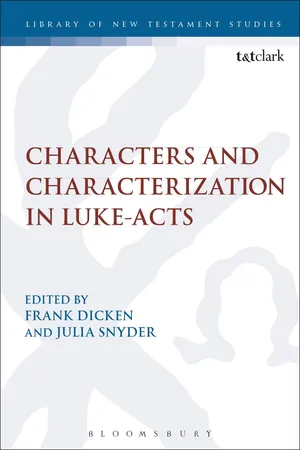
Characters and Characterization in Luke-Acts
- 256 pages
- English
- ePUB (mobile friendly)
- Available on iOS & Android
eBook - ePub
Characters and Characterization in Luke-Acts
About this book
Information
Part I
THE GOSPEL OF LUKE
1
THE WOMAN WHO CRASHED SIMON’S PARTY: A READER-RESPONSE APPROACH TO LUKE 7:36-50
Reader-response criticism pays close attention to the actions of the reader in responding to a text, and focuses on what the text does to the reader.1 An examination of the text in and of itself is replaced by an analysis of the reading process, a description of the interaction between reader and text. Stanley Fish, an early reader-response critic, outlines the maneuvers of the reader when engaged in a temporal reading. “The concept is simply the rigorous and disinterested asking of the question, what does the word, phrase, sentence, paragraph, chapter, novel, play, poem do? And the execution involves an analysis of the developing responses of the reader in relation to the words as they succeed one another in time.”2
Multiple theoretical orientations are subsumed under the label “reader-response criticism,” including phenomenological, subjective, transactive, rhetorical, and structural, to name a few.3 All focus on the reading process, but each involves a different relationship between reader and text. Some critics, for example, focus on the reader in the text.4 They see the reader as inscribed in the text and as a property of the literary work. At the other end of the spectrum is a subjective approach that gives the reader complete dominance over the text. This reader is outside the text, and meaning is a creation by and in the individual reader.5 Still others see the act of reading as a two-way interaction between reader and text. An “implied”6 or “informed”7 reader interacts with the text, and meaning is a product of reader-text dialectic.
This essay develops the critical assumptions of Wolfgang Iser, and applies his phenomenological theory of reading to biblical literature. A reading of the story of the woman in Luke 7:36-50 serves as a test case for his method. This is followed by a discussion of reader-response criticism as a necessary method for the analysis of characters in Luke.
Four Critical Assumptions of Wolfgang Iser
The first critical assumption of Iser focuses on the reader’s role in the realization of a text’s potentiality. The reader is active, not passive, and contributes to the production of textual meaning by filling in information that is implied but not written. The implied sections of a text are called “gaps,” areas of “indeterminacy,” or “blanks.”8 By filling in blanks, the reader contributes to the meaning of the text. Iser calls this the “realization”9 (Konkretisation) of the work. He thus makes an important distinction between a “text” as written by an author and a “work” as realized by a reader: “The work is more than the text, for the text only takes on life when it is realized, and furthermore the realization is by no means independent of the individual disposition of the reader—though this in turn is acted upon by the different patterns of the text. The convergence of text and reader brings the literary work into existence.”10 A “text” is thus a product created by an author while a “work” is the realization of a text by a reader. Yet the reader’s participation in the realization of the text is limited; the text guides the reader in the Konkretisation of the literary work. Iser illustrates the reader’s contribution using the analogy of two people gazing at the night sky: “Both [may] be looking at the same collection of stars, but one will see the image of a plough, and the other will make out a dipper. The ‘stars’ in a literary text are fixed; the lines that join them are variable.”11 Each reader thus selects and organizes parts of a text, fills in gaps in her or his own way, and develops an interpretation, but the written portions of the text place limits on the reader’s production of textual meaning.12
Iser’s second critical assumption describes where the reader stands in relationship to the text. Is the reader inside the text, outside the text as a real reader, or between author and real reader as an intermediary? Iser’s reader is neither a “real” nor an “ideal” reader; rather, he uses the heuristic concept of the “implied reader.”13 Whereas the ideal reader is a property of the text and can perfectly interpret its meaning, Iser’s implied reader is more loosely tied to the text. The Iserian reader approaches the text with certain social and cultural assumptions and a degree of literary competence. He or she then follows guidelines transmitted in the text to realize the full potentiality of the text’s meaning. The implied reader is thus an intermediary between two conscious minds, that of the author and that of the real reader. Although the implied reader is located in the real reader’s mind, he or she is called into being by the author’s text, which asks to be read in a particular way.14
Iser’s third critical assumption defines the meeting place between text and reader. The reader can interact with a text only to the extent that conventions are shared by both text and reader. These conventions—what Iser calls a “repertoire”—consist “of all the familiar territory within the text. This may be in the form of references to earlier works, or to social and historical norms, or to the whole culture from which the text has emerged.”15 But communication “always entails conveying something new,”16 and the meeting place between text and reader therefore goes beyond the shared familiar repertoire. “Communication would be unnecessary if that which is to be communicated were not to some extent unfamiliar.”17 The author takes the reader’s familiar repertoire and places it in a new context that makes the familiar appear strange, or employs disorienting devices to make the familiar seem odd and the unfamiliar seem natural.
The disorientation of the reader’s familiar repertoire is a technique Iser—as Russian Formalist Victor Shklovsky18 before him—calls “defamiliarization.”19 For Iser, the ultimate function of textual strategies is “to defamiliarize the familiar.”20 The implied reader recognizes familiar literary patterns and themes, as well as allusions to common social and historical contexts, but the familiar now appears strange. This strangeness forces the reader to reexamine routine conventions, and the reader’s familiar repertoire is deformed, disautomatized, or reassembled in a new way as a result. What seems familiar appears unfamiliar; what is taken for granted becomes strange; commonplace, everyday points of view seem odd. Defamiliarization occurs, for example, when a context is deformed, or a reader is entrapped by a premature judgment that turns out to be false. It works when a point of view is demolished, or an expected outcome is overturned. The technique of defamiliarization jolts the reader from the lethargy of the habitual, compelling the reader to see familiar norms and values that have thus far been taken for granted in a different way.
Iser’s fourth critical assumption focuses on the development of a consistent interpretation, which he calls “consistency-building.” Consistency-building:
is the process of grouping together all the different aspects of a text to form the consistency that the reader will always be in search of. While expectations may be continually modified, and images continually expanded, the reader will still strive, even if unconsciously, to fit everything together in a consistent pattern … By grouping together the written parts of the text, we enable them to interact, we observe the direction in which they are leading us, and we project onto them the consistency which we, as readers, require. This “Gestalt” must inevitably be colored by our own characteristic selection process.21
By filling in the gaps of the text and developing interpretations that are later fulfilled, modified, or shattered by the text itself, the reader brings the work with all its familiar and unfamiliar aspects into existence. Consistency-building relies on a strategy of anticipation and retrospection that encourages the reader to anticipate outcomes, only to have those expectations frustrated or revised. Familiar elements of the reader’s repertoire are backgrounded or foregrounded, diminished or highlighted, trivialized or magnified, so that a “strategic overmagnification, trivialization, or even annihilation” of the familiar occurs.22 The reader’s interaction with a text invo...
Table of contents
- Library of New Testament Studies
- Title
- Contents
- Contributors
- Acknowledgments
- Abbreviations
- Introduction Frank Dicken and Julia Snyder
- Part I The Gospel of Luke
- Chapter 1 The Woman Who Crashed Simon’s Party: A Reader-Response Approach to Luke 7:36-50 James L. Resseguie
- Chapter 2 Levi’s Banquet (Luke 5:29-39) and Lukan Discipleship: Group Characters and Christian Identity Formation John A. Darr
- Chapter 3 Zechariah and Gabriel as Thematic Characters: A Narratological Reading of the Beginning of Luke’s Gospel (Luke 1:8-20) Hannah M. Cocksworth
- Chapter 4 The Characterization of the Two Brothers in the Parable of the Prodigal Son (Luke 15:11-32): Their Function and Afterlives David B. Gowler
- Chapter 5 A Woman’s Touch: Manual and Emotional Dynamics of Female Characters in Luke’s Gospel F. Scott Spencer
- Chapter 6 The Rich are the Bad Guys: Lukan Characters and Wealth Ethics Cornelis Bennema
- Chapter 7 A Cognitive Narratological Approach to the Characterization(s) of Zacchaeus Joel B. Green
- Part II The Acts of the Apostles
- Chapter 8 Jesus, Present and/or Absent? The Presence and Presentation of Jesus as a Character in the Book of Acts Steve Walton
- Chapter 9 Sight and Spectacle: “Seeing” Paul in the Book of Acts Brittany E. Wilson
- Chapter 10 The Characterization of Disciples in Acts: Genre, Method, and Quality Sean A. Adams
- Chapter 11 Sociolinguistic Dynamics and Characterization in the Acts of the Apostles Julia A. Snyder
- Chapter 12 Simeon in Acts 15:14: Simon Peter and Echoes of Simeons Past Stephen E. Fowl
- Chapter 13 Herod as Jesus’ Executioner: Possibilities in Lukan Reception and Wirkungsgeschichte Frank E. Dicken
- Bibliography
- Index of Ancient Texts
- Index of Subjects
- Index of Authors
- Copyright
Trusted by 375,005 students
Access to over 1.5 million titles for a fair monthly price.
Study more efficiently using our study tools.
Frequently asked questions
Yes, you can cancel anytime from the Subscription tab in your account settings on the Perlego website. Your subscription will stay active until the end of your current billing period. Learn how to cancel your subscription
No, books cannot be downloaded as external files, such as PDFs, for use outside of Perlego. However, you can download books within the Perlego app for offline reading on mobile or tablet. Learn how to download books offline
Perlego offers two plans: Essential and Complete
- Essential is ideal for learners and professionals who enjoy exploring a wide range of subjects. Access the Essential Library with 800,000+ trusted titles and best-sellers across business, personal growth, and the humanities. Includes unlimited reading time and Standard Read Aloud voice.
- Complete: Perfect for advanced learners and researchers needing full, unrestricted access. Unlock 1.5M+ books across hundreds of subjects, including academic and specialized titles. The Complete Plan also includes advanced features like Premium Read Aloud and Research Assistant.
We are an online textbook subscription service, where you can get access to an entire online library for less than the price of a single book per month. With over 1.5 million books across 990+ topics, we’ve got you covered! Learn about our mission
Look out for the read-aloud symbol on your next book to see if you can listen to it. The read-aloud tool reads text aloud for you, highlighting the text as it is being read. You can pause it, speed it up and slow it down. Learn more about Read Aloud
Yes! You can use the Perlego app on both iOS and Android devices to read anytime, anywhere — even offline. Perfect for commutes or when you’re on the go.
Please note we cannot support devices running on iOS 13 and Android 7 or earlier. Learn more about using the app
Please note we cannot support devices running on iOS 13 and Android 7 or earlier. Learn more about using the app
Yes, you can access Characters and Characterization in Luke-Acts by Frank Dicken, Julia Snyder, Frank Dicken,Julia Snyder in PDF and/or ePUB format, as well as other popular books in Teología y religión & Crítica e interpretación bíblicas. We have over 1.5 million books available in our catalogue for you to explore.