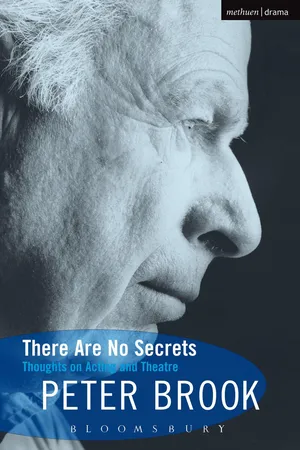
Peter Brook was the most consistently innovative director in Western theatre. In these three essays he returns to the concept of his first book The Empty Space and examines what that means for the life of a production. How can a company establish its own "empty space" - a rehearsal and performance environment which will encourage the actors to abandon the security of the hackneyed and release their true creativity?
The potency of Brook's writing lies in his ability invest general truths with fresh vigour and to be as simple as he is profound.
- 128 pages
- English
- ePUB (mobile friendly)
- Available on iOS & Android
eBook - ePub
About this book
Information
Subtopic
Performing ArtsThe Slyness of Boredom
One day, in an English university, while giving the lectures that were the basis for my book The Empty Space, I found myself up on a platform in front of a big black hole, and right at the back of that hole I vaguely distinguished some people sitting in the darkness. As I began to speak, I felt that everything I said was quite pointless. I became more and more depressed, for I couldn’t find a natural way of getting through to them.
I saw them sitting like attentive pupils, waiting for words of wisdom with which to fill their schoolbooks, while I was cast in the role of a tutor, vested with the authority that goes with standing six feet above the listeners. Luckily I had the courage to stop and suggest that we look for another space. The organisers went off, searched throughout the university and finally came up with a small room which was too narrow and very uncomfortable but where we found it possible to have a natural and more intense relationship. Speaking in these new conditions, I at once felt that a new contact existed between the students and myself. From that point on, I was able to talk freely and the audience was liberated in the same way. The questions, like the answers, flowed much more smoothly. The strong lesson concerning space that I received that day became the basis of the experiments that we undertook many years later in Paris, in our International Centre of Theatre Research.
In order for something of quality to take place, an empty space needs to be created. An empty space makes it possible for a new phenomenon to come to life, for anything that touches on content, meaning, expression, language and music can exist only if the experience is fresh and new. However, no fresh and new experience is possible if there isn’t a pure, virgin space ready to receive it.
A remarkably dynamic South African director who created a Black Theatre movement in the South African townships said to me, ‘We have all read The Empty Space, it has helped us a lot.’ I was pleased but very surprised, as most of the book was written before our experiences in Africa and makes constant reference to the theatres of London, of Paris, New York . . . What could they have found of use in its text? How could they feel that the book was also for them? How could it link with the task of bringing theatre into the conditions of life in Soweto? I asked this question and he answered, ‘The first sentence!’
I can take any empty space and call it a bare stage. A man walks across this empty space whilst someone else is watching him, and this is all I need for an act of theatre to be engaged.
They had been convinced that doing theatre under their conditions was an unavoidable disaster because in the townships of South Africa there isn’t a single ‘theatre building’. They had the feeling they could not get very far if they didn’t possess thousand-seat theatres, with curtains and flies, lights and coloured projectors, like in Paris, London and New York. Then suddenly along came a book the first sentence of which affirmed that they had all they needed for doing theatre.
In the early seventies we began doing experiments outside of what was regarded as ‘theatres’. For the first three years we played hundreds of times in streets, in cafés, in hospitals, in the ancient ruins of Persepolis, in African villages, in American garages, in barracks, between concrete benches in urban parks... We learned a lot, and the major experience for the actors was playing to an audience they could see, as opposed to the invisible audience to which they were accustomed. Many of them had worked in large, conventional theatres, and it was a profound shock to find themselves in Africa in direct contact with the audience, the only floodlight being the sun, which united spectator and performer in the same impartial glare. Bruce Myers, one of our actors, once said: ‘I’ve spent ten years of my life in the professional theatre without ever seeing the people for whom I’m doing this work. Suddenly I can see them. A year ago, I would have been panicked by the feeling of nakedness. The most important of my defences was being taken away. I’d have though, “What a nightmare to see their faces!” ’ Suddenly he realised that, on the contrary, seeing the spectators gave a new meaning to his work. Another aspect of the empty space is that the emptiness is shared: it’s the same space for everyone who is present.
At the time I wrote The Empty Space, those who searched for a ‘Popular Theatre’ believed that everything that was ‘for the people’ automatically had vitality, as contrasted with something that didn’t have vitality, which was called ‘Elite Theatre’. At the same time, the ‘Elite’ felt they were privileged participants in a serious intellectual adventure which contrasted strongly with the turgid and devitalised ‘Commercial Theatre’. Meanwhile, those who were working on ‘Great Classic Texts’ were convinced that ‘High Culture’ injects into the veins of society a quality way beyond the low-grade adrenaline of a vulgar comedy. However, my experience over the years taught me that this is quite false and that a good space is one in which many varied energies converge and all those categories disappear.
Luckily, when I started working in the theatre I was totally ignorant of all classifications. The great advantage that England provided in those days was that there was no school, no master, no examples. The German theatre was totally ignored, Stanislavsky virtually unknown, Brecht just a name and Artaud not even that. There were no theories, so people doing theatre slid naturally from one genre to another. Great actors could go from performing Shakespeare to a farce or a musical comedy. The audience and the critics followed in all simplicity, without feeling that they – or ‘theatre art’ – were being betrayed.
In the early fifties we presented Hamlet in Moscow with Paul Scofield, who had played major roles for over ten years or so and was known in England as one of the most brilliant and accomplished actors of his generation. This was in the old Stalinist Russia, completely isolated – in fact, I think we were the first English company to perform there. It was quite an event and Scofield was treated like a pop star.
Back in England, we continued to work together for a while, doing a play by Eliot, another by Graham Greene. One day, after our season had ended, he was offered the part of a cockney impresario in a musical comedy, the first of the pre-rock musicals. Paul was very excited: ‘It’s wonderful. Instead of another Shakespeare play, I can sing and dance. It’s called Expresso Bongo!’ I encouraged him to accept, and he was very pleased and the play was a success.
While the show was running, an official Russian delegation comprised of about twenty actors, actresses, directors and theatre managers suddenly arrived from Moscow. As we had been so well received over there, I went to welcome them at the airport. The first question they asked concerned Scofield: ‘What’s he doing? Can we see him?’ ‘Of course,’ I replied. We arranged tickets for them and they went to see the show.
The Russians, especially in that period, had learned that one can always get out of any theatrical embarrassment with the use of one word: interesting. So they watched the play, met with Scofield and exclaimed unconvincingly that they had been ‘most interested’. A year later we received a copy of a book written about the trip by the leader of the delegation, a Shakespeare expert at Moscow University. In the book I found a bad photo of Scofield wearing his slanting trilby from Expresso Bongo, with the following caption: ‘We were all saddened by the tragedy of the situation of the actor in a capitalist country. What humiliation for one of the greatest actors of our time to be forced to perform in something called Expresso Bongo in order to feed his wife and two children!’
I’m telling this story to share with you a fundamental idea: that theatre has no categories, it is about life. This is the only starting point, and there is nothing else truly fundamental. Theatre is life.
At the same time, one cannot say that there is no difference between life and theatre. In 1968 we saw people who, for very valid reasons, tired by so much ‘deadly theatre’, insisted that ‘life is a theatre’, thus there was no need for art, artifice, structures . . . ‘Theatre is being done everywhere, theatre surrounds us,’ they said. ‘Each of us is an actor, we can do anything in front of anyone, it’s all theatre.’
What is wrong with this statement? A simple exercise can make it very clear. Ask any volunteer to walk from one side of a space to another. Anyone can do this. The clumsiest idiot cannot fail, he just has to walk. He makes no effort and deserves no reward. Now ask him to try to imagine that he is holding a precious bowl in his hands and to walk carefully so as not to spill a drop of its contents. Here again anyone can accomplish the act of imagination that this requires and can move in a more or less convincing manner. Yet your volunteer has made a special effort, so perhaps he deserves thanks and a five-penny piece as a reward for trying. Next ask him to imagine that as he walks the bowl slips from his fingers and crashes to the ground, spilling its contents. Now he’s in trouble. He tries to act and the worst kind of artificial, amateur acting will take over his body, making the expression on his face ‘acted’ – in other words, woefully unreal. To execute this apparently simple action so that it will appear as natural as just walking demands all the skills of a highly professional artist – an idea has to be given flesh and blood and emotional reality: it must go beyond imitation, so that an invented life is also a parallel life, which at no level can be distinguished from the real thing. Now we can see why a true actor is worth the enormous daily rate that film companies pay him for giving a plausible impression of everyday life.
One goes to the theatre to find life, but if there is no difference between life outside the theatre and life inside, then theatre makes no sense. There’s no point doing it. But if we accept that life in the theatre is more visible, more vivid than on the outside, then we can see that it is simultaneously the same thing and somewhat different.
Now we can add some specifics. Life in the theatre is more readable and intense because it is more concentrated. The act of reducing space and compressing time creates a concentrate.
In life we speak in a chattering tumble of repetitive words, yet this quite natural way of expressing ourselves always takes a great deal of time in relation to the actual content of what one wants to say. But that is how one must begin – with everyday communication – and this is exactly like in theatre when one develops a scene through improvisation, with talk that is much too long.
The compression consists of removing everything that is not strictly necessary and intensifying what is there, such as putting a strong adjective in the place of a bland one, whilst preserving the impression of spontaneity. If this impression is maintained, we reach the point where if in life it takes two people three hours to say something, on stage it should take three minutes. We can see this result clearly in the limpid styles of Beckett, Pinter or Chekhov.
With Chekhov, the text gives the impression of having been recorded on tape, of taking its sentences from daily life. But there is not a phrase of Chekhov’s that has not been chiseled, polished, modified, with great skill and artistry so as to give the impression that the actor is really speaking ‘like in daily life’. However, if one tries to speak and behave just like in daily life, one cannot play Chekhov. The actor and the director must follow the same process as the author, which is to be aware that each word, even if it appears to be innocent, is not so. It contains in itself, and in the silence that precedes and follows it, an entire unspoken complexity of energies between the characters. If one can manage to find that, and if, furthermore, one looks for the art needed to conceal it, then one succeeds in saying these simple words and giving the impression of life. Essentially, it is life, but it is life in a more concentrated form, more compressed in time and space.
Shakespeare goes even farther. It used to be thought that verse was a form of beautifying through poetry. Then, as an inevitable reaction, came the idea that verse is no more than an enriched form of everyday speech. Of course, verse must be made to sound ‘natural’, but this means neither colloquial nor ordinary. To find the way, one must see very clearly why the verse exists and what absolutely necessary function it has to perform. In fact, Shakespeare, as a practical man, was forced to use verse to suggest simultaneously the most hidden psychological, psychic and spiritual movements in his characters without losing their down-to-earth reality. Compression can hardly go farther.
The entire problem resides in trying to know if, moment for moment, in the writing or in the playing, there is a spark, the small flame that lights up and gives an intensity to that compressed, distilled moment. For compression and condensation are not enough. One can always reduce a play that’s too long, too wordy, and still end up with something tedious. The spark is what matters, and the spark is rarely there. This shows to what extent the theatrical form is frighteningly fragile and demanding, for this small spark of life must be present each and every second.
This artistic problem exists only in the theatre and the cinema. A book may have its dull spots, but in the theatre, from one second to the next, the audience can be lost if the tempo is not right.
If I now stop speaking... we hear a silence ... but everyone is paying attention . . . For a moment I have you in the palm of my hand, and yet in the next second your minds inevitably will wander. Unless . . . unless what? It is nearly superhuman to be able continually to renew the interest, find the originality, the freshness, the intensity, that each coming second demands. That is why, compared to other art forms, there exist so few masterpieces in the world’s theatre. As the risk always exists that the spark of life will disappear, we must analyse precisely the reasons for its frequent absence. For this, one must observe the phenomenon with clarity.
Thus it is very important to examine simultaneously and without preference the classical theatre and the commercial theatre, the actor who rehearses for months and the one who prepares in a few days, comparing what is possible when there is a lot of money with what is possible when there is very little – in other words, all the different conditions in which acting takes place.
I wish to compare what can occur only on a regular stage, with a set and lighting, with what can take place only without lighting, without scenery, out of doors, in order to demonstrate that the phenomenon of a living theatre is not linked to external conditions. One can go and see a very banal play with a mediocre subject which is a huge hit and is making a great deal of money in a very conventional theatre, and sometimes find in it a spark of life quite superior to what happens when people spoonfed on Brecht or Artaud, working with good resources, present a show that is culturally respectable but lacking in fascination. Faced with this type of performance, one can quite easily spend a dreary evening watching something in which everything is present – except life. It is very important to appraise this coldly, clearly, pitilessly, especially if one wishes to avoid being influenced by the snobbery of so-called cultural criteria.
That is why I insist on the dangers that represent a very great author such as Shakespeare, or great works of opera. The cultural quality of these pieces can bring out the best or the worst. The greater the work, the greater the dreariness if the execution and interpretation are not of the same level.
This is always very difficult to admit for those who have been struggling, often with difficulty, to find the means to bring work of a serious cultural level to an indifferent audience. One is nearly always forced to defend the attempt, and we are frequently very disappointed because audiences, in every country, often refuse these works and prefer what we consider to be of lower quality. If one looks carefully, one notices the weakness. The great work, the masterpiece, is in fact presented without the one ingredient that can link it to its audience: the irresistible presence of life. Which brings us back to the empty space.
If habit leads us to believe that theatre must begin with a stage, scenery, lights, music, armchairs ... we set off on the wrong track. It may be true that to make films one needs a camera, celluloid and the means to develop it, but to do theatre there is only one thing one needs: the human element. This does not mean that the rest is unimportant, but it is not the primary concern.
I once claimed that theatre begins when two people meet. If one person stands up and another watches him, this is already a start. For there to be a development, a third person is needed for an encounter to take place. Then life takes over and it is possible to go very far – but the three elements are essential.
For example, when two actors play together in a rehearsal, without an audience, there is the temptation for them to believe that theirs is the only relationship that exists. They can then be trapped into falling in love with the pleasure of a two-way exchange, forgetting that a three-way exchange is what it’s all about. Too much time in rehearsal can end by destroying the unique possibility which the third element brings. The moment we feel that a third person is watching, the conditions of a rehearsal are always transformed.
In our work we often use a carpet as a rehearsal zone, with a very clear purpose: off the carpet, the actor is in daily life, he can do what he wants – waste his energy, engage in movements that don’t express anything in particular, scratch his head, fall asleep... But as soon as he finds himself on the carpet, he is under the obligation of...
Table of contents
- Cover
- Title Page
- Dedication
- Contents
- The Slyness of Boredom
- The Golden Fish
- There Are No Secrets
- About the Author
- eCopyright
Trusted by 375,005 students
Access to over 1.5 million titles for a fair monthly price.
Study more efficiently using our study tools.
Frequently asked questions
Yes, you can cancel anytime from the Subscription tab in your account settings on the Perlego website. Your subscription will stay active until the end of your current billing period. Learn how to cancel your subscription
No, books cannot be downloaded as external files, such as PDFs, for use outside of Perlego. However, you can download books within the Perlego app for offline reading on mobile or tablet. Learn how to download books offline
Perlego offers two plans: Essential and Complete
- Essential is ideal for learners and professionals who enjoy exploring a wide range of subjects. Access the Essential Library with 800,000+ trusted titles and best-sellers across business, personal growth, and the humanities. Includes unlimited reading time and Standard Read Aloud voice.
- Complete: Perfect for advanced learners and researchers needing full, unrestricted access. Unlock 1.5M+ books across hundreds of subjects, including academic and specialized titles. The Complete Plan also includes advanced features like Premium Read Aloud and Research Assistant.
We are an online textbook subscription service, where you can get access to an entire online library for less than the price of a single book per month. With over 1.5 million books across 990+ topics, we’ve got you covered! Learn about our mission
Look out for the read-aloud symbol on your next book to see if you can listen to it. The read-aloud tool reads text aloud for you, highlighting the text as it is being read. You can pause it, speed it up and slow it down. Learn more about Read Aloud
Yes! You can use the Perlego app on both iOS and Android devices to read anytime, anywhere — even offline. Perfect for commutes or when you’re on the go.
Please note we cannot support devices running on iOS 13 and Android 7 or earlier. Learn more about using the app
Please note we cannot support devices running on iOS 13 and Android 7 or earlier. Learn more about using the app
Yes, you can access There Are No Secrets by Peter Brook in PDF and/or ePUB format, as well as other popular books in Media & Performing Arts & Performing Arts. We have over 1.5 million books available in our catalogue for you to explore.