Can your business go green? Can it afford not to? Never has our impact on the environment been so relevant as it is today, and organisations of all sizes have an important role to play.
The Good Green Guide for Small Businesses guides the reader through taking an environmental audit of their business to highlight the areas most in need of attention. It then addresses how to minimise the impact of office essentials, such as utilities, insulation, recycling and waste, electrical equipment, water systems, lighting options, food and drink, and office cleaning arrangements and products. It also covers issues such as incentivising green working and promoting a green company image, and discusses the effect that going green will have on the company's bottom line.
This book is packed with practical, realistic, user-friendly advice for business owners or managers who want to change the way they work for the better.
- 192 pages
- English
- ePUB (mobile friendly)
- Available on iOS & Android
eBook - ePub
Good Green Guide for Small Businesses
About this book
Information
Chapter 1
Why go green?
Are you already convinced that greening your business is a good idea? Do you know what the main benefits will be – for the planet and for you? If the answer to both these questions is ‘yes’, feel free to skip this chapter. Otherwise, read on to find out why reducing your carbon emissions and the other resources you use will help to make your business more sustainable . . .
WHAT ARE CARBON EMISSIONS AND
WHY ARE THEY A PROBLEM?
WHY ARE THEY A PROBLEM?
We’re all aware that climate change is a big problem and that we need to do something about it. If we continue with business-as-usual, the climate in the UK will alter in a number of ways; some of which may be welcomed but many will not.
Temperature and rainfall changes will vary across the country but, by 2050, average summer temperatures could be at least two degrees higher across most of the UK and three degrees higher in the South East. It’s likely that the number of extremely warm days – that’s above 27 degrees in the South East – will increase by 10 to 20 per cent. Winters might become 10 to 20 per cent wetter (although with much less snow), with heavier downpours more common. In the summer, on the other hand, it could get 20 to 40 per cent drier across the country, with an increased risk of droughts and restrictions on water use, especially in the South East.
Agriculture, forestry, fisheries and wildlife would all be affected by these changes. While vineyards in North East Scotland might be able to produce decent white wine, the country’s seed potato industry could be ruined as milder winters allow virus-carrying aphids to survive. As soils dry out and summer rainfall decreases, more irrigation systems will be needed to support crop production. Christmas trees might suffer from storm damage and pest attacks. Cod could migrate from UK waters and be replaced by Mediterranean species such as tuna. New residents might include scorpions and poisonous spiders, and infestations of fleas, wasps, mice and rats that thrive in milder winters could increase.
Tourism could experience both benefits and setbacks from the changes. Rising sea levels and more storm surges would increase coastal erosion and cause problems for seaside resorts. Less snow could spell the end for the Scottish ski industry, and areas of moorland might regularly be closed to the public as the risk of wildfires increased. On the other hand, warmer weather would attract more tourists to northern destinations.
Damage to buildings and infrastructure could prove costly and disruptive. Buildings in low-lying areas prone to flooding might become very expensive or, indeed, impossible to insure and those on clay soils could be increasingly prone to subsidence as the soils dry out and shrink. Transport networks would be more vulnerable to both flooding and heatwaves, causing rails to buckle and road surfaces to melt.
Life in big cities would become increasingly difficult. Summer heatwaves and their attendant smogs make people ill. If they increased in frequency, the demand for air conditioning – and the costs that go with this – would increase massively. Public transport, especially the London Underground, and buildings could become unbearably hot in summer, resulting in a loss of productivity for businesses.
But what does all this have to do with you controlling your carbon dioxide emissions?
In short, carbon dioxide emissions are the main cause of man-made climate change, and most emissions come from energy use in industrialised countries. Each time you fire up the boiler or flick the switch to power up your lights, your PC or your process machinery, you are using oil, gas or electricity (which is generated from a number of fuels including coal, oil and gas). Burning fossil fuels (coal, oil and gas), whether in your boilers or in power stations, results in emissions of carbon dioxide. So, the more energy you use, the more carbon dioxide you are responsible for (unless your energy comes from zero-carbon sources, but we’ll come to that later). But why should you be worried about this?
Carbon dioxide and other greenhouse gases help to trap some of the sun’s energy in the earth’s atmosphere and ensure that the planet stays at a temperature that is comfortable for us (without them the earth would be a frozen wasteland). But we are now emitting these gases at a rate that means the amount in the atmosphere is increasing. It’s rather like being wrapped in a blanket and we are increasing the thickness of that blanket. As more of the heat is trapped by the gases, the amount of energy in the earth’s climate system increases and this leads to climate change: the average temperature at the earth’s surface increases and there are also more extreme weather events like storms, fuelled by this increased energy in the system. To avoid dangerous climate change, global emissions of carbon dioxide and other greenhouse gases need to be reduced by somewhere between 50 and 80 per cent. Those of us living and working in industrialised countries will have to take a bigger share of these reductions if we are to improve global equity at the same time.
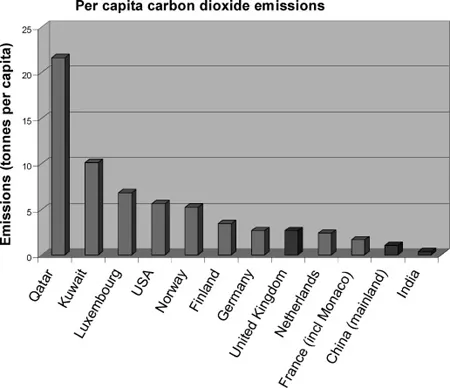
Based on research by the Carbon Dioxide Information Analysis Center.
People often talk about the need to ensure that the world’s growing economies, such as China and India, play their part. And, indeed, this will be necessary, but we have to remember the very different point from which they are starting. At the moment, in the UK we are on average each responsible for 2.67 tonnes of carbon dioxide emissions each year, while in China, many people still use very little energy and the average emissions per person stand at just over one tonne per year. In India they are even lower, at about a third of a tonne per year. The chart below makes this difference strikingly clear.
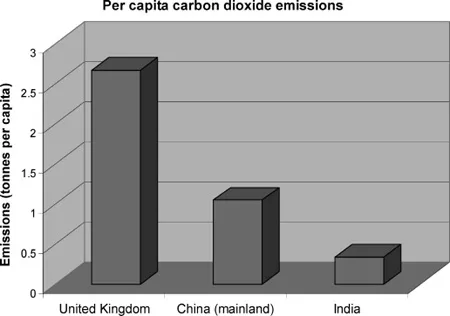
Based on research by the Carbon Dioxide Information Analysis Center.
What about other greenhouse gases?
Carbon dioxide is not the only greenhouse gas, but it is the main contributor to man-made climate change and that is why we focus on it here.
However, some of the actions you take to ‘green your business’ will help by reducing emissions of other greenhouse gases. In particular, avoiding sending biodegradable waste to landfill will help to reduce emissions of methane.
The remaining greenhouse gases include water vapour, nitrous oxide, ozone, and a range of CFCs (chlorofluorocarbons), HFCs (hydrofluorocarbons) and halons (gases commonly used in fire extinguishers). Unless your business is refrigeration (where CFCs and HFCs have been used), fire suppression (using halons) or farming (where nitrous oxide emissions could be an issue) you won’t be responsible for emitting these greenhouse gases so you don’t need to worry about them.
WHAT IS RESOURCE EFFICIENCY AND WHY SHOULD YOU BE CONCERNED?
Everything that you do at work involves resources of some sort. When you grab a piece of paper and scribble down a note, the paper and pen are resources, as is the time that it takes you to write the note. Resource efficiency is about how to use and manage the resources you have available to get the most you can out of them.
Sometimes resource efficiency is called waste minimisation. But it’s not just about what you put into your rubbish bin, although this is often a good place to start; it’s about finding the waste throughout your business and doing more with less.
Essentially, it means using resources such as water, energy and even your workforce more efficiently and making sure you aren’t wasting them. The resources you use to produce your final product can include:

It’s inevitable that your company will have wastage in all of these areas, so what is the problem with a bit of waste?
Climate change is still our major concern. Everything we produce leads to more climate change gases being emitted into the atmosphere. Think about the simplest thing, say a pen. It is often made from plastic, which is manufactured from oil. To make a pen, first energy is used and, therefore, carbon and other climate change gases are emitted – in drilling for oil, refining it, making the refined fraction into plastic, and forming the plastic into a pen. Add to this the emissions from the transport needed to ship the raw materials, intermediate and final products from well to refinery to factory to supplier and finally to you.
In addition, biodegradable products, such as the food we leave at the back of the refrigerator at work, usually end up in landfill and give off methane. The methane emissions from biodegradable waste in landfill account for three per cent of all UK greenhouse gas emissions.
Our next major concern is what happens to all the material resources that we throw away – the raw materials, consumables and machinery. These will probably end up in landfill. The government reported in 2007 that, in England, 13 per cent of our waste comes from industry and 11 per cent from the commercial sector. It’s even worse in demolition and construction businesses, which account for 32 per cent of our waste. And, of course, there are some materials we should never put in landfill (like b...
Table of contents
- Cover page
- Title Page
- Copyright Page
- Table of Contents
- Acknowledgements
- Introduction
- 1 Why go green?
- 2 Taking control of your resource use
- 3 Environmental checks
- 4 Getting the team on board
- 5 Promoting your company’s green credentials
- 6 Adapting your business to climate change
- 7 Making your premises sustainable
Trusted by 375,005 students
Access to over 1.5 million titles for a fair monthly price.
Study more efficiently using our study tools.
Frequently asked questions
Yes, you can cancel anytime from the Subscription tab in your account settings on the Perlego website. Your subscription will stay active until the end of your current billing period. Learn how to cancel your subscription
No, books cannot be downloaded as external files, such as PDFs, for use outside of Perlego. However, you can download books within the Perlego app for offline reading on mobile or tablet. Learn how to download books offline
Perlego offers two plans: Essential and Complete
- Essential is ideal for learners and professionals who enjoy exploring a wide range of subjects. Access the Essential Library with 800,000+ trusted titles and best-sellers across business, personal growth, and the humanities. Includes unlimited reading time and Standard Read Aloud voice.
- Complete: Perfect for advanced learners and researchers needing full, unrestricted access. Unlock 1.5M+ books across hundreds of subjects, including academic and specialized titles. The Complete Plan also includes advanced features like Premium Read Aloud and Research Assistant.
We are an online textbook subscription service, where you can get access to an entire online library for less than the price of a single book per month. With over 1.5 million books across 990+ topics, we’ve got you covered! Learn about our mission
Look out for the read-aloud symbol on your next book to see if you can listen to it. The read-aloud tool reads text aloud for you, highlighting the text as it is being read. You can pause it, speed it up and slow it down. Learn more about Read Aloud
Yes! You can use the Perlego app on both iOS and Android devices to read anytime, anywhere — even offline. Perfect for commutes or when you’re on the go.
Please note we cannot support devices running on iOS 13 and Android 7 or earlier. Learn more about using the app
Please note we cannot support devices running on iOS 13 and Android 7 or earlier. Learn more about using the app
Yes, you can access Good Green Guide for Small Businesses by Impetus Consulting in PDF and/or ePUB format, as well as other popular books in Commerce & Organismes sans but lucratif et organismes de bienfaisance. We have over 1.5 million books available in our catalogue for you to explore.