- 224 pages
- English
- ePUB (mobile friendly)
- Available on iOS & Android
eBook - ePub
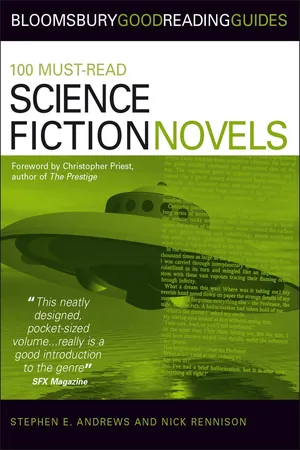
100 Must-read Science Fiction Novels
About this book
"A reliable guide to what science fiction is" Christopher Priest, award-winning science fiction author
"A really good introduction to the genre" SFX Magazine
"Perceptive and glorious" Ian Watson, author of the screenplay for Steve Spielberg's A.I.
Want to become a science fiction buff? Want to expand your reading in your favourite genre? This is a good place to start! From the publishers of the popular Good Reading Guide comes a rich selection of some of the finest SF novels ever published. With 100 of the best titles fully reviewed and a further 500 recommended, you'll quickly become an expert in the world of science fiction.
The book is arranged by author and includes some thematic entries and special categories such as SF film adaptations, SF in rock music and Philip K. Dick in the mass media . It also includes a history of SF and a new definition of the genre, plus lists of award winners and book club recommendations. Foreword by Christopher Priest, the multiple award-winning SF author.
Information
Publisher
A&C Black Academic and ProfessionalYear
2006Print ISBN
9780713675856
Edition
1eBook ISBN
9781408136089
A-Z OF ENTRIES
BRIAN ALDISS (b. 1925) UK

HOTHOUSE (1962)
At some point in the far future the Earth has become fixed in its orbit in such a way that one side faces continually towards the sun and the other remains shrouded in perpetual darkness. The result has been a radical alteration in the flora and fauna on the planet. The sunward side of the Earth is largely given over to plants and it is dominated by the vast efflorescence of a gigantic, multi-levelled tree. While the vegetation and plant species, many of them weird and wonderful, and brilliantly described by Aldiss, have flourished, human life has retreated to one of the lowest rungs of the ecological ladder. Stranded amid the fecund jungle of the future, and surrounded by the berrywhisks, trapper-snappers, oystermaws and wiltmilts of Aldiss’s imagination, the green-skinned descendants of man have to struggle to survive. The story focuses on a boy named Gren who is taken away from his tribe and comes into contact with an intelligent fungus intent on using humans for its own purposes. Linked to the fungus in a symbiotic relationship, Gren and others are led on a journey that eventually takes them to the dark side of the planet.
Like Non-Stop, Aldiss’s first SF novel, Hothouse follows a human quest to understand the nature of the world. The narrative is driven forward by Gren’s voyage further and further into the unknown but what the reader eventually remembers of Hothouse is not so much the quest itself as the inventiveness with which Aldiss creates his alternative world. Aldiss has been an important figure in British SF for close on half a century and his Helliconia trilogy, first published in the 1980s, is an epic vision of the rise and fall of civilizations but his earlier novels, of which Hothouse is a fine example, can scarcely be matched for the sense of wonder and astonishment they evoke.

Non-Stop, Frankenstein Unbound, The Saliva Tree
Michael Coney, The Ultimate Jungle; Robert Holdstock, Mythago Wood; » Ursula K. Le Guin, The Word For World is Forest
Michael Coney, The Ultimate Jungle; Robert Holdstock, Mythago Wood; » Ursula K. Le Guin, The Word For World is Forest
ISAAC ASIMOV (1920–92) USA
I, ROBOT (1950)
One of the most consistently recurring motifs in SF has been the idea of artificial intelligence and thinking machines, and it was particularly prevalent in the decade and a half immediately after the Second World War. The classic 1940s’ vision of the robot (although the stories were not published in book form until 1950, they had mostly appeared in SF magazines in the previous decade) is that of Isaac Asimov. Built around the famous Three Laws of Robotics, the stories collected in I, Robot did much to shape popular notions of what a robot might be and it is difficult to over-estimate their influence. Although the three laws were created by Asimov in close collaboration with Astounding editor » John W. Campbell, it was Asimov who used them to most memorable effect. The nine stories in I, Robot, self-contained but tied together by the character of Susan Calvin, a robopsychologist working for the company which first manufactured the thinking machines, explore the consequences and implications of the laws when humans and robots interact. Through the stories Asimov not only builds up a gripping fictional history of the development of robotics from the late 20th century to the late 21st century but also sets out the logical and moral dilemmas that face both humans and robots as machine intelligence grows more powerful. In one story a robot on a space station, after logically deducing the existence of a deity, decides to serve God rather than man; in another a telepathic robot struggles to reconcile contradictory interpretations of the Laws and self-destructs when it finds it impossible to do so. Asimov’s inventive stories, ranging in tone from darkly dystopian to humorous, examine questions about the dividing line between man and machine that have always intrigued SF writers.

The Rest of the Robots, The Caves of Steel, The Naked Sun
Artificial men: » Barrington J. Bayley, The Soul of a Robot; Josef and Karel Capek R.U.R. (see Glossary: Robot); Sheila MacLeod, Xanthe and the Robots; » Robert Silverberg, Tower of Glass; » Jack Williamson, The Humanoids
Artificial men: » Barrington J. Bayley, The Soul of a Robot; Josef and Karel Capek R.U.R. (see Glossary: Robot); Sheila MacLeod, Xanthe and the Robots; » Robert Silverberg, Tower of Glass; » Jack Williamson, The Humanoids
FOUNDATION (1953)
Asimov’s Foundation trilogy, of which this is the first volume, is set far in the future when much of the known universe is united in a peaceful and largely benevolent galactic empire. Hari Seldon, a professor of psychohistory (statistical and psychological prediction of the future), foresees a disastrous era of war and anarchy in the empire to come, and establishes two Foundations on the galaxy’s edge, apparently dedicated to safeguarding civilized knowledge until it is again required. This first volume concentrates on the first Foundation, allowing readers to watch its history unfold over more than a century in a series of snapshots from the passing decades. More of Seldon’s long-term plans are revealed, years after his death. The influence of the Foundation begins to spread from the planet on which it was originally established to neighbouring worlds. Through the power of religion and trade, the seeds of a new civilization in waiting are planted.
Originally published in instalments in » John W. Campbell’s Astounding magazine (which explains the episodic structure of the books), the Foundation trilogy is a massively ambitious attempt to map out the decline and eventual resurrection of an entire galaxy-wide civilization. Working on such a vast canvas, Asimov has little opportunity (or indeed inclination) to make use of subtlety of characterization or carefully nuanced plotting but this scarcely matters. In Foundation, he is not concerned with the ordinary and the everyday but with the large-scale workings of history and destiny. The grandeur of his imagination as he allows it the scope to play with the rise and fall of empires remains impressive more than fifty years after the books were first published. In later life Asimov returned to the Foundation universe to write a series of sequels. All are disappointing when compared to the epic vision of the original novels, written when the concept was fresh in Asimov’s mind.
Foundation and Empire, Second Foundation (the other two volumes in the original Foundation trilogy)
Imperial explorations: » John Brunner, Interstellar Empire; » Arthur C. Clarke, Imperial Earth; Keith Laumer, Retief; » Ursula K. Le Guin, Worlds of Exile and Illusion; Dan Simmons, Hyperion
Imperial explorations: » John Brunner, Interstellar Empire; » Arthur C. Clarke, Imperial Earth; Keith Laumer, Retief; » Ursula K. Le Guin, Worlds of Exile and Illusion; Dan Simmons, Hyperion
J.G. BALLARD (b. 1930) UK
THE DROWNED WORLD (1962)
In the mid-21st century an ecological disaster has struck the world. Temperatures have risen, the polar ice caps have melted and much of the Earth has been flooded. Only around the poles is civilization now possible. London has sunk beneath the waters and is at the centre of a vast swamp where life is much as it was in the Triassic Age. An expedition heads southwards from the Arctic to study the flora and fauna of this new world. One of the expedition members is a scientist named Robert Kerans. Amid the lush swamplands and hidden monuments of a drowned London, Kerans begins to experience strange dreams. Just as the Earth has regressed to a past state, so too Kerans seems to be making a psychic descent into prehistory. Left in the primal lagoons covering the city when the expedition heads back north, Kerans and two colleagues begin to respond to the deep, atavistic urges that are calling to them from the surreal landscape but they are interrupted by the arrival of Strangman, a dandified pirate with a cohort of violent henchmen intent on plundering the drowned world.
Ballard’s fascination with the exploration of inner space and with plumbing the psychic depths, so unusual and liberating in the SF of the early 1960s, is most brilliantly revealed in The Drowned World. His prescience in describing a world transformed by environmental catastrophe may seem all the greater as the years pass but the strength of the novel lies not so much in this as in the voluptuous power with which he conjures up his vision of a primeval landscape and its effects on those who enter it. The Drowned World is a short novel but it is one that provides a startling and memorable perspective on the conscious and subconscious mind.
The Terminal Beach, The Drought
Not with a Bang: » Brian Aldiss, Greybeard; Anna Kavan, Ice; Adam Roberts, The Snow
Not with a Bang: » Brian Aldiss, Greybeard; Anna Kavan, Ice; Adam Roberts, The Snow
SUPER-CANNES (2000)
It is five minutes into the future ...
Table of contents
- Cover Page
- Title Page
- Copyright Page
- Table of Contents
- Foreword
- About This Book
- Introduction
- A-Z of Entries
- Science Fiction Awards
- A Brief Glossary of SF Terms
Trusted by 375,005 students
Access to over 1.5 million titles for a fair monthly price.
Study more efficiently using our study tools.
Frequently asked questions
Yes, you can cancel anytime from the Subscription tab in your account settings on the Perlego website. Your subscription will stay active until the end of your current billing period. Learn how to cancel your subscription
No, books cannot be downloaded as external files, such as PDFs, for use outside of Perlego. However, you can download books within the Perlego app for offline reading on mobile or tablet. Learn how to download books offline
Perlego offers two plans: Essential and Complete
- Essential is ideal for learners and professionals who enjoy exploring a wide range of subjects. Access the Essential Library with 800,000+ trusted titles and best-sellers across business, personal growth, and the humanities. Includes unlimited reading time and Standard Read Aloud voice.
- Complete: Perfect for advanced learners and researchers needing full, unrestricted access. Unlock 1.5M+ books across hundreds of subjects, including academic and specialized titles. The Complete Plan also includes advanced features like Premium Read Aloud and Research Assistant.
We are an online textbook subscription service, where you can get access to an entire online library for less than the price of a single book per month. With over 1.5 million books across 990+ topics, we’ve got you covered! Learn about our mission
Look out for the read-aloud symbol on your next book to see if you can listen to it. The read-aloud tool reads text aloud for you, highlighting the text as it is being read. You can pause it, speed it up and slow it down. Learn more about Read Aloud
Yes! You can use the Perlego app on both iOS and Android devices to read anytime, anywhere — even offline. Perfect for commutes or when you’re on the go.
Please note we cannot support devices running on iOS 13 and Android 7 or earlier. Learn more about using the app
Please note we cannot support devices running on iOS 13 and Android 7 or earlier. Learn more about using the app
Yes, you can access 100 Must-read Science Fiction Novels by Nick Rennison,Stephen E. Andrews in PDF and/or ePUB format, as well as other popular books in Languages & Linguistics & Publishing. We have over 1.5 million books available in our catalogue for you to explore.