An enthralling collection of 45 dramatic stories of yachts lost at sea, Total Loss has been a consistent bestseller since first publication. This fascinating new edition carries exciting first-hand accounts, including the tragic sinking of the yacht Ouzo, run down or swamped by a P&O ferry in the English Channel, the loss of Hooligan V, the sinking of two boats in the Atlantic after rudder failure, and the rescue of Pete Goss and his crew from the giant catamaran Team Philips.
Here are tales of collisions with UFOs (unidentified floating objects), fire, explosion, exhaustion and crew failure, navigational blunders, capsize, gear failure, dismastings and severe storms. The moving, emotionally charged descriptions of shipwrecked sailors abandoning their yachts at sea will have you on the edge of your seat. But these accounts are more than just gripping tales of disaster - they carry valuable lessons which the survivors have been able to pass on to all who go to sea for pleasure.
Every year, hundreds of yachts are lost at sea. For those who wish to avoid a similar fate, or learn how best to cope with emergencies, this book is a compelling, thought-provoking bunkside read.
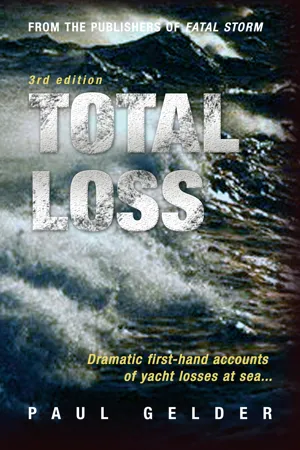
- 288 pages
- English
- ePUB (mobile friendly)
- Available on iOS & Android
eBook - ePub
About this book
Information
Print ISBN
9780713687835
Edition
3one
RUN DOWN OR SWAMPED? THE OUZO MYSTERY
| Yacht | | Ouzo (Sailfish 25) |
| Skipper | | Rupert Saunders |
| Crew | | James Meaby and Jason Downer |
| Bound from | | Bembridge, Isle of Wight to Dartmouth |
| Date of loss | | 21 August 2006 |
| Position | | south of Isle of Wight, UK |

Being run down by a big ship is a sailor’s worst nightmare. The scenario sometimes involves fog or crossing shipping lanes. But in the case of the 25ft yacht Ouzo, a fatal chain of unseen factors led to the deaths of three sailors on a summer’s night off the Isle of Wight in Britain.
ONE OF THE LAST PEOPLE to see Ouzo afloat was Bill Mitchell (46), proprietor of the Bembridge boatyard AA Coombes on the Isle of Wight, where the yacht had been based for 25 years. At around 1930 on Sunday 20 August 2006, Bill was walking his dog along the beach when he saw the 25ft navy blue GRP sloop a quarter of a mile offshore. She was in the Bembridge Channel motoring out towards St Helen’s Fort.
Bill was confident the yacht was in good shape. He had fitted out the Angus Primrose-designed Sailfish 25 three months earlier. All her navigation lights – masthead tricolour, port and starboard lights on the pulpit and stern light, plus steaming light – were working when the yacht was launched at the end of May. Ouzo did not have a liferaft, but she did have an inflatable dinghy. The crew were experienced sailors. Skipper-owner Rupert Saunders (36) was setting out on a night passage to take part in Dartmouth Regatta Week. His crew were two friends, James Meaby (36) and Jason Downer (35).
At 2230, a mobile phone call from one of the crew confirmed her last known position as Sandown Bay, as Ouzo sailed south of the Isle of Wight, beyond the range of Southampton VTS radar, and into one of the biggest maritime mysteries of recent times.
The first sign that something had gone tragically wrong came 38 hours later. At noon on 22 August the body of a man wearing a lifejacket was found floating in the sea 10 miles off the SE coast of the Isle of Wight. It was later identified as James Meaby. Next day, the bodies of the two other crew were recovered 10 miles south of the Nab Tower.
Despite an extensive search of 95 square miles of seabed for the wreck, using the Royal Navy, merchant ships and aircraft, no wreckage was ever found and exactly what happened on that fateful night is still shrouded in mystery. It is known that Ouzo had DSC VHF radio, a one million candela flashlight, a compressed air canister foghorn, an octahedral radar reflector, distress flares and a deflated three-man inflatable dinghy stowed in a locker.
Voyage Data Recorder (VDR) records from all ships in the Solent that night were traced and examined and a detailed inspection was made of the hull of P&O ferry Pride of Bilbao, looking for paint samples and scratches. A ship one mile away travelling at 20 knots will take just three minutes to reach a yacht.
The Marine Accident Investigation Branch’s (MAIB) report into the loss of Ouzo was a 174-page dossier which cost more than £150,000 and took seven months to complete. It made chilling reading for yachtsmen and pieced together the events on that night.
The 37,583 tonne P&O ferry Pride of Bilbao had left Portsmouth bound for Spain, via the eastern Solent, over two hours late, at 2325, due to a technical fault.
At 0022 approaching the Nab Tower, the ship’s captain gave orders for full ahead, the normal procedure. At 0030 he handed control of the vessel over to the Second Officer Michael Hubble (61) and told him he would be in his cabin should he be needed. At 0059 there was a changeover of lookout on the ship’s bridge and a couple of minutes later a radar check revealed no close targets. A course change was made from 221° to 243°. This was to take three minutes using the electronic autopilot. At 0107, the ferry’s lookout on the port side spotted a dim white light off the starboard bow and then a brighter red light. The ferry was travelling at 19 knots.
The Second Officer used the joystick to turn the bow of the ferry. The lookout saw a yacht with two white sails passing down the starboard side. The Second Officer altered course again, the other way, thinking the ferry’s stern might strike the yacht. After seeing a light off the stern, he believed the yacht was safely clear and continued on course across the Channel.
Inspectors from the MAIB spent several nights at sea on the Pride of Bilbao reconstructing what happened. In varying conditions, they checked blind spots on the bridge and gave out questionnaires to passengers to check for clues. The ferry lookout’s eyes were tested and his prescription glasses sent for tests by experts. The ferry’s radar was also investigated.
The report concluded that the ferry’s course alteration at 0101 that night may have confused Ouzo’s crew about the ship’s intentions. Visibility was good and although it was a dark night, the ferry was well lit and approaching from astern, not obscured by Ouzo’s sails.
The report added: ‘Any attempts by the yachtsmen on Ouzo to attract the ferry’s attention were ineffective as the watchkeeping officer and lookout only saw the yacht’s lights at the last minute’ – when it was too late.
The fatal chain of factors on the bridge of the ferry, which are believed to have contributed to the tragedy, included the following: the lookout was wearing the wrong sort of glasses, with photochromatic lenses, which darken in light and affect light transmission in low light levels. When the Second Officer altered course, he used the autopilot joystick. If, instead, he had used the override controls, the ship would have changed course much more swiftly, though the 1,490 passengers aboard might have felt the forces of gravity.
FIVE FACTORS WHICH COULD SAVE YOUR LIFE
Below are five key factors and recommendations involving the P&O ferry:
1 The yacht didn’t show up on the ferry’s radars because GRP yachts the size of Ouzo have poor radar reflectivity, even with a radar reflector displayed (which was believed to be the case: Ouzo had an octahedral reflector). The radar signal is reduced further in moderate or rough conditions. At least one of the ferry’s radars was adjusted using automatic clutter control.
Recommendation: Ships’ radars should be routinely switched to manual clutter control to check for small targets.
2 There were poor blackout procedures on the ferry’s bridge. Light pollution affected the vision of both lookout and watchkeeper. The red light in the chart room was switched to white because the Second Officer found it gave him headaches. Some blackout curtains were not drawn, further impairing night vision.
Recommendation: Keep stray light to a minimum.
3 The lookout first saw Ouzo when he’d been on the bridge for nine minutes. His eyes were still adapting to the dark – a possible reason he didn’t spot Ouzo earlier.
Recommendation: Handovers should be 15 minutes long, so a lookout’s eyes are better adapted to the dark. It takes 10–15 minutes to get full night vision.
4 After the incident, the ferry failed to stop, assist or communicate with the yacht. The officer saw a light astern, but this didn’t mean Ouzo was safe. Her battery compartment was well-protected and her lights may have been lit despite being swamped or capsized with crew in the water in desperate need of help. The lack of an aggrieved VHF radio call from the yacht may have indicated she was not safe.
Recommendation: The effect of a large, fast ship passing close to a small boat can be dangerous . . . every effort should be made to ensure the safety of small vessels after a near collision.
5 Research commissioned from the Institute of Ophthalmology showed the lookout’s photochromatic glasses stopped at least 20 per cent of light transmission.
Recommendation: Such glasses should not be worn by bridge lookouts at night.
WHAT HAPPENED ABOARD OUZO?
The loss of Ouzo was a puzzle that was the talk of yacht club bars for many weeks. Was she swamped? Why wasn’t she seen until the last minute? The MAIB inspectors used a sister ship to reconstruct Ouzo’s probable track from Bembridge and to assess the yacht’s survivability in various swamping scenarios.
Coastguard computer software was used to calculate the drift of a partially submerged 25ft yacht, as well as the bodies of the crew. James Meaby’s body drifted 40 miles in wind and tide. The MAIB inspectors tested the most commonly used radar reflectors as well as yacht navigation lights. They also investigated the psychological impact of collision at sea on lookouts and watch officers, and whether or not ‘denial’ was a factor in this case.
Here are 10 key factors uncovered and some safety recommendations:
1 Masthead tricolour navigation light lenses, similar to Ouzo’ s, are prone to crazing, reducing their efficiency. Bulbs fitted can be accidentally replaced with ones of lower luminosity.
Recommendation: Yachtsmen should check lenses and make sure bulbs are constantly bright, knocking the lens case and moving the wires to simulate movement.
2 In a yacht heeled more than 5°, the horizontal intensity of her navigation lights may be decreased. Ouzo was probably close-hauled and heeling to 20° or more, so her masthead light may well have been compromised.
3 Even if Ouzo had deployed her octahedral radar reflector, it would not have been very effective in the ‘clutter’ of moderate sea conditions.
Recommendation: Fit the best radar you can afford. Consider the Sea-Me active radar reflector, which came top in a group test conducted by Yachting Monthly.
4 Ouzo’s crew didn’t have time to send a MAYDAY by VHF radio, or to fire distress flares. Without a liferaft or EPIRB, the survival of Ouzo’s crew depended on their physical fitness, clothing and lifejackets. All three were physically fit and in good shape. The attention they gave to their choice of clothing was impressive: under high-quality waterproof jackets and trousers, all three wore warm fleece garments on trunk and legs over normal indoor clothing. All wore 150N lifejackets. One was of the auto-inflation type, two were manually inflatable, but none had crotch straps or lights.
The crew weren’t declared missing until almost 40 hours after the collision, when the first body was found 10 miles south of the Nab Tower. It is estimated that James Meaby survived for at least 12 hours and his crewmates for only three. Why? Because Meaby had fitted his lifejacket more tightly.
Survival expert Dr Frank Golden wrote: ‘All three lifejackets were fully inflated at the time of recovery but none were supporting the body in the optimal position to assist survival. Two bodies were found face down in the water, supported only by their lifejacket waist strap under their armpits. Their heads had slipped through the collar as they hung vertically with the lobes floating on the surface.
James Meaby’s angle of flotation was still nearer the vertical, so that when consciousness was eventually lost through hypothermia, the neck muscles were no longer able to support the weight of the head. Had lifejacket crotch straps been fitted and secured, it would have helped all three crew to float nearer the horizontal than vertical, significantly increasing their survival chances.
Given the water temperature (18°C), the relatively benign sea conditions, and the amount of insulation Ouzo’s crew were wearing, all three would have survived for some time (6–12 hours) had they been able to float in the desired semi-reclining angle. But buoyancy was lost as air trapped ...
Table of contents
- Cover
- REVIEWS OF THE FIRST EDITION
- Title page
- eCopyright
- Dedication
- Table of Contents
- PREFACE
- COLLISION
- 1 RUN DOWN OR SWAMPED? THE OUZO MYSTERY
- 2 ANATOMY OF A COLLISION
- 3 SUNK IN THE NORTH SEA
- 4 RUN DOWN, OR RESCUED?
- 5 ANATOMY OF A SINKING
- 6 THAT SINKING FEELING
- 7 THE LOSS OF A ‘FRIEND’
- 8 THERE SHE BLOWS
- FAILURE OF GEAR OR RIGGING
- 9 THE NIGHT OUR KEEL FELL OFF
- 10 WHY WE HAD TO SINK OUR YACHT
- 11 PULLING THE PLUG
- 12 SINK AND SWIM
- 13 THE END OF AN OSTAR
- STRESS OF WEATHER
- 14 THE CAT WITHOUT NINE LIVES
- 15 NO ESCAPE AT FÉCAMP
- 16 PERFECT STORM
- 17 ABANDONED!
- 18 MAYDAY FOR MAY BEE
- 19 THE SINKING OF GALWAY BLAZER
- 20 A SHORT RACE ACROSS THE ATLANTIC
- 21 FASTNET RESCUE
- 22 CAPSIZE! HOW I LOST GULF STREAMER. . .
- 23 ‘I AM NOT GOING TO DIE!’
- FAULTY NAVIGATION
- 24 SHIPWRECKED ON AN UNMARKED REEF
- 25 THE FATAL REEF
- 26 THE LOSS OF KEELSON II
- 27 SONG – THE FINAL EPISODE
- 28 LAST TIME OVER
- 29 CHARTREUSE ON THE ROCKS
- FIRE OR EXPLOSION
- 30 FIRE AND ICE
- 31 LPG – A DISASTER WAITING TO HAPPEN
- 32 A BLAZING YACHT IN THE IONIAN
- 33 LIGHTNING STRIKE
- FAILURE OF GROUND TACKLE OR MOORING LINES
- 34 GIRL STELLA’S GOING
- 35 BAD LUCK IN BOULOGNE
- BEING TOWED
- 36 TYPHOON BRENDA AND THE TOW
- 37 THE LOSS OF JESTER
- 38 MISCHIEF’S LAST VOYAGE
- ACKNOWLEDGEMENTS
Trusted by 375,005 students
Access to over 1.5 million titles for a fair monthly price.
Study more efficiently using our study tools.