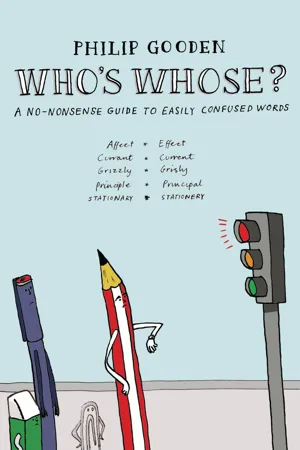
Who's Whose? is an entertaining and straightforward guide to the most commonly confused words in English today, with real examples of good and bad usage to make differences crystal-clear. The Embarrassment Rating involved in each mistake is included, together with an explanation of why the confusion happens and how to avoid it in the future.
So if you mistrust (or distrust?) your spellchecker and want to maintain or improve your written English, this is the perfect companion for you.
Almost identical spelling and pronunciation often results in the first two being mixed up.
A calendar is a ‘table for telling the date’ or simply a ‘list’:
The nude calendar, with carefully placed objects à la Austin Powers, raised £578,000. (Guardian)
It’s quite common to find the wrong word used when calendar is meant:
St Patrick’s Day celebrations are firmly fixed on the national party calender [should be calendar]. (Observer)
But calender is a word not in everyday use since it’s restricted to a couple of specialist applications: a ‘machine for rolling cloth or paper’ or (still more obscure) a ‘member of a Persian religious sect’.
Neither word should be confused with colander, the ‘kitchen container used for straining food’:
With more holes in its plot than a colander, Last Day in Limbo rollicks along with a cast of 2-D characters … (Observer)
Embarrassment rating:
Even if you get the spelling wrong with the first two, your meaning will not be mistaken. As long as you don’t refer to looking things up in a colander …
How to avoid: An almanac is a register of days, events, etc. – note the ‘a’s of almanac, like the end of calendar. More practically, calender is such a specialist term that the ‘-er’ spelling is almost always going to be the wrong one.
CALLOUSorCALLUS
Any problem with this pair of closely related words is likely to come with the spelling of the second one, which doesn’t ‘look’ English.
Callous (which can be used to describe ‘hardened’ skin) is an adjective with the principal meaning of ‘without feeling’, or ‘ruthless’:
Cruelty does not simply consist of a neutral act, but of delighting in the hurt – or being callous towards the suffering – so caused. (Daily Telegraph)
Callus, which comes direct from Latin, is the noun for a ‘patch of toughened skin’:
The presence of calluses on the forehead of a Shi’ite Muslim, by contrast, is a sign of great religiosity. (Daily Telegraph)
Embarrassment rating:
, if you put the first spelling in place of the second (‘he had callouses on his hand’). The meaning is clear but it’s still a mistake.
How to avoid: The grammatical rule is that words ending in ‘–ous’ tend to be adjectives, like callous, and those ending in ‘–us’ are usually nouns. Otherwise there is no neat way to remember the difference. Callus is a fairly specialist term, at least when it’s written down, and I suspect that most people would reach for some alternative phrase like ‘rough patches’ before using it.
CANorMAY
Two very simple words which are used interchangeably but which can – or may – convey subtly different meanings.
Can denotes ability:
She can speak five languages.
(but is often used in the sense of ‘has permission’:
She’s just been told she can come on the trip).
May indicates possibility:
It may rain tomorrow.
and permission:
You may leave when the job’s finished.
There is a small potential ambiguity in a sentence like the one above, which could mean ‘You might take it into your head to leave …’.
There is a stronger ambiguity in a sentence like ‘He may drive across’. Context and tone of voice will tell the listener whether it’s a matter of permission or possibility.
Embarrassment rating:
Long, long ago a pedantic teacher or parent might pick on a child’s question ‘Can I do X?’ by saying ‘Of course you can do X. What you mean is, may you do it?’ But no one talks like this any more, do they?
How to avoid: Despite the above, it’s sometimes worth considering in formal writing the distinction between can and may. Do you want to imply capability or permission?
CANNONorCANON
As with the example of ‘calendar/calender’ earlier, the identical pronunciation of cannon/canon sometimes causes the wrong spelling to be used.
A cannon is a ‘large gun’ or a ‘type of shot in billiards’. By contrast, canon has a variety of different applications: a ‘priest attached to a cathedral’; a ‘principle or rule’ (as in ‘accepted canons of decency’); the ‘body of work attributed to a particular author’ (the Shakespearean canon, for example, covers all those works considered to have been written by him and not attributable to another author). Canon also has an adjectival form, ‘canonical’.
The two words are sometimes mixed up, generally with canon being used for cannon. In this example, a clergyman is apparently on the rampage:
Stoddart, an uncomfortably outspoken loose canon [should be cannon] in the secretive world of formula one … (Guardian)
Embarrassment rating:
Moderate to high if you put the wrong word, since there is comic potential in the idea of firing off priests or, alternatively, installing guns in cathedrals.
How to avoid: Cannon is frequently associated with ‘loose’, as in the example above. ‘Loose’ has a doubled letter in the middle; so does cannon. If you’re not talking of guns or games, but of priests, rules, or art, then canon is likely to be the appropriate spelling.
CANVASorCANVASS
Mistakes are sometimes made over the spellings of these two (see below), perhaps because of some half-conscious association between making pictures and establishing views.
Canvas is ‘material used for painting on, for making ship’s sails’, etc.; its plural form is ‘canvases’.
To canvass (verb) is to ‘gather support in a political setting’ or simply to ‘ascertain other people’s views’:
The President of the United States himself was canvassed for his opinion on the matter, but it seems that he took the precaution of falling asleep in front of the telly on Sunday, before the beast could spring its attack on his tender sensibilities. (Daily Telegraph)
Canvass also operates as a noun with the same sense of ‘estimating numbers’, ‘gathering support for a vote’. It should not be confused with the other word and spelling, as it is here:
… the first full canvas [should be canvass] of Tory MPs suggested that Mr Major would win by a comfortable margin. (The Times)
Embarrassment rating:
The sentence quoted above is confusing because it suggests a group portrait of Tory MPs, and makes a kind of halfway sense.
How to avoid: To canvass is to try to assess the opinions of others – note the shared ‘ss’s. Everything else to do with boats, material, paintings, etc. is the single ‘s’ canvas.
CAPITALorCAPITOL
Two words with near-identical pronunciation, both suggestive of something powerful or important.
Capital has a range of meanings as a noun describing an ‘important city’ or ‘seat of governmen...
Table of contents
Cover
Title
Contents
Introduction
A
B
C
D
E
F
G
H
I
J
K
L
M
N
O
P
Q
R
S
T
U
V
W
Y
Z
Imprint
Trusted by 375,005 students
Access to over 1.5 million titles for a fair monthly price.
Study more efficiently using our study tools.
Frequently asked questions
Yes, you can cancel anytime from the Subscription tab in your account settings on the Perlego website. Your subscription will stay active until the end of your current billing period. Learn how to cancel your subscription
No, books cannot be downloaded as external files, such as PDFs, for use outside of Perlego. However, you can download books within the Perlego app for offline reading on mobile or tablet. Learn how to download books offline
We are an online textbook subscription service, where you can get access to an entire online library for less than the price of a single book per month. With over 1.5 million books across 990+ topics, we’ve got you covered! Learn about our mission
Look out for the read-aloud symbol on your next book to see if you can listen to it. The read-aloud tool reads text aloud for you, highlighting the text as it is being read. You can pause it, speed it up and slow it down. Learn more about Read Aloud
Yes! You can use the Perlego app on both iOS and Android devices to read anytime, anywhere — even offline. Perfect for commutes or when you’re on the go. Please note we cannot support devices running on iOS 13 and Android 7 or earlier. Learn more about using the app
Yes, you can access Who's Whose? by Philip Gooden in PDF and/or ePUB format, as well as other popular books in Languages & Linguistics & Linguistics. We have over 1.5 million books available in our catalogue for you to explore.