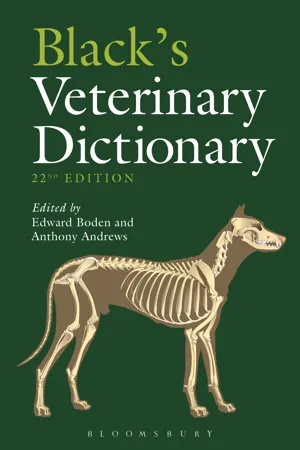
Black's Veterinary Dictionary has been a bestseller for over 80 years. It is an essential reference tool for all with a professional or leisure interest in the care of animals. Much more than a list of veterinary terms, its practical approach ensures that readers gain an insight into the signs and symptoms of common, and less common, diseases, their diagnosis and treatment.
For the 22nd edition much new and updated information has been included, reflecting the numerous developments that have taken place in animal care and husbandry, and welfare. There is greatly expanded coverage of topics relating to popular breeds of dog and cat, and the inheritable conditions that might affect their health.
Advances in medicine, surgery and diagnostic techniques; descriptions of newly identified diseases such as Schmallenberg virus; the resurgence of old scourges such as TB in cattle, and ongoing enzootic infections such as bird flu are included in this new edition.
The growing risk of exotic diseases such as heartworm being imported following the relaxation of travel arrangements for dogs and cats is reflected in new entries. Notes on many new species being farmed or kept as companion animals are among the thousands of topics covered.
Whether your interest is in cats or cattle, horses or hamsters, puppies or pigeons, the A-Z of veterinary matters is covered in Black's Veterinary Dictionary.
- 816 pages
- English
- ePUB (mobile friendly)
- Available on iOS & Android
eBook - ePub
About this book
Information
P
Pacemaker
An electronic device implanted under the skin of the chest which stimulates the heartbeat.
Pacemakers have been successfully implanted into dogs and horses which showed an impaired conduction of the impulse that regulates the heartbeat, so that a lack of coordination between the beating of the atria and that of the ventricles occurs.
Pacheco’s Disease
Pacheco’s disease is caused by a herpesvirus which is present in South American psittacines (parrots, parakeets). In the wild it does not appear to cause any harm. In aviaries, however, sudden onset of disease and death may occur, with up to 100 per cent mortality. The birds become weak and have diarrhoea. Post-mortem examination shows necrosis of the liver and spleen.
Pachyderm
Large thick-skinned animals with hooves, such as ELEPHANTS, hippopotamuses, and rhinoceroses,
Pachymeningitis
Inflammation of the dura mater of the brain and spinal cord. (See MENINGITIS.)
Pacinian Corpuscles
(See under TOUCH, SKIN.)
Packed Cell Volume
(See under BLOOD – Composition; HAEMATOCRIT VALUE.)
Paddocks
Paddock grazing is a system of pasture management in which animals rotate around different patches of ground. Careful management is needed to avoid a build-up of parasitic worms, particularly where only one species is used to graze them. Ideally paddocks need ‘resting’ for 12 months, or grazing by a different species of animal, rotationally or using a suitable worming policy.
Pain
(For relief of pain, see ANALGESICS; ANAESTHESIA, GENERAL.) Pain can be defined as ACUTE or CHRONIC. Acute pain is generally associated with tissue damage or the threat of tissue damage. It results in a rapid alteration in behaviour in order to avoid damage or minimise any further damage. It optimises conditions under which healing can occur and stops once healing is complete. Chronic pain is of long standing and continues long after any acute signs and, in humans, it has an effect on the physical wellbeing of the person, as well as having a psychological impacts such as fear, anger, anxiety and depression. This reduces the patient’s quality of life. In human and animal illness this affects the HEALTH-RELATED QUALITY OF LIFE. PAIN ASSESSMENT in these situations is difficult.
Animals which are natural hunters (predators) may cry out when suffering pain. Species which are, or were, normally hunted may not do so because it would reveal that they are injured or hiding. Thus, because an animal does not cry out, or show signs of restlessness, it should not be assumed that it is free from pain. The clinical signs of pain can differ from species to species. Pain can be a cause of aggressiveness. The effect of pain can last longer than the pain itself: it has been shown that as long as a month after foot pain has been corrected in cattle, cows still behave as if in pain, as the animal’s body has not returned to normal. In sheep, this can last even longer. As a result, bodily condition and milk production may not return to normal until some time after the animal has made an apparent recovery.
Pain Assessment
The assessment of ACUTE pain is generally easy. The use of psychometric methods to measure acute pain in dogs can involve various methods including the GLASGOW COMPOSITE MEASURE PAIN SCALE. Psychometric methods can be used to provide valid, reliable, reproducible and responsive assessment to clinical changes in the underlying condition. This allows assessment and then decision making to be made, dependent on the degree of pain presented by the animal. CHRONIC pain is more difficult to assess. However, in dogs a subjective assessment can be made by the owner using a standard form to measure pain and thereby allow a HEALTH-RELATED QUALITY OF LIFE assessment. This can be used together with an assessment by the veterinary surgeon. Together, they allow the practitioner to manage and treat chronic pain in animals under their care.
Paint
(See HOUSE DECORATING, POISONING; LEAD POISONING, CAGE AND AVIARY BIRDS, DISEASES OF.)
Palatability
(See under DIET AND DIETETICS.)
Palate
The palate is the partition between the cavity of the mouth below, and that of the nose above. It consists of the hard palate and the soft palate. The hard palate is formed by the bony floor of the nasal cavity covered with dense mucous membrane, which is crossed by transverse ridges in all the domesticated animals. These ridges assist the tongue to carry the food back to the throat. The hard palate stretches back a little beyond the last molar teeth in animals, and ends by becoming continuous with the soft palate. This latter is formed by muscles covered with mucous membrane. The act of swallowing causes the distal soft palate to press against the back of the pharynx and prevent food entering the nose. In the horse, the soft palate acts as a sort of curtain between the cavity of the mouth and that of the pharynx. Material brought up from the stomach must pass out by way of the nostrils. In racehorses, distressed breathing may arise as the result of inflammation or partial paralysis of the soft palate, which may be linked with paresis or paralysis of the vocal cords. Partial resection of the soft palate has been carried out as treatment for this latter condition. (See GUTTURAL POUCH DISEASE.)
Prolonged soft palate is a recognised inherited abnormality of the short-nosed breeds of dogs, e.g. boxers, bulldogs, Pekingese, pugs, cocker spaniels. It makes breathing difficult at times, with snoring or even loss of consciousness resulting. An operation to correct the condition is often very successful.
Severe injury to the hard palate is not uncommonly seen in cats which have fallen from a height, and suturing may be required.
Palatitis
Inflammation of the mucosa covering the hard and/or soft palate.
Palatoschisis
(See CLEFT PALATE.)
Pale Soft Exudative Muscle (PSE)
(See PORCINE STRESS SYNDROME.)
Palliative Medicine
This involves treatment of an animal to alleviate pain or distress but without attempting to treat the condition.
Palm Kernel
A by-product of oil manufacture produced by expelling and/or extraction. Used in ruminants, pigs and poultry. It has high protein (CP 18 per cent), high energy (ME about 12.5 MJ/kg in ruminants; about 14.0 MJ/kg for pigs) and a high fibre level (crude fibre about 17 per cent). High arsenic levels were found in palm kernel expeller imported from Malaysia to the EU for cattle feed in 2011.
Palo Santo Trees
The leaves, fruit, and seeds cause poisoning in cattle in South America. Signs include tympany, depression, and convulsions.
Palpebral
Relating to the eyelids.
Pan-
Pan- is a prefix meaning all or completely.
Pancreas
The pancreas is partly an endocrine gland, producing hormones; and partly an exocrine gland, producing the pancreatic juice for digestive purposes.
The pancreas is situated in the abdomen, a little in front of the level of the kidneys and a little below them. When fresh it has a reddish-cream colour. It can be seen using ULTRASOUND, COMPUTED TOMOGRAPHY, MRI or EXPLORATORY LAPAROTOMY.
The pancreatic juice is secreted into the small intestine to meet the food which has undergone partial digestion in the stomach. The juice contains alkaline salts and at least nine enzymes: e.g. trypsin, which carries on the digestion of proteins already begun in the stomach; amylase, which converts starches into sugars; and lipase, which breaks up fats; as well as a substance that curdles milk. (See DIGESTION, ABSORPTION AND ASSIMILATION - INTESTINAL DIGESTION.)
The pancreas also has groups of cells, the islets of Langerhans. (See INSULIN; DIABETES MELLITUS; GLUCAGON; HORMONES.) Here alpha-cells produce glucagon, and beta-cells, insulin.
Pancreas, Diseases of
Thes...
Table of contents
- Cover
- Title
- Preface
- Contents
- A
- B
- C
- D
- E
- F
- G
- H
- I
- J
- K
- L
- M
- N
- O
- P
- Q
- R
- S
- T
- U
- V
- W
- X
- Y
- Z
- Copyright
Trusted by 375,005 students
Access to over 1.5 million titles for a fair monthly price.
Study more efficiently using our study tools.
Frequently asked questions
Yes, you can cancel anytime from the Subscription tab in your account settings on the Perlego website. Your subscription will stay active until the end of your current billing period. Learn how to cancel your subscription
No, books cannot be downloaded as external files, such as PDFs, for use outside of Perlego. However, you can download books within the Perlego app for offline reading on mobile or tablet. Learn how to download books offline
Perlego offers two plans: Essential and Complete
- Essential is ideal for learners and professionals who enjoy exploring a wide range of subjects. Access the Essential Library with 800,000+ trusted titles and best-sellers across business, personal growth, and the humanities. Includes unlimited reading time and Standard Read Aloud voice.
- Complete: Perfect for advanced learners and researchers needing full, unrestricted access. Unlock 1.5M+ books across hundreds of subjects, including academic and specialized titles. The Complete Plan also includes advanced features like Premium Read Aloud and Research Assistant.
We are an online textbook subscription service, where you can get access to an entire online library for less than the price of a single book per month. With over 1.5 million books across 990+ topics, we’ve got you covered! Learn about our mission
Look out for the read-aloud symbol on your next book to see if you can listen to it. The read-aloud tool reads text aloud for you, highlighting the text as it is being read. You can pause it, speed it up and slow it down. Learn more about Read Aloud
Yes! You can use the Perlego app on both iOS and Android devices to read anytime, anywhere — even offline. Perfect for commutes or when you’re on the go.
Please note we cannot support devices running on iOS 13 and Android 7 or earlier. Learn more about using the app
Please note we cannot support devices running on iOS 13 and Android 7 or earlier. Learn more about using the app
Yes, you can access Black's Veterinary Dictionary by in PDF and/or ePUB format, as well as other popular books in Medicine & Veterinary Medicine. We have over 1.5 million books available in our catalogue for you to explore.