- 256 pages
- English
- ePUB (mobile friendly)
- Available on iOS & Android
eBook - ePub
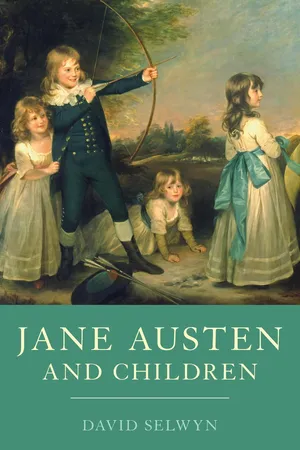
Jane Austen and Children
About this book
Jane Austen is not usually associated with children - especially since she had none of her own. But there are in fact more children in her novels than one might at first think. She herself was from a sizeable family, with numerous nephews and nieces. She was, by all accounts, good with children and popular with them. It was therefore natural for her to include them in her novels, even if sometimes offstage. This book, by one of the world's leading authorities on Austen, looks at both the real and the literary children in her life - children seen and unseen (and dead); children as models of behaviour, good and bad; as objects of affection, amusement, usefulness, pity, regret, jealousy, resentment; children in the way; children as excuses; children as heirs. In the process it casts fascinating light on a hitherto largely ignored aspect of her work and the age in which she lived.
Information
1
Confinement
To be in at the beginning of life, one must start at the end of the novel.
For although Jane Austen concludes her books with the marriage of hero and heroine to which the whole thrust of the narrative has been leading, and the reader rejoices in the perfect happiness of the union, in reality the best is yet to come: they will have children – procreation being not only the natural and desirable end of marriage, but also an economic and dynastic necessity. And those children will have their own stories, which we may make a reasonable guess at, since there were established ways of doing these things. What will become of the Darcy children? The eldest boy will inherit Pemberley, of course; one of his brothers may go into the army, perhaps joining Colonel Fitzwilliam’s regiment, and another will probably enter the Church, no doubt enjoying that living to which Mr Wickham was so particularly unsuited. And among the girls there will surely be at least one pair of fine eyes to win the heart of a Bingley cousin. Meanwhile, Mr and Mrs Knightley will produce an heir to Donwell who will supplant little Henry, the ‘heir expectant’1 whose claims Emma is so quick to defend when Mrs Weston suggests that Mr Knightley may marry Jane Fairfax;2 and the Revd and Mrs Edmund Bertram will fill Mansfield parsonage with children, just as the Revd and Mrs George Austen filled Steventon rectory. Jane Austen, who knew her Shakespeare, was well aware that ‘the world must be peopled’.3
But it is neither her business nor that of the accepted structure of comedy to follow the hero and heroine beyond the church door; while it is true that at the end of Sense and Sensibility Marianne is foreseen as ‘the mistress of a family’4 (that is to say, of a whole household, comprehending children and servants), in Mansfield Park, where Jane Austen does permit her pen to speculate about her characters’ future, there is only the most oblique of references to Fanny and Edmund having children. So in her novels there are only one or two minor characters who experience pregnancy during the course of the narrative; and as one might expect, any mention of their condition is of the most discreet kind.
In writing to her sister Cassandra about their friends and relations, however, Jane was prepared to be far more forthcoming, and over the years she reported frequently on the confinements of her sisters-in-law. ‘Mary is quite well . . . “& uncommonly large”,’ she quoted her brother James as saying, when in October 1798 his wife was expecting a baby.5 Two days before the birth, she went to Deane parsonage with her father to see Mary, and reported that she was ‘still plagued with the rheumatism, which she would be very glad to get rid of, and still more glad to get rid of her child, of whom she is heartily tired’.6 A monthly nurse had been sent for, and Jane wrote that she had ‘no particular charm either of person or manner’; but, she added, ‘as all the Hurstbourne world pronounce her to be the best nurse that ever was, Mary expects her attachment to increase’. She also told Cassandra that two women had recently died in childbirth, and added cheerfully, ‘We have not regaled Mary with this news’. By the time she got to the end of the letter, she was able to write: ‘I have just received a note from James to say that Mary was brought to bed last night, at eleven o’clock, of a fine little boy, and that everything is going on very well.’ The fine little boy was James Edward Austen-Leigh, destined eventually to be his aunt’s first biographer.
At this time, Jane and her mother had not long returned from Godmersham in Kent, where another sister-in-law, Edward’s wife Elizabeth, had also given birth, to her fifth child, and where Cassandra was staying on to lend assistance. Mrs Austen was still suffering from the fatigues of the journey; she was very close to both James and his wife, and if, as is probably the case, Mary had experienced a miscarriage the previous year,7 it is not surprising that she was too anxious to wish to follow the last stages closely: ‘My mother had desired to know nothing of it before it should be all over,’ Jane wrote, ‘and we were clever enough to prevent her having any suspicion of it, though Jenny, who had been left here by her mistress, was sent for home.’ No doubt Jane too was relieved that all had gone well, and that after a second visit she was able to write to Cassandra that she had been ‘really amazed at the improvement which three days had made’ in her sister-in-law, that she ‘looked well’ and ‘her spirits were perfectly good’.8 Yet there is something curiously detached about the way in which, before she gives any account of mother and child, she begins this letter in a tone of high comedy:
My dear Sister
I expected to have heard from you this morning, but no letter is come. I shall not take the trouble of announcing to you any more of Mary’s children, if, instead of thanking me for the intelligence, you always sit down and write to James. I am sure that nobody can desire your letters so much as I do, and I don’t think anybody deserves them so well. Having relieved my heart of a great deal of malevolence, I will proceed to tell you that Mary continues quite well, and my mother tolerably so.
Mary’s example did little to make Jane Austen feel that she herself would ever care to go through the experience of having a child, however. When she wrote again a week later, she could not help making comparisons between the two young mothers:
I was at Deane yesterday morning. Mary was very well, but does not gain bodily strength very fast. When I saw her so stout on the third and sixth days, I expected to have seen her as well as ever by the end of a fortnight. . . . Mary does not manage matters in such a way as to make me want to lay in myself. She is not tidy enough in her appearance; she has no dressing-gown to sit up in; her curtains are all too thin, and things are not in that comfort and style about her which are necessary to make such a situation an enviable one. Elizabeth was really a pretty object with her nice clean cap put on so tidily and her dress so uniformly white and orderly.9
There were times when, unmarried as she was, she clearly felt sympathy for those women who were forced to undergo a seemingly unending cycle of pregnancies. Some years later, in a letter from Godmersham announcing the arrival of Elizabeth’s eleventh child, Cassandra passed on the news that Mrs Tilson, wife of Henry Austen’s banking partner, was also about to have a baby; ‘poor Woman!’ Jane replied, ‘how can she be honestly breeding again?’10 Perhaps the general sense of over-production was too much for her; what could hardly be said, even to Cassandra, about the wife of their own brother, could be displaced onto a mere acquaintance. The child was Mrs Tilson’s eighth. Five years later, Jane met Mrs Tilson in London; she was ‘as affectionate & pleasing as ever’, she told Cassandra, commenting ironically: ‘from her appearance I suspect her to be in the family way. Poor Woman!’11 She added that her niece Fanny prophesied ‘the Child’s coming within 3 or 4 days’, and so it proved: shortly afterwards, the Tilsons’ eleventh child, a little girl, was born.
A woman subjected to a series of thirteen pregnancies that came every two years with clockwork regularity was Mrs John Benn, wife of the rector of Farringdon, a mile to the south of the Austens’ later home at Chawton. She was certainly well used to the routine; Jane wrote to Cassandra in September 1816: ‘You left us in no doubt of Mrs Benn’s situation, but she has bespoke her Nurse.’12 And her thoughts turning to her brother Frank’s wife, also Mary, then two months into her seventh pregnancy, she added: ‘Mrs F. A. seldom either looks or appears quite well. – Little Embryo is troublesome I suppose.’ There was a regularity in Mary’s proceedings too; when Frank brought her to dinner at Chawton, six months later, Jane wrote to Fanny that it was ‘the last visit of the kind probably, which she will be able to pay us for many a month; – Very well, to be able to do it so long, for she expects much about this day three weeks, & is generally very exact.’13 At the same time, one of Fanny’s aunts on her mother’s side was expecting her eighteenth child; Jane wrote to her niece: ‘Good Mrs Deedes! – I hope she will get the better of this Marianne, & then I wd recommend to her & Mr D. the simple regimen of separate rooms.’14 About twenty-four-year-old Fanny’s own marriage prospects, she advised her not to be in a hurry; then, ‘by not beginning the business of Mothering quite so early in life’, she would be ‘young in Constitution, spirits, figure & countenance’, unlike Fanny’s friend Mary Hammond, who, married at twenty, was ‘growing old by confinements & nursing’.15 Yet at that time, twenty-four was far from being considered ‘early in life’ for a woman to marry and begin the ‘business of Mothering’: Jane’s sister-in-law Elizabeth Bridges, Fanny’s mother, had been only 18 when she married Edward, and another sister-in-law, Fanny Palmer, was the same age when she married Charles Austen. Among her own heroines, Marianne Dashwood marries at nineteen, Fanny Price at eighteen and Catherine Morland at seventeen.
One has the feeling that in the last months of her life, the contemplation of this never-ending cycle of marrying and breeding seemed gradually to overwhelm her; and with her niece Anna Lefroy pregnant for the third time, it all became too much for her, almost as if her own ailing constitution could not withstand the thought of so much teeming new life. There is a palpable sense of disgust in her tone when she writes to Fanny:
Anna has not a chance of escape; her husband called here the other day, & said she was pretty well but not equal to so long a walk; she must come in her Donkey Carriage. – Poor Animal, she will be worn out before she is thirty. – I am very sorry for her. – Mrs Clement too is in that way again. I am quite tired of so many Children. – Mrs Benn has a 13th.16
As it turned out, on this occasion Anna had a miscarriage. Her aunts had originally suspected her pregnancy partly because she was looking pale, but also because she had just weaned her previous child. Again, Jane’s choice of words is interesting: ‘We fear something else’, she told Fanny.17
It was widely held that breastfeeding could prevent conception; a mother might delay becoming pregnant again too soon after giving birth by prolonging the period of suckling, but once she had ceased, falling pregnant again became a possibility. Mary Wollstonecraft actually advocated breastfeeding as a method of controlling the intervals between pregnancies, thus enabling a woman to manage her children herself rather than leaving them entirely to the care of servants, without wholly sacrificing her own needs to – in Jane Austen’s phrase – the business of mothering:
fulfilling the duties of a mother, a woman with a sound constitution, may still keep her person scrupulously neat, and assist to maintain her family, if necessary, or by reading and conversations with both sexes, indiscriminately, improve her mind. For nature has so wisely ordered things, that did women suckle their children, they would preserve their own health, and there would be such an interval between the birth of each child, that we should seldom see a houseful of babes.18
The frank discussion of pregnancy and its consequences was all very well in the letters that Jane wrote to her sister, but it is not something that would find its way into any of her novels, where, as we shall see, the stages of a woman’s confinement are generally, though not quite always, charted at second-hand through the conversation of intermediary characters. There are novels by her contemporaries, Mary Wollstonecraft, Charlotte Smith and Mrs Opie among them,19 in which not only does the heroine become pregnant but her condition plays an important part, functionally and psychologically, in the narrative; dealing as they do with the more extreme forms of pressure exerted on women’s sensibilities, however, these narratives are not comedies.20
In the medical literature of the time a debate was taking place about the effects on women of the physiological changes brought about by pregnancy. Many physicians believed that at conception the womb was stimulated to a condition of excitement termed ‘irritability’, and that the other organs of the body were in ‘consent’ with it and were similarly excited; since this ‘consent’ could extend to the mind or emotions, a pregnant woman might often appear less calm and reasonable than she would normally be, and indeed might be subject to moods of extreme dejection or hysteria. Clare Hanson sees in this view a ‘reworking of the Greek theory of the “wandering womb”’21 – that is, the ‘mother’, a phenomenon most familiar to us, perhaps, from Lear’s cry when he fears the onset of madness:
O! how this mother swells up toward my heart;
Hysterica passio! down, thou climbing sorrow!
Thy element’s below.22
The idea of the ‘irritability’ of the body in pregnancy, however, was dismissed by a female writer and midwife who took her stand in the controversy over the ascendancy of the man-midwife which was a matter of considerable importance in eighteenth-century obstetrics (and which will be discussed in the next chapter). Martha Mears, in The Midwife’s Candid Advice to the Fair Sex, counters the term ‘irritability’ with t...
Table of contents
- Cover
- Title page
- Table of Contents
- Introduction
- 1 Confinement
- 2 Birth
- 3 Infancy
- 4 Childhood
- 5 Parents
- 6 The child in the family
- 7 Reading and writing
- 8 Education
- 9 Maturity
- Acknowledgements
- Bibliography
- Notes
- eCopyright
Trusted by 375,005 students
Access to over 1.5 million titles for a fair monthly price.
Study more efficiently using our study tools.
Frequently asked questions
Yes, you can cancel anytime from the Subscription tab in your account settings on the Perlego website. Your subscription will stay active until the end of your current billing period. Learn how to cancel your subscription
No, books cannot be downloaded as external files, such as PDFs, for use outside of Perlego. However, you can download books within the Perlego app for offline reading on mobile or tablet. Learn how to download books offline
Perlego offers two plans: Essential and Complete
- Essential is ideal for learners and professionals who enjoy exploring a wide range of subjects. Access the Essential Library with 800,000+ trusted titles and best-sellers across business, personal growth, and the humanities. Includes unlimited reading time and Standard Read Aloud voice.
- Complete: Perfect for advanced learners and researchers needing full, unrestricted access. Unlock 1.5M+ books across hundreds of subjects, including academic and specialized titles. The Complete Plan also includes advanced features like Premium Read Aloud and Research Assistant.
We are an online textbook subscription service, where you can get access to an entire online library for less than the price of a single book per month. With over 1.5 million books across 990+ topics, we’ve got you covered! Learn about our mission
Look out for the read-aloud symbol on your next book to see if you can listen to it. The read-aloud tool reads text aloud for you, highlighting the text as it is being read. You can pause it, speed it up and slow it down. Learn more about Read Aloud
Yes! You can use the Perlego app on both iOS and Android devices to read anytime, anywhere — even offline. Perfect for commutes or when you’re on the go.
Please note we cannot support devices running on iOS 13 and Android 7 or earlier. Learn more about using the app
Please note we cannot support devices running on iOS 13 and Android 7 or earlier. Learn more about using the app
Yes, you can access Jane Austen and Children by David Selwyn in PDF and/or ePUB format, as well as other popular books in Littérature & Critique littéraire. We have over 1.5 million books available in our catalogue for you to explore.