eBook - ePub
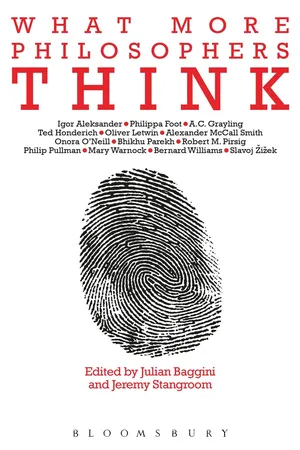
What More Philosophers Think
- 208 pages
- English
- ePUB (mobile friendly)
- Available on iOS & Android
eBook - ePub
What More Philosophers Think
About this book
Following on from the success of the first edition of What Philosophers Think, this second edition brings together a collection of interviews with some of the world's most important and influential philosophers and intellectuals and leading figures in the arts and politics, including: Bernard Williams - Onora O'Neill - Philippa Foot - Philip Pullman - Bhikhu Parekh - Slavoj Žižek - AC Grayling - Igor Alexander - Alexander McCall Smith - Daniel Dennett - Oliver Letwin The interviews - all revised and expanded from The Philosopher's Magazine - cover a wide range of issues and offer a unique insight into the minds behind the great ideas of today. Always lively, provocative and accessible, these interviews get to the heart of today's most vital questions.
Information
1 Politics and Philosophy
Imagine, if you will, President George W. Bush or Prime Minster Tony Blair giving a speech which contained a line like, The Kantian half of the truth about virtue and vice is that they are chosen; the Aristotelian half of the truth about virtue and vice is that they are learned.’ It’s not literally unimaginable – it’s just that the chances of its actually happening are negligible.
Yet there is a senior British politician who uttered just those words in a political speech. He wasn’t bluffing or taking the credit for the erudition of his speechwriter. The person who spoke these words knew what he was talking about, because he was a philosopher before he became a politician.
The Conservative Member of Parliament Oliver Letwin followed the old-fashioned route to high office: Eton, then Cambridge. His brief stint as an academic philosopher was as a fellow of Darwin College, Cambridge from 1981–1983. In 1987 he published a book of serious philosophy, Ethics, Emotion and the Unity of Self. But by the time it came out he had already left academe and was in the thick of politics.
Between 1983 and 1986 he was a member of Margaret Thatcher’s policy unit. Then in 1987 he won the parliamentary seat of Dorset West, and in 2001 he rose to the front benches, having been appointed by lain Duncan Smith to the post of Shadow Home Secretary. In 2003, he climbed even further, as Michael Howard made him Shadow Chancellor of the Exchequer. His recent move to the lesser role of Shadow Secretary of State for Environment, Food and Rural Affairs seems not to be a demotion, but was at least in part down to a personal choice to concentrate more on his family. The more cynical suggest that he might be biding his time, aiming to challenge for the leadership of his party when it looks more likely to form a government.
With this intriguing and unusual biography, Letwin is uniquely placed to offer a view on the issue of social justice that is both philosophically informed and politically viable. Yet the mixing of his philosophical and political selves is far from straightforward, as we shall see.
When I spoke to Letwin at his office in Westminster’s Portcullis House, I asked him what he thought the key issue of social justice was.
‘I think the main question we need to be addressing is how we can have a society in which people grow up to be the kind of people that we would all like to be. That isn’t the way it’s often put, but it’s my view of what it means to live in a socially just society. To my mind, something has gone very wrong – so we’re doing a great social injustice – if there are people growing up to be the kind of people we wouldn’t like to be: people who find themselves with chaotic lifestyles which they can’t control and which drive them to despair and suicide; people who are oppressed by a lack of ability to control their world and deal with it; people who are deprived of a culturally rich existence: all these things seem to me profound social injustices.
‘Some of them have to do with material prosperity, although that’s never a guarantee of getting where I want people to be able to get to; nor is its absence a guarantee of not being able to get people where I want people to be able to get to. There are relationships, but it isn’t the case that they should be conceived as a sort of mechanical operation for making sure that everybody has enough money, or for making sure that nobody is attacked by a burglar. It’s something much deeper than either of those.’
Letwin agreed when I suggested that that sounded a lot like an Aristotelian conception of human flourishing. Yet, as he intimated, this is not what people usually think of when they hear the words ‘social justice’. What tends to spring to mind are issues about distribution of wealth, and making sure it is fair. In contrast, when Letwin talks about social justice he is more concerned with what he called ‘The Neighbourly Society’, the title he gave to his collected speeches 2001–2003, covering the period he served as Shadow Home Secretary. This conception of justice has social order at its core. As he put it in one speech, ‘the only just society is a crime-free society’. But does that mean redistribution of wealth does not come into his thinking at all? His answer might come as some surprise.
‘I wrote a book called The Purpose of Politics in which I tried to work out what relation Rawlsian or other distributive conceptions of justice or policy had to prosperity, virtue, beauty and other desirable ends in politics. I came to believe that because politics should really be about trying to foster a civilized existence, each of these things is a value, and no one has supremacy – it isn’t an either/or exercise. So I think that distributive justice of some form – and I’m actually quite attracted to Rawlsian views of what distributive justice amounts to – is one value, so is the value of prosperity, so is the value of beauty, so is the value of justice in a criminal sense. I don’t see any one of these as supreme and I don’t believe that there are permanent solutions to balancing these off. I see politics therefore as something that ought to be a process of continuous readjustment of the balance between a series of values, no one of which has primacy.’
This talk of different values, none of which is a master value, owes a great deal to the pluralism of Isaiah Berlin, which Letwin acknowledges. Does that then mean that Letwin, a senior Tory, can imagine a hypothetical situation in which the economic distribution in the country is much more uneven than it is now, in which he’d favour some sort of redistribution?
‘Yes, yes, absolutely. Well I do favour continuous redistribution anyway. In fact every major political party in Britain at the moment does, and sponsors an enormous amount of it. But I could imagine circumstances in which increasing the level of redistribution became a primary goal. I can also imagine circumstances in which it was not at all the primary goal because a lot of that was going on, but something else was going very wrong. I don’t see these things as permanent. I see them as constantly shifting.’
So the differences between the political parties is not so much that each holds different values, but rather has a lot to do with which one of those values they lay the greatest emphasis on.
‘At any given moment,’ he qualifies. ‘Precisely the argument I make in that book is that it is not the case that Mr X wants something which is the exact opposite of what Mr Y wants. It is rather that Mr X and Mr Y will actually share in great part a series of values, but for one reason or another at a given moment one person is emphasizing one rather than the other. And the business of politics in a liberal democracy is the resolution of that particular issue.’
Right now, economic inequality is low on Letwin’s list of priorities. At the top are those Aristotelian concerns about arranging society so as to enable people to become their best selves.
‘I think there is at the moment a paradox that certain kinds of activity where it would be better if they were freer are more constrained; and other kinds of things where it would better if there were more social support or where social solidarity has been left to decline. For example, we live in a society where there is a huge aversion to risk. There is a colossal amount of regulation designed to minimize risk, I think to an extent which is impeding excellence, exuberance, cultural richness and so on. On the other side, people are growing up in circumstances where they are cruelly deprived of the emotional support that a human being needs in order to live the kind of life that many of us want to lead. This is a particularly intrusive state in some respects and a particularly thin society in other respects.’
Even though our conversation is philosophical, Letwin resists attempts to suggest that philosophy may actually have helped shape these views. He declines to name individual philosophers that he finds most attractive, saying, 1 don’t think philosophers line up that way.’ More seriously, perhaps, he refuses to entertain the notion that many of his political ideas rest on philosophical premises. For example, the autonomy of the self is clearly an important part of Letwin’s social conservatism. And if he values the human capacity to choose freely, surely he must, as a philosopher, have some supporting views on the metaphysics of freedom? But, no, apparently.
‘Issues of free will of the most profound, philosophical kind don’t have much to do with addressing practical questions of our own lives or social organization.’
But, I insist, since he believes it is politically important that people should be treated as, and enabled to maximize themselves as, autonomous free agents, his position would only make sense under a certain understanding of human nature, and fundamentally the nature of the self.
‘Yes, absolutely,’ he says, before dodging the deeper philosophical disputes again. ‘If I didn’t believe that people are capable of making decisions and that it makes sense to hold people responsible for their decisions, then more or less everything else that I believe also wouldn’t be believable. But I don’t think anybody should delude themselves into imagining that they don’t believe people make free decisions, or that they don’t believe people should be held responsible for their decisions’
I say I find it hard to believe that, given he was immersed in philosophy, his views on freedom had not in some way been shaped by philosophy.
‘No-no-no-no-no, I resist that entirely,’ he says, before I can finish the question. ‘It is not the case that the reason why I think that we ought to do politics as if people were able to take decisions and be held responsible for them is because I have some philosophical preconception about how people are. On the contrary, this seems to me just blindingly obvious, and you don’t need to be any kind of philosopher at all to recognize it. In fact people of all kinds recognize it every day of their lives all the time, and that’s why they blame their children when they act wrongly and get cross with people who do things they don’t think they should do.
‘It is certainly the case that there are issues about how philosophically we deal with this brute fact alongside the brute fact that we are machines and that there are laws of physics. I accept that is a profound philosophical nexus of issues, but it’s not a practical issue for moral life or political life.’
How separate then are Letwin’s political and philosophical selves?
‘I think that the only real connection between the two in my own case – and I may be deluding myself – is that habits of thought formed in the one inevitably get applied to the other. Whether it’s beneficial for a politician to have a philosophical habit of thought, I don’t know, but anyway I have one. The answer is that there ought to be people who do politics in that way and there ought to be people who do politics in quite other ways, and these people ought to be mixed, because, after all, politics is so death-defyingly difficult that people ought to come to it from very different perspectives.’
This echoes some comments he made back in 2003 at the British Academy, in a discussion co-organized with The Philosophers’ Magazine. There, Letwin said that the benefit of philosophy is that it could raise the level of debate: ‘As I see it, the biggest single problem of democracy in Britain today is the level of political discourse rather than the substance of the positions taken.’
‘Yes, I do think that,’ he confirms. ‘I don’t think this is unique to philosophy, but I think that any deep immersion in a serious academic discipline leads people to learn habits of thought that tend to raise levels of discourse. Philosophy is perhaps particularly well adapted to that because it is about thinking about matters of great complexity. That’s a particularly good thing for talking about politics in a dispassionate, rational, careful fashion, which helps. It doesn’t get the whole way to any answer, but it helps.’
It is interesting that Letwin is not better known as a philosopher. In countries like France, Spain or Germany it would be considered a great asset for a politician to be a philosopher. Does he think that in this country it’s almost a disadvantage to confess a philosophical background?
‘Massive,’ he says, without hesitation. ‘I do my best to conceal it.’
So why does it put people off?
‘There’s a good side and a bad side to that. The good side is that this country is a robustly commonsensical sort of place in which people distrust over-intellectualizing. After all, it’s possible to intellectualize yourself into the gas chambers. The bad side to that is this is also a country in which there is a sort of excessive distaste for intellectuals, and there’s something good about a country like France where people came out in the streets when Sartre died, which certainly wouldn’t happen in England.’
For now, Letwin’s thoughtful approach to politics has retreated from the front line. One can’t help wondering, however, what would happen if Letwin did return to try to lead his party. What would Britain make of a philosopher-ruler in waiting?
Suggested Reading
The Neighbourly Society (Centre for Policy Studies)
The Purpose of Politics (The Social Market Foundation)
2 11 September
In the autumn of 2001, at the invitation of The Philosophers’ Magazine, the philosophers Jonathan Rée, Anthony O’Hear, Jennifer Hornsby and David Conway participated in a roundtable discussion on the appropriate philosophical response to the events of 11 September 2001.
In what way, if any, do the events of 11 September and their aftermath demand or invite a distinctly philosophical response? Rée: I think there is a pretty sharp distinction between those who have simply used 11 September as an occasion to explain how right they’ve always been in their analysis of everything; and those – a fairly large number, I suspect – who have really taken it seriously as an event which opens out a new space of political and philosophical possibilities, scope both for new hope and for new fears. I think it may prove to be an event of the same order as 14 July 1789 – that people may still be wondering whether the event and its consequences were on the whole progressive or on the whole disastrous two hundred years later, just as they are with the storming of the Bastille.
The reasons why it might seem to be an event which thoroughly upsets people’s political concepts is nothing to do with the scale of it. As many people have pointed out, the death of a few thousand people in New York does not count for much statistically, compared with the 20 million innocent civilians who have been killed in wars in the past ten years. I think you can get an idea of what’s novel about it by trying to imagine the state of mind of the people who flew the planes, particularly into the World Trade Center. Picture them waiting in the departure lounge, with the people they were about to kill milling around them. Picture the little kids wandering around, coming up to them and trying to engage them in conversation, as kids do. Obviously there have been bombers who have killed more people, at Hiroshima, for example. But somehow or other, perhaps through self-delusion, they didn’t have to be in a state of vindictive personal hatred when they did it; indeed they probably thought they were doing it out of love of humanity and peace. It seems to me this does make a big difference.
Conway: I don’t know if philosophers have any particular insight into it, but I’ve been very interested in trying to work out, or to see if anyone is capable of working out, the nature of the states of mind of the people who perpetrate such acts, both at the times they commit them and also in the lead up to their doing so. I gather that they’re not all as they were originally characterized – uneducated lads who had been brainwashed – but they were quite educated, often highly educated.
Hornsby: I agree broadly speaking with what’s been said, but I’m actually doubtful whether philosophers have any particular expertise in understanding their states of mind. I’m also doubtful that one should spend a lot of time trying to think about their states of mind and understanding them better. Maybe it’s enough to say that they were fanatics who loved what strikes most of us as evil. I don’t think philosophers can get much beyond that. It’s not so much their individual states of mind but the background to them – the states of mind of millions of people in the world –that’s a far more interesting question.
I think events have created a moment to think, and since philosophers are thinkers they should be thinking. But I actually suspect that it’s a relatively small area in which we have any special expertise.
Conway: Like some people here I’m uncertain as to what distinctive contrib...
Table of contents
- Cover
- Title Page
- Contents
- Acknowledgements
- Preface
- 1. Politics and Philosophy
- 2. 11 September
- 3. Security and ‘The War on Terror’
- 4. Terrorism and Punishment
- 5. Multiculturalism
- 6. Multiculturalism, Pluralism and Tolerance
- 7. Trust and Autonomy
- 8. Philosophy and Public Understanding
- 9. Making Babies
- 10. Goodness
- 11. Love
- 12. Truth and Truthfulness
- 13. The Metaphysics of Quality
- 14. Philosophy and the Novel
- 15. Writing for Children
- 16. Artificial Intelligence
- Index
- Copyright
Trusted by 375,005 students
Access to over 1.5 million titles for a fair monthly price.
Study more efficiently using our study tools.
Frequently asked questions
Yes, you can cancel anytime from the Subscription tab in your account settings on the Perlego website. Your subscription will stay active until the end of your current billing period. Learn how to cancel your subscription
No, books cannot be downloaded as external files, such as PDFs, for use outside of Perlego. However, you can download books within the Perlego app for offline reading on mobile or tablet. Learn how to download books offline
Perlego offers two plans: Essential and Complete
- Essential is ideal for learners and professionals who enjoy exploring a wide range of subjects. Access the Essential Library with 800,000+ trusted titles and best-sellers across business, personal growth, and the humanities. Includes unlimited reading time and Standard Read Aloud voice.
- Complete: Perfect for advanced learners and researchers needing full, unrestricted access. Unlock 1.5M+ books across hundreds of subjects, including academic and specialized titles. The Complete Plan also includes advanced features like Premium Read Aloud and Research Assistant.
We are an online textbook subscription service, where you can get access to an entire online library for less than the price of a single book per month. With over 1.5 million books across 990+ topics, we’ve got you covered! Learn about our mission
Look out for the read-aloud symbol on your next book to see if you can listen to it. The read-aloud tool reads text aloud for you, highlighting the text as it is being read. You can pause it, speed it up and slow it down. Learn more about Read Aloud
Yes! You can use the Perlego app on both iOS and Android devices to read anytime, anywhere — even offline. Perfect for commutes or when you’re on the go.
Please note we cannot support devices running on iOS 13 and Android 7 or earlier. Learn more about using the app
Please note we cannot support devices running on iOS 13 and Android 7 or earlier. Learn more about using the app
Yes, you can access What More Philosophers Think by Julian Baggini, Jeremy Stangroom, Julian Baggini,Jeremy Stangroom in PDF and/or ePUB format, as well as other popular books in Philosophy & Philosophy History & Theory. We have over 1.5 million books available in our catalogue for you to explore.