Food and Architecture is the first book to explore the relationship between these two fields of study and practice. Bringing together leading voices from both food studies and architecture, it provides a ground-breaking, cross-disciplinary analysis of two disciplines which both rely on a combination of creativity, intuition, taste, and science but have rarely been engaged in direct dialogue.
Each of the four sections – Regionalism, Sustainability, Craft, and Authenticity – focuses on a core area of overlap between food and architecture. Structured around a series of 'conversations' between chefs, culinary historians and architects, each theme is explored through a variety of case studies, ranging from pig slaughtering and farmhouses in Greece to authenticity and heritage in American cuisine. Drawing on a range of approaches from both disciplines, methodologies include practice-based research, literary analysis, memoir, and narrative. The end of each section features a commentary by Samantha Martin-McAuliffe which emphasizes key themes and connections.
This compelling book is invaluable reading for students and scholars in food studies and architecture as well as practicing chefs and architects.
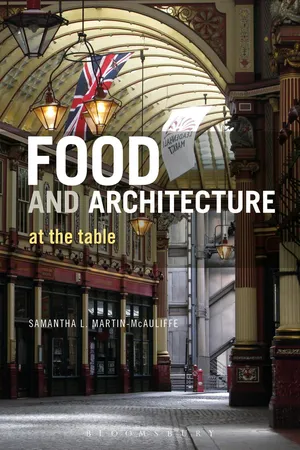
- 304 pages
- English
- ePUB (mobile friendly)
- Available on iOS & Android
eBook - ePub
About this book
Information
1
Introduction
Cuisine and Architecture: Beams and Bones – Exposure and Concealment of Raw Ingredients, Structure and Processing Techniques in Two Sister Arts
Ken Albala and Lisa Cooperman
The most familiar and enduring example comparing architecture and cuisine hails from the nineteenth century and the magnificent edible fantasies of Marie-Antonin Carême, king of chefs and chef of kings. Carême is credited with having said, ‘The Fine Arts are five in number: Painting, Music, Poetry, Sculpture, and Architecture – whereof the principle branch is Confectionery’, and indeed his cakes were discernible only in scale from their non-edible counterparts. Other examples also come to mind: the towering stacks of food faddish in the 1980s, not to mention structures which themselves recall wedding cakes like the monument to King Victor Emmanuel that hovers over the Roman Forum, or the Brighton Pavilion.
But these examples obscure some of the deeper aesthetic affinities between these sister arts. Their origins follow a directly parallel development: at a vital juncture in our evolution, hominids came to depend not only on fire but also upon mechanical means of processing raw materials, rendering them edible through cutting, pounding, soaking, drying and fermentation. Thus cuisine was born. At a comparable stage, humans employed natural materials such as wood, stone and hides to fashion shelter for protection from the elements and predators. While early forms of architecture may predate the invention of cooking, both these arts have since become indispensable for human existence; both are resolutely functional, as a building one cannot enter becomes sculpture, likewise an inedible meal.
Architecture and gastronomy employ, in much the same way, compositional principles of balance, contrast, proportion, scale and emphasis. Visual and structural elements find parallels in the organization of flavours and the schema of their presentation. Not surprisingly, they also share a similar aesthetic vocabulary that describes the complex relationship to their raw materials, at times seeking to emphasize and lay bare the ‘natural’ or organic origin of ingredients, as well as the basic means of construction, while at other times seeking to hide through artifice the creative process to highlight the inventiveness of the artist as a moulder of unformed matter.
We might then describe two fundamentally opposed approaches to raw material as a function of the prevailing aesthetic trends. Roughly speaking, these trends divide into oppositional pairs familiar from the language of art history: classicizing and romanticizing, ‘Poussinists’ and ‘Rubenists’, disegno ou colour (line and colour), Picasso and Matisse. Of course, while aesthetic developments represent the continual process of synthesis, absorption and rejection of competing ideologies and practices, one persuasion usually dominates. For example, during one phase of a period artists may intentionally lay bare the beams that conceptually and physically hold a structure together, emphasizing the comprehensibility of its organization and character of materials. Likewise some cookbooks expose the structural ‘bones’ of a meal, not only as in actual bones on a plate but also in emphasizing the origin and straightforward honesty of the ingredients, prepared without fuss or extravagance.
Gastronomically, we are in the middle of exactly such a period and one could argue likewise architecture is undergoing an organic, sustainable phase, literally and figuratively speaking the same language as cooking. Witness the current popularity of home gardening and butchery, and the premium placed on locally sourced materials. The do-it-yourself approach to home renovation stems from the same basic impetus. The impulse to present natural unaffected ingredients stretches from the home cook and builder right up to the most expensive restaurant and professionally designed architecture.
Such periods stand in contrast to those in which the ingredients and the process are less important than the artistic statement, when the creative genius of the artist turns raw matter into something novel, intellectually stimulating, and occasionally intentionally obscure and difficult to read. In cuisine, the most contemporaneous example would be the disguised and scientifically transformed inventions of molecular gastronomy, the Ferran Adriàesque colloidal suspensions and foams. Adrià’s late twentieth-century architectural parallel is Frank Gehry, in particular his geometrically gymnastic exteriors of the Disney Concert Hall and Guggenheim Museum Bilbao. It is not to say this approach cannot exist at the same time as more ‘natural’ artists are working, but one approach tends to prevail at a particular time.
What triggers such alternating currents of approach is a matter for speculation. In periods of austerity it is likely that people tend to forgo expensive, fussy white tablecloth meals and return to simple ingredients and traditional preparations. Contrariwise, a wildly speculative economy with fortunes quickly made leads to stiff competition for restaurants to attract ever-wealthier clients, which they do with hyper-designed food fantasies. The same process is of course involved in physical structures, going over the top when patrons want to display their wealth and sophistication and coming more ‘down to earth’ when tight budgets focus concerns on conservation and efficiency or a return to ‘traditional’ values.
An ancient example will illustrate the perennial juxtaposition of these two basic approaches to ingredients and techniques and their relation to status. In the mid-fourth-century BC the ancient Greek connoisseur Archestratus composed a verse book of recipes (Hedypatheia or Life of Luxury) at Gela on the south coast of Sicily. It survives in fragments in the compilation of Athenaeus written several centuries later. There is no doubt that Archestratus was responding to what he considered excessively fussy cooking using brash combinations of contrasting flavours. In one recipe for amia, a small bonito, he warns not to use too much oregano, no cheese, no fancy nonsense. Instead he focuses on the finest ingredients, sourced from places only the well-heeled traveller could expect to access and recognize. His gastronomic approach favours simple direct presentations in which the techniques are straightforward and highlight quality and freshness. This is a kind of sophistication that reflects not mere profligate wealth or abundance, but the cultural capital of knowledge, experience and savoir faire.
The architectural equivalent of Archestratus is a Doric temple about forty-five miles to the west in Agrigento. The Temple of Concord is among the best preserved of all ancient Greek temples, and not a single structural element of its perfect geometric balance is hidden. Bold fluted columns comprise the peristyle. The abiding aesthetic is perfectly analogous to Archestratus’ cooking. It is practical, solid, earthbound and resolutely functional. Its boldness comes from scale, balance and compositional integrity. The ingredients and techniques are allowed to speak for themselves through purity without artifice.
One might argue that the opposite approach is apparent in the next great cookbook of ancient times, usually known as De re coquinaria, attributed to the first-century AD Roman gourmand Apicius, though probably a compilation made several centuries later judging from the language. In any case, Apicius’ cookbook employs a wide array of exotic ingredients: flamingo tongues; dormice; ostrich; and sow’s womb, with flavours dramatically juxtaposed through the use of salty fish sauce called garum or liquamen, the sweetness of honey, the bitterness of herbs like rue, the sourness of vinegar and the piquancy of imported pepper. Moreover, the texture of these dishes often pounded fine (like the rose patina, a smooth mixture of brains and rose petals) or cooked into a jumble of ingredients suggests that the basic elements are intentionally obscured. One would have to guess the welter of ingredients that enter into most of the dishes. Why, one may wonder, the distantly sourced flavourings, the curiously named dishes (a la Apicius or Vitellius)? These are meant to create distance from the aspiring nouveau riches. They are over-the-top inventions possible only within a massive empire of unbounded social mobility, and in particular one in which the old landed wealth feels threatened by social upstarts. The impression one gets from the cookbook is that it may well have been written for exactly this sort of person, one who is trying hard to impress, and ‘pass’ among social superiors.
The general tone of late Imperial architecture follows in the same spirit. A shifting axis of influences brings motifs and flavours from the east as well as a revision of ancient sources. Combined with the technical innovations afforded by the use of tile-covered concrete and brick, architecture experiences a leap to free-flowing interior spaces and decorative impulses delighted with doodads: swags, putti, balustrades, medallions in relief and stairs leading nowhere. Straightforward structural columns are replaced with marble pilasters and faux colonnades that line façades for decorative effect. The structures themselves become imbalanced, top heavy and strewn with frou-frou. Consequently, they become hard to read; the form outweighs the function and at times even defies it. The Arch of Constantine (AD 312–15) is perhaps the most analogous structure to Apicius’ cookbook, not only because it too is a mishmash of earlier borrowed elements but also because the elements are tossed together in such frenetic profusion. It is almost impossible to read and the entire mass is squat and ungainly, especially compared to the much earlier and classically balanced Arch of Titus (ca. AD 81), which stands nearby to the northwest. Additionally, its purpose is purely propagandistic: it serves to declare the greatness of its subject, his conquests and the extent of his massive empire. It is meant to overawe in much the same way Apicius’ recipes are often merely for shock value.
However, the switch from one approach to another need not be simply a matter of resources, political clout or patronage. A style may, on its own accord, evolve in excessively self-referential and sophisticated ways due to theoretical elaboration or because it is driven by the processes of social emulation. For example, once direct trade routes opened up to Asia in the sixteenth century, spices arrived in Europe in much greater volume and common people had greater access to them. The wealthiest of customers therefore gradually abandoned spices in most dishes or marginalized them to dessert. Thus, when fashions – culinary as well as architectural – can be imitated by social aspirants (i.e. nouveau riches), the style no longer serves as a mark of distinction, and something new must be invented to re-establish that distance in taste and discernment. At this juncture style may look backward again to reinvigorate traditional forms.
Such is the case in Renaissance Italy beginning with one of the perfect examples of humanistic architecture, the Tempietto of Donato Bramante within San Pietro in Montorio, on the Janiculum Hill in Rome. Built in 1502, it is mathematically proportioned, and perfectly balanced, showing restrained surface ornament. Most importantly, this small martyrium, a miniature house of worship, is on a human scale, not attempting to overawe, but meant for quiet reflection and the kind of direct spirituality that would so heavily influence the Reformation just a decade later. Its harmonious unity is a product of resolute belief in the values of Classical antiquity synthesized with Christianity. Without pretension or erudite reference, the small domed temple symbolizes the pinnacle of High Renaissance style.
The cookbook and health manual of Bartolomeo Sacchi, known as Platina (De honesta volupate), is a few decades older but comparable in its use of Classical references to describe the properties of individual ingredients. Like the Tempietto, it is balanced, sober and self-assured. It goes so far as to combine health advice with a cookbook by Martino of Como, which is a slightly older work, at least stylistically. At times his recipes are a little too extravagant or certain ingredients a little too dangerous in Platina’s mind and he does not hesitate to respond to these with comments like ‘I would only feed this to my enemies’. But as a whole the text is equally an expression of Renaissance taste: health is balanced with pleasure, meals should be rational, flavours balanced so as to generate the best humours and flavourings used judiciously. That is, the logic of Platina’s diet is easy to understand – the strange, extravagant and exotic make way for well-tempered meals.
If we move into the next century to the age of Mannerism, the spirit of the arts has shifted entirely. Mannerist art and architecture are both intentionally obscure, crowded, even dizzying. The clarity of proportion and human scale of the Renaissance give way to surprises, marvels and sheer technical proficiency. Exoticism prevails. Arnold Hauser called this an age of anxiety, the result of recurring invasion by Spain and France. But it seems here too the engine of social mobility may once again have been at play. The sixteenth century was a period of rapid inflation and population growth. Even if one was fortunate not to have been among the lower social strata, both land and basic foodstuffs still held a high premium. In such periods, social mobility runs rampant, and the ‘old’ nobility naturally try to protect their position, which is reflected directly in the hyper-sophisticated palaces they built for themselves. They are meant to be ‘artificial’, again a positive value for them. Take, for example, the Palazzo del Te outside Mantua designed by Giulio Romano in the 1520s–1530s. On the elongated courtyard façades, triglyphs on the frieze appear to have slipped out of position, threatening to fall on the heads of observers. The joke is of course apparent only to those who know where these should be, only to the aesthetically savvy. The inside joke is brought to seeming reality once one enters the Hall of Giants, where the ceiling literally comes hurtling down from above, the walls disappearing beneath the cascade of tumbling giants and boulders. The structure is intentionally hidden, not merely through trompe l’oeil effects, but literally transforming into sculpture above one’s head. The function of the room, beyond funhouse, is not apparent. But it does serve to distinguish the Gonzaga patrons as connoisseurs of the most titillating and bizarre art imaginable.
Operating on the same level is the exactly contemporaneous Mannerist cookbook of Christoforo di Messisbugo written at the Este court of Ferrara, which was closely related to the Gonzaga court through marriage. Here we find pearls and coral ground into food, not for any medicinal or gastronomic reason, but merely to flaunt wealth. In the meals described, courses proceed in staggering profusion, each laden with sweets and savouries, soups and pastries, roast fowl, fish and meat in defiance of any recognizable order or progression. Some ingredients are presented in every single course, though prepared differently in each, to showcase the genius and inventiveness of the cook (exactly as in Guilio Romano’s work). Most importantly, the flavours are wildly erratic, food is disguised and sugar and cinnamon are strewn liberally on practically every dish. Foreign recipes abound – from Turkey, Hungary, France, even a Hebraic dish – the more exotic the better. Where the ingredients come from, whether they are discernible in the final meal, is not important, but rather the technical sophistication of how they are prepared, transformed, even if they ultimately confuse and repel the diner. How else can one account for a pie filled to the brim with eyeballs of tuna? The taste, if not the function, is sacrificed to the creative spirit of the chef.
It may be that every style ultimately evolves into a kind of Mannerist phase before being completely abandoned to something new. The Mannerists of the sixteenth century saw what they were doing as the perfection of Renaissance style until their works became so busy, fussy, difficult to read and filled with bizarre and obscure references that eventually they were replaced by the very straightforward, direct style of the early Baroque.
In France, where the power of its monarchy extended to most issues of aesthetic thinking, this process appeared in the cookbook of La Varenne and those that followed in the mid-seventeenth century. This generation sought to reinvent cooking with a new kind of sophistication unobtainable by ordinary people, one that depended not on any particular ingredient, expense or quantity of food, but upon meticulous technique which only years of professional training and experience could provide. It also involved the creation of canons of taste, codified by experts. The garden designs of Le Notre, and the palace of Versailles by Levau, Mansart and Le Brun, function in exactly the same way. Their rational, controlled and stoic Baroque programmes codify standards of orthodox correctness, which only the educated consumer could hope to comprehend and the thoroughly trained artisan hope to replicate. The shift from material to technique as creative signifier suggests a new kind creative possibility inherent in traditional solutions.
These canons of taste dominated European gastronomy and architecture everywhere in Europe for nearly a century. The perpetual search for novelty saw the monarchy eventually move to occupy the more intimate and functional architectural forms of the early Rococo. The direct ‘authentic’ and natural approach applied to food as well as buildings; food should now ‘taste like itself’ rather than be disguised. Buildings should exhibit integrity of materials with function as the primary consideration. It is apparent in the so-called nouvelle cuisine of the eighteenth century, when simpler preparations, explicit reference to common, ordinary and wholesome food served with less pomp and elabo...
Table of contents
- Cover
- Halftitle Page
- Title Page
- Contents
- List of Illustrations
- List of Contributors
- Acknowledgements
- Preface
- 1. Introduction: Cuisine and Architecture: Beams and Bones – Exposure and Concealment of Raw Ingredients, Structure and Processing Techniques in Two Sister Arts
- Part One: Regionalism: Commentary for Part One: Regionalism Over the River and through the Wood: Nomenclatures of Regionalism
- Part Two: Sustainability: Commentary for Part Two: Sustainability Green Polemics: What Are We Talking about When We Talk about Sustainability?
- Part Three: Craft: Commentary for Part Three: Craft Repeat as Necessary
- Part Four: Authenticity: Commentary for Part Four: Authenticity Variations on a Theme
- Index
- Imprint
Trusted by 375,005 students
Access to over 1.5 million titles for a fair monthly price.
Study more efficiently using our study tools.
Frequently asked questions
Yes, you can cancel anytime from the Subscription tab in your account settings on the Perlego website. Your subscription will stay active until the end of your current billing period. Learn how to cancel your subscription
No, books cannot be downloaded as external files, such as PDFs, for use outside of Perlego. However, you can download books within the Perlego app for offline reading on mobile or tablet. Learn how to download books offline
Perlego offers two plans: Essential and Complete
- Essential is ideal for learners and professionals who enjoy exploring a wide range of subjects. Access the Essential Library with 800,000+ trusted titles and best-sellers across business, personal growth, and the humanities. Includes unlimited reading time and Standard Read Aloud voice.
- Complete: Perfect for advanced learners and researchers needing full, unrestricted access. Unlock 1.5M+ books across hundreds of subjects, including academic and specialized titles. The Complete Plan also includes advanced features like Premium Read Aloud and Research Assistant.
We are an online textbook subscription service, where you can get access to an entire online library for less than the price of a single book per month. With over 1.5 million books across 990+ topics, we’ve got you covered! Learn about our mission
Look out for the read-aloud symbol on your next book to see if you can listen to it. The read-aloud tool reads text aloud for you, highlighting the text as it is being read. You can pause it, speed it up and slow it down. Learn more about Read Aloud
Yes! You can use the Perlego app on both iOS and Android devices to read anytime, anywhere — even offline. Perfect for commutes or when you’re on the go.
Please note we cannot support devices running on iOS 13 and Android 7 or earlier. Learn more about using the app
Please note we cannot support devices running on iOS 13 and Android 7 or earlier. Learn more about using the app
Yes, you can access Food and Architecture by Samantha L. Martin-McAuliffe in PDF and/or ePUB format, as well as other popular books in Política y relaciones internacionales & Crítica de la arquitectura. We have over 1.5 million books available in our catalogue for you to explore.