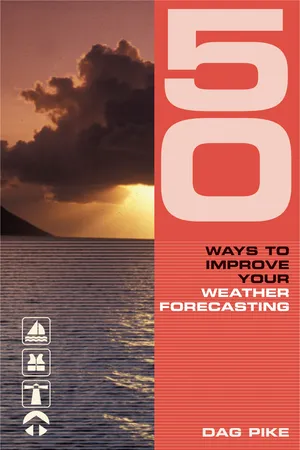
This is a book about practical weather forecasting, and it starts where most other books finish. Weather forecasts give you a lot of information about the weather to come but they often leave out a lot of the detail, and the timing of changes can also be vague. In this book, Dag Pike shows how to translate the basics into practical weather forecasts so that you can work out what it will be like in your area and along your proposed route. Sailors will be able to make better use of the available wind and avoid difficult areas, whilst powerboat drivers more interested in the sea conditions will be able to find the smoothest waters for a better ride.
With the help of this book, readers will pick up expert tips such as
Predicting the weather at sea from scanty weather forecasts
Knowing what conditions to expect when near cliffs, river estuaries and valleys
Understanding how the wind affects tides
50 Ways to Improve Your Weather Forecasting distils Dag Pike's experience gained from over 50 years of driving a whole range of craft from high-speed powerboats and lifeboats to ships and sailing boats. Written by one of the most experienced seamen in the world, it is your passport to practical weather forecasting techniques that will get you safely to your destination whether in fine weather or foul.
- 1 pages
- English
- ePUB (mobile friendly)
- Available on iOS & Android
eBook - ePub
About this book
Information
Print ISBN
9780713682687
Edition
1Table of contents
- Cover
- Title page
- Table of Contents
- WEATHER FORECASTS
- 2 Negotiating with the weather
- 3 Weather in the fourth dimension
- 4 The limitations of forecasts
- 5 Questioning the forecast
- 6 Evolving weather
- 7 You get what you pay for
- 8 Weather from coast stations
- INTERPRETING THE FORECASTS
- 10 Reading between the lines
- 11 The meaning of ‘later’
- 12 The speed of the weather
- 13 Pinning down the wind strength
- 14 The language of forecasters
- 15 Forecasting wave height
- FINE-TUNING THE FORECAST
- 17 Inconsistencies in the forecast
- 18 When the airflow is broken
- 19 When the wind is off the land
- 20 Winds around and over islands
- 21 Winds parallel to the shore
- 22 Sea breezes
- THE WIND AND THE SEA
- 24 The effect of wind on the tides
- 25 Tides and waves
- 26 Wave refraction
- 27 Wave heights
- 28 The effect of depth on sea conditions
- 29 Identifying dangerous sea conditions
- 30 What makes a wave break
- 31 Fetch and time
- LOCAL WEATHER CONDITIONS
- 33 Advection fog
- 34 When will the fog clear?
- 35 Drizzle
- 36 Gusts
- 37 Squalls
- 38 Thunderstorms
- 39 Avoiding thunderstorms
- 40 Line squalls and waterspouts
- 41 The message from the clouds
- 42 Clouds in a warm front
- TACTICS AND SHORT-TERM CHANGES
- 44 Secondary lows
- 45 Using satellite information
- 46 Running for shelter
- 47 Weather tactics
- 48 Coastal tactics
- 49 Weather routing
- 50 Weather lore
- ACKNOWLEDGEMENTS
- eCopyright
Trusted by 375,005 students
Access to over 1.5 million titles for a fair monthly price.
Study more efficiently using our study tools.