The time when every vessel going to sea made use of 3-strand rope has gone. Splicing that type of rope and cord is relatively straightforward. Nowadays the most common type of rope used on board yachts, dinghies, motorboats, working boats and ferries is braided rope. Few people have the knowledge to splice it, or even where to start.
Splicing Modern Ropes is the first guide to this essential skill. It explains why splices are better – and stronger – than knots or shackles for joining or shortening rope, and how to go about it. With this skill, yachtsmen can customise their ropes, optimise their deck layout, taper their sheets for ease of handling, and splice an extra cover on their ropes to give better grip, avoid chafe and make them last longer.
Using clear, step-by-step photography and detailed instructions, this book will guide readers through all the stages required to make strong, reliable splices.
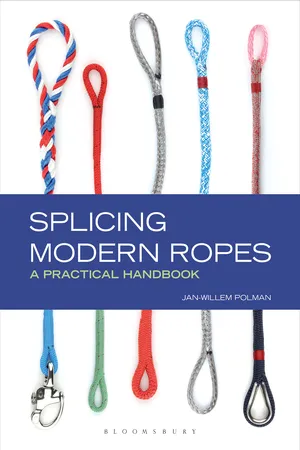
- 176 pages
- English
- ePUB (mobile friendly)
- Available on iOS & Android
eBook - ePub
About this book
Information
Print ISBN
9781472923202
Edition
1Table of contents
- Cover
- Title
- Contents
- Introduction
- 1. Synthetic fibres
- 2. Construction of ropes
- 3. Which type of rope?
- 4. Before you start
- 5. Eye splice in plaited or twisted ropes
- 6. Eye splice in polyester ropes
- 7. Eye splice in Dyneema ropes
- 8. Dyneema shackles
- 9. Weight savings and tapering
- 10. Thickening and strengthening
- 11. Continuous loops
- 12. Whippings
- 13. Reeving of new halyards
- 14. Splicing tools
- Appendices
- Acknowledgements
- About the author
- Bibliography
- eCopyright
Trusted by 375,005 students
Access to over 1.5 million titles for a fair monthly price.
Study more efficiently using our study tools.