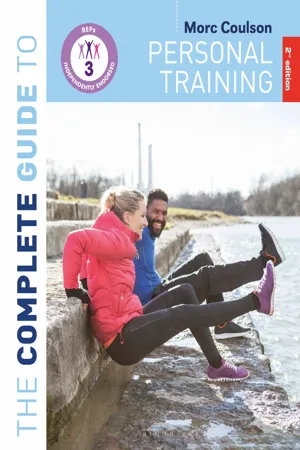
A revised and updated second edition of the popular Complete Guide to Personal Training. Expertly written and suitable for anyone working as, or training to be a Personal Trainer.
This is a complete reference guide for fitness professionals who prescribe exercise programmes to clients. This guide contains practical tips for designing a range of appropriate client exercise programmes. Importantly, it focuses on the best ways you can sustain a financially successful business in this area and how you can stand out from the crowd.
It includes:
- The foundations of personal training
- Planning and delivering exercise programmes
- Training methods and exercise techniques
- Nutrition
- Health and safety
- Setting up
- marketing and growing a successful business.
The book also includes all Level 3 requirements detailed within the Health and Fitness National Occupational Standards and the Qualifications Framework relating to personal training and has been awarded 3 CPD points by the Register of Exercise professionals.
- 336 pages
- English
- ePUB (mobile friendly)
- Available on iOS & Android
eBook - ePub
The Complete Guide to Personal Training: 2nd Edition
About this book
Information
PART ONE THE FOUNDATIONS OF PERSONAL TRAINING
1 Professional practice
The national occupational standards (NOS) level 3 personal trainer criteria covered in this chapter are:
•The values or codes of practice relevant to the work you are carrying out and their importance
•The role of the fitness professional in the industry and the structure of the industry
•The importance of reflection and continuing professional development in helping to develop client fitness and motivation
•Industry organisations and their relevance to the fitness professional
•Appropriate registration systems and continuing professional development requirements
•Employment opportunities in different sectors of the industry
•The difference between advising on exercise participation and lifestyle physical activity
•How to present a positive image of yourself and your organisation
•Why the relationship based on trust and openness between the instructor and client is important
•The type of instructor/client relationship which will assist client progress and adherence to physical activity
•The types of personal qualities that instructors need to develop in order to help and support clients
•Why your clients need to understand your role and responsibilities, and the roles and responsibilities of other professionals
•The extent/limitations of your own role and responsibility when working with clients
•What is meant by a ‘professional relationship’ between instructor and client
•What is meant by ‘valuing diversity’ in a practical context when working with clients
•The types of prejudice and discrimination that individual clients might experience and how to overcome these
•What is meant by ‘confidentiality’ and why it is important when working with clients, other staff and professionals
•The types of information that may be covered by confidentiality agreements
•How to maintain confidentiality
•How to manage conflict and disagreements with colleagues
•Procedures to follow in the event of client complaints
•How to establish rapport with your clients and the communication skills you need
The industry
The health and fitness sector is made up of both private (commercial) and public providers (such as local authority leisure centres) and has grown substantially over the years to a club membership of almost 5 million (mainly in the private sector). This figure can be misleading, however, as there are many public-sector participants but on a pay-as-you-go basis. A number of leading chains have developed with fewer and fewer ‘stand-alone’ clubs across the sector. There appears to have been a shift in focus over the years from physical fitness to health and wellbeing. This shift was emphasised in 2007 when Nuffield (a health care company in the UK) took over Cannons Health and Fitness Clubs. It is also emphasised by the additional services offered by clubs including physiotherapy, massage, relaxation, clinics and homeopathy, etc.
However, despite the high club membership across the public and private sectors, it is becoming increasingly more difficult to gain employment in the health and fitness industry, especially for those individuals who do not possess appropriate qualifications. In order to aid individuals in this process and help make the industry more professional, organisations such as the Fitness Industry Association (FIA) and SkillsActive played a lead role. The FIA was founded in 1991 to drive up participation and address concerns in the industry relating to safety and unfair codes of conduct. The FIA now works closely with government to help deliver its public health targets and represent the interests of health and fitness organisations across the United Kingdom. FIA members include operators from the public and private sector, service/product suppliers to the industry, training providers, independent professionals and affiliated bodies. SkillsActive was licensed by government as the Sector Skills Council for Active Leisure and Wellbeing until 2017. Charged by employers, SkillsActive led the skills and productivity drive across the sport and recreation, health and fitness, outdoors, playwork, and caravan industries – known as the active leisure and learning sector. SkillsActive worked with health and fitness professionals across the United Kingdom to ensure the workforce was appropriately skilled and qualified. To this end, National Occupational Standards (NOS) were developed by SkillsActive and approved by the Qualifications and Curriculum Authority (QCA). These standards help define job roles and offer descriptions of skills and knowledge required to perform various roles within the industry. Qualifications in the industry are closely aligned with the NOS so that individuals who hold specific qualifications will have demonstrated the NOS skills specific to their qualification.
The Register of Exercise Professionals (REPs)
In many industries there is a requirement for a professional body membership before an individual can practise. Currently in the health and fitness industry there is no requirement for membership to practise, however, the Register of Exercise Professionals (REPs) has been set up to help safeguard and to promote the health and interests of people who are using the services of exercise and fitness instructors, teachers and trainers. Most employers are now looking for membership of REPs in their potential employees. REPs uses a process of self-regulation that recognises industry-based qualifications, practical competency, and requires fitness professionals to work to a Code of Ethical Practice (see appendix 1) within the framework of National Occupational Standards. In other words, any individual who is accepted onto the Register of Exercise Professionals will have demonstrated appropriate competency relevant to the level to which they hav...
Table of contents
- Cover
- Title Page
- Contents
- About this book
- Foreword
- Introduction
- Part One The Foundations of Personal Training
- Part Two Plan Exercise Programmes
- Part Three Deliver Exercise Programmes
- Part Four Manage Exercise Programmes
- Part Five Working with Special Populations
- Part Six Nutrition, Exercise and Weight
- Part Seven Health and Safety In Practice
- Part Eight Sales and Marketing In Practice
- Appendices
- Glossary
- References
- eCopyright
Trusted by 375,005 students
Access to over 1.5 million titles for a fair monthly price.
Study more efficiently using our study tools.
Frequently asked questions
Yes, you can cancel anytime from the Subscription tab in your account settings on the Perlego website. Your subscription will stay active until the end of your current billing period. Learn how to cancel your subscription
No, books cannot be downloaded as external files, such as PDFs, for use outside of Perlego. However, you can download books within the Perlego app for offline reading on mobile or tablet. Learn how to download books offline
Perlego offers two plans: Essential and Complete
- Essential is ideal for learners and professionals who enjoy exploring a wide range of subjects. Access the Essential Library with 800,000+ trusted titles and best-sellers across business, personal growth, and the humanities. Includes unlimited reading time and Standard Read Aloud voice.
- Complete: Perfect for advanced learners and researchers needing full, unrestricted access. Unlock 1.5M+ books across hundreds of subjects, including academic and specialized titles. The Complete Plan also includes advanced features like Premium Read Aloud and Research Assistant.
We are an online textbook subscription service, where you can get access to an entire online library for less than the price of a single book per month. With over 1.5 million books across 990+ topics, we’ve got you covered! Learn about our mission
Look out for the read-aloud symbol on your next book to see if you can listen to it. The read-aloud tool reads text aloud for you, highlighting the text as it is being read. You can pause it, speed it up and slow it down. Learn more about Read Aloud
Yes! You can use the Perlego app on both iOS and Android devices to read anytime, anywhere — even offline. Perfect for commutes or when you’re on the go.
Please note we cannot support devices running on iOS 13 and Android 7 or earlier. Learn more about using the app
Please note we cannot support devices running on iOS 13 and Android 7 or earlier. Learn more about using the app
Yes, you can access The Complete Guide to Personal Training: 2nd Edition by Morc Coulson in PDF and/or ePUB format, as well as other popular books in Medicine & Sport & Exercise Science. We have over 1.5 million books available in our catalogue for you to explore.