Effective asset-liability management (ALM) of a financial institution requires making informed strategic and operational decisions. Ever more important in the wake of the corporate bailouts and collapses of the financial crisis, ALM encompasses the formulation, implementation, monitoring, and revision of strategies, often on a daily basis due to the fast-moving nature of the related risks and constraints.
This approachable book features up-to-date practitioner and academic perspectives to provide you with the knowledge you need. Key foundation information is backed up by the latest research and thought leadership to form a comprehensive guide to ALM for today and into the future, with case studies and worked examples. Detailed coverage includes:
* Successful risk management frameworks
* Coherent stress-testing
* Modeling market risk
* Derivatives and ALM
* Contingency funding to manage liquidity risks
* Basel III capital adequacy standard
* Investment management for insurers
* Property and casualty portfolio management
* Funds transfer pricing
* Problem loan modeling
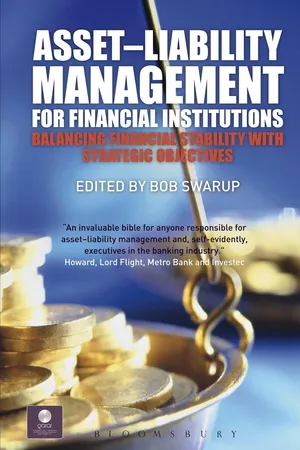
eBook - ePub
Asset–Liability Management for Financial Institutions
Balancing Financial Stability with Strategic Objectives
- 224 pages
- English
- ePUB (mobile friendly)
- Available on iOS & Android
eBook - ePub
Asset–Liability Management for Financial Institutions
Balancing Financial Stability with Strategic Objectives
About this book
Information
Analyzing a Bank’s Financial Performance
Accounting, Audit and Consulting Professional, Philadelphia, Pennsylvania, USA
This Chapter Covers

Introduction
Individually and collectively, the financial health of banks and the banking system is critical to national and global economies. Central banks or other regulators in various countries monitor financial institutions using rating and evaluation systems that may be unique to those countries. However, there are certain common measures of financial performance and the safety and soundness of a financial institution. No one measure, by itself, is an indicator of the financial health of a bank. It is important to understand each and the interplay among all or many of these measures to properly evaluate a bank’s financial performance.
Analyzing a Bank’s Financial Performance
It is necessary to understand the composition of a bank’s basic financial statements (this is itemized in detail in the Appendix to this chapter) and the business of banking (described in the section “Earnings” below). It is difficult to analyze a bank’s financial performance merely by looking at financial information at a particular point in time. Essential to this analysis is a review of how similar components of a bank’s financial information have trended over time, compared to its own past performance as well as the performance of its peers.
Common measures of financial performance are capital adequacy, asset quality, liquidity, earnings, management capability, risk management, and critical key ratios that serve as tools to analyze a bank’s financial performance.
Common Measures of Financial Performance
Capital Adequacy
How do banking regulators measure, evaluate, and rate the quality of a bank’s financial stability or, in industry parlance, the safety and soundness of a bank? Capital adequacy is a keystone. The Basel Committee on Banking Supervision of the Bank of International Settlements (BIS) has established minimum capital standards that are widely followed by banks across the world. (In September 2010 higher global minimum capital standards were announced that will be phased in over a period of time.) Capital adequacy is generally measured in the following categories.
Capital adequacy helps to sustain a bank’s growth and protect it from the consequences of the risks represented by its various lines of business. For instance, if a bank makes a strategic decision to expand its lending operations in a new geography, it will need to ensure that any impairment losses inherent in the new operations can be adequately absorbed by retained earnings while still maintaining healthy capital ratios.
These ratios are a necessary disclosure in any bank’s financial statements. Once a bank’s key capital ratios start to hover near or sink below the minimums required, alarm bells sound, hinting to analysts and regulators that the financial institution requires closer monitoring. In the United States, starting in 2009, peaking in 2010, and continuing today have been numerous bank failures that resulted in closure by the Federal Deposit Insurance Corporation (FDIC). A common thread among these failures is credit losses so excessive that they eroded retained earnings, and hence capital, to below the minimum or to such critically deficient levels as to threaten the very existence of the financial institution. Analyses of several of these bank failures can be read on the FDIC’s website (see More Info section at the end of the chapter).
Asset Quality
The asset quality measure largely addresses the quality of the loans and advances of a bank, although the quality of investment securities has also come into play. While all banks have credit policies that provide a framework within which the bank limits its lending operations, the varied nature of the loans made by a bank, the vast geographies over which they are spread, the varied nature, characteristics, and demographics of the borrowers, and the collateral underlying the loans present risks of nonperformance and collectability that are difficult to measure and quantify. Hence, credit risk is among the most critical risks that a financial institution must manage. Banks must necessarily have risk management systems in place to continuously monitor their loan portfolios.
The notes to a bank’s financial statements detail a bank’s credit risk management policies, the types of loans it makes, policies related to when nonperforming loans (NPLs) are placed on nonaccrual status (usually at 90 days of delinquency), charge-off (write-off as losses) policies, when loans are deemed impaired, policies related to the evaluation and measurement of impaired loans, and what factors are considered by the bank in establishing reserves (or allowances) for credit impairment and losses. Key asset quality ratios include the following.
Liquidity
At any given point in time, a bank must have the necessary funds to make loans and advances to borrowers, meet the demands of customers for deposit withdrawals, and pay other obligations. Although a bank can project some of these requirements based on loan commitment...
Table of contents
- Cover Page
- Title Page
- Contents
- Introduction by Bob Swarup
- Contributors
- The Big Challenges
- The Impact of Financial Crisis
- The Importance of Detail
- Notes
- Imprint
Trusted by 375,005 students
Access to over 1.5 million titles for a fair monthly price.
Study more efficiently using our study tools.
Frequently asked questions
Yes, you can cancel anytime from the Subscription tab in your account settings on the Perlego website. Your subscription will stay active until the end of your current billing period. Learn how to cancel your subscription
No, books cannot be downloaded as external files, such as PDFs, for use outside of Perlego. However, you can download books within the Perlego app for offline reading on mobile or tablet. Learn how to download books offline
Perlego offers two plans: Essential and Complete
- Essential is ideal for learners and professionals who enjoy exploring a wide range of subjects. Access the Essential Library with 800,000+ trusted titles and best-sellers across business, personal growth, and the humanities. Includes unlimited reading time and Standard Read Aloud voice.
- Complete: Perfect for advanced learners and researchers needing full, unrestricted access. Unlock 1.5M+ books across hundreds of subjects, including academic and specialized titles. The Complete Plan also includes advanced features like Premium Read Aloud and Research Assistant.
We are an online textbook subscription service, where you can get access to an entire online library for less than the price of a single book per month. With over 1.5 million books across 990+ topics, we’ve got you covered! Learn about our mission
Look out for the read-aloud symbol on your next book to see if you can listen to it. The read-aloud tool reads text aloud for you, highlighting the text as it is being read. You can pause it, speed it up and slow it down. Learn more about Read Aloud
Yes! You can use the Perlego app on both iOS and Android devices to read anytime, anywhere — even offline. Perfect for commutes or when you’re on the go.
Please note we cannot support devices running on iOS 13 and Android 7 or earlier. Learn more about using the app
Please note we cannot support devices running on iOS 13 and Android 7 or earlier. Learn more about using the app
Yes, you can access Asset–Liability Management for Financial Institutions by Bob Swarup in PDF and/or ePUB format, as well as other popular books in Business & Business General. We have over 1.5 million books available in our catalogue for you to explore.