Is your business as profitable as it could be? How can you rise above your competition, and stay there once you have? Most management tools only look at one part of the picture, but Business Performance Excellence (BPE) is the complete model, integrating revolutionary new techniques with tried and tested approaches, covering the strategic, financial, systems, and human factors.
The editors are experts in business performance improvement, and this approachable book presents the latest thinking and developments in the BPE model that has been enhanced and refined over the course of 30 years. The comprehensive case studies and worked examples presented can be applied to your business whatever your industry, benefiting your bottom line. Detailed coverage includes:
* Strategic planning and hoshin kanri
* Customer product rationalization
* Restructuring and recalibrating
* Customer quality assurance systems
* The balanced scorecard
* Critical performance measures
* Benchmarking
* Financial performance turnaround
* Lean manufacturing
* Creating value through people
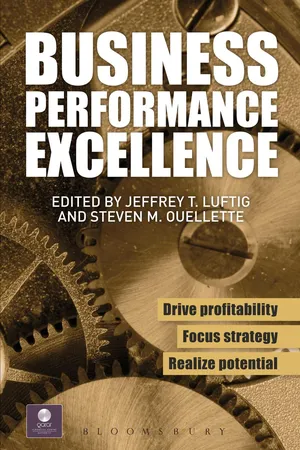
eBook - ePub
Business Performance Excellence
- 240 pages
- English
- ePUB (mobile friendly)
- Available on iOS & Android
eBook - ePub
Business Performance Excellence
About this book
Information
Hoshin Kanri: Deploying Your Strategic Intents to Achieve Business Excellence
Lockheed Martin Engineering Management Program, College of Engineering and Applied Science, University of Colorado, Boulder, USA
This Chapter Covers

Introduction
Many companies strive to be the best in their market. Most never succeed. Many of those that do, do so only temporarily, and subsequently lose their position through misunderstanding how they got there and what is needed to stay there. Very few, as Jim Collins (2001) has stated, are capable of going from “good to great.”
Companies that achieve, and subsequently maintain, business excellence have a number of traits in common. One of the most fundamental, though, is that the company has a vision of where it is going and everyone there knows what they need to do in order to support the company’s objectives.
This does not happen by accident. The first phase in attaining business performance excellence is the process of strategic planning and policy deployment. In this chapter we will demonstrate a proven method called hoshin planning (also referred to as “policy deployment”), a process that is designed for identifying and deploying activities in order to make progress toward business performance excellence.
The outcome of an effective hoshin planning process is hoshin kanri, a Japanese phrase that means “controlling the compass” and which is interpreted to refer to the actions needed to align everyone in an organization to achieve the company’s goals (Akao, 1991). In the absence of companywide direction, cascaded through the organization, each person in the company has no alternative but to guess at what they should work on to add value. Using hoshin planning, employees know exactly what to do and how that supports the company’s objectives.
Strategic Planning in the Absence of Hoshin
In our experience, most companies perform strategic planning in exactly the reverse order that they should. The second author has experience of an organization that had just been through a large-scale and expensive strategic planning session. The results certainly looked impressive—a 20-page brochure with beautiful four-color photographs and a professionally designed layout on glossy paper. On closer examination, however, although each page corresponded to what each area or discipline was going to work on that year, there was no unifying theme and no direction for the organization as a whole.
In this case, the strategic planning had been done by first asking each discipline to identify its SWOTs—strengths, weaknesses, opportunities, and threats. Each disparate division had done so, and from there found a number of strengths to leverage, weaknesses to improve, opportunities to exploit, and threats to avoid—and metrics to measure all of that. There was, however, no integration showing how these divisions were going to work toward a common goal, or how they would support one another on their path to excellence. Instead, each area focused on its own expertise, working on what it thought it should rather than on what the organization as a whole needed. With disparate goals such as these, divisions compete for resources and upper-level attention and the organization as a whole makes little or no progress toward an objective. In fact, in such a situation there is no objective for them to make progress toward.
We will define the proper strategic planning process in general terms first, and then follow up with a real-world case study of a business in need of a major turnaround in order to survive.
The Strategic Planning Process
Step 1: Who Are We?
In order to arrive at a destination, it is a good idea to know where you are going first. Yet many businesses have, at most, a plan for the future that consists of trite phrases that no one really believes influences policy. At worst, these statements are a cruel joke: for example, “People are our most important resource” in the face of downsizing. Is it any wonder that companies fail to arrive at success if they have never defined what success looks like?
The first step of strategic planning is to answer the questions: “Who are we, where are we going, what will we look like when we arrive, and how are we going to get there together?” These four questions are answered by four main statements: the vision, the mission, the value proposition, and the method of strategic differentiation.
The Vision
In our terminology the vision is not an empty statement of ideals, but a statement of how we define our success. The vision is a word-picture of where the organization will be in 10 or 15 years—a description of the destination that will result in the measures that will let us know if we are there.
The Mission
The mission is a statement about what milestone(s) we will accomplish and measure over the next three to five years in order to make progress toward the vision. If the vision is the destination, the mission identifies signposts along the way that will tell us we are on track.
The Value Proposition
The value proposition is why our customers give us money. This requires a clear-eyed understanding of what exactly our customers expect and how we get it to them. A value proposition should be focused on and be appealing to your customers. A value proposition that resonates with management more than with customers is a recipe for disaster.
The Method of Strategic Differentiation
The authors favor Treacy and Wiersema’s (1993) model of how companies differentiate themselves from their competition. This provides a clear objective for the company: excel in one area while maintaining parity in the others.
Step 2: What Do We Measure?
Now that we know where we are going, we can examine the words that we used to identify what to measure so we can know the current performance of the company in those areas that are necessary to achieve the vision.
Construct Analysis
Construct analysis is the means we use to identify themes in the words chosen to describe our destination and turn them into measurements. Constructs describe—even to an external observer—how the company will appear if successful. Words or terms such as “recognized (as),” “dominate,” “safe(ty),” “reliable,” and “quality” describe common constructs in vision, mission, and value proposition statements. This step prevents empty slogans, since measurements drive behavior and the flow of resources. This encourages the organization to use the vision, mission, and value proposition statements to make management and resource decisions.
Metrics Cascade
Once the construct analysis has defined the measures of success for the organization (level I metrics), these measures must be translated to every level of the organization. A CEO is not likely to achieve his or her metrics if no one else in the company knows how what they do relates to those metrics. A useful tool for this translation is a control matrix that shows the relationship of each management level to the next level down, similar to a quality function deployment (QFD) matrix.
During the creation of the metrics, the owner of the companywide level I metrics challenges his or her direct staff (level II) to come up with measures for their areas of responsibility and within their span of control that relate to the level I metrics. This negotiation takes place at each level of the company, until every individual has an opportunity to propose output metrics for their area of responsibility. This step ensures that everyone knows what to measure and how it ...
Table of contents
- Cover
- Title Page
- Contents
- Introduction: The Origins and Structure of the Original Model for Business Performance Excellence (BPE) by Jeffrey T. Luftig and Steven Ouellette
- Contributors
- Strategic Planning and Policy Deployment
- Finance and Cost Reduction
- Systems and Tools in Business Performance Improvement
- Ethics and Creating Value through Employee Management
- Imprint
Trusted by 375,005 students
Access to over 1.5 million titles for a fair monthly price.
Study more efficiently using our study tools.
Frequently asked questions
Yes, you can cancel anytime from the Subscription tab in your account settings on the Perlego website. Your subscription will stay active until the end of your current billing period. Learn how to cancel your subscription
No, books cannot be downloaded as external files, such as PDFs, for use outside of Perlego. However, you can download books within the Perlego app for offline reading on mobile or tablet. Learn how to download books offline
Perlego offers two plans: Essential and Complete
- Essential is ideal for learners and professionals who enjoy exploring a wide range of subjects. Access the Essential Library with 800,000+ trusted titles and best-sellers across business, personal growth, and the humanities. Includes unlimited reading time and Standard Read Aloud voice.
- Complete: Perfect for advanced learners and researchers needing full, unrestricted access. Unlock 1.5M+ books across hundreds of subjects, including academic and specialized titles. The Complete Plan also includes advanced features like Premium Read Aloud and Research Assistant.
We are an online textbook subscription service, where you can get access to an entire online library for less than the price of a single book per month. With over 1.5 million books across 990+ topics, we’ve got you covered! Learn about our mission
Look out for the read-aloud symbol on your next book to see if you can listen to it. The read-aloud tool reads text aloud for you, highlighting the text as it is being read. You can pause it, speed it up and slow it down. Learn more about Read Aloud
Yes! You can use the Perlego app on both iOS and Android devices to read anytime, anywhere — even offline. Perfect for commutes or when you’re on the go.
Please note we cannot support devices running on iOS 13 and Android 7 or earlier. Learn more about using the app
Please note we cannot support devices running on iOS 13 and Android 7 or earlier. Learn more about using the app
Yes, you can access Business Performance Excellence by Jeffrey T. Luftig, Steven M. Ouellette, Jeffrey T. Luftig,Steven M. Ouellette in PDF and/or ePUB format, as well as other popular books in Business & Business General. We have over 1.5 million books available in our catalogue for you to explore.