This book has been designed on the premise of 3 Cs – Comprehensive, Conceptual Clarity and Concise. Authors have given special attention to work upon the speed and accuracy of the students through development of logical methods to understand the concepts, thought process enrichment of mind and short cut techniques to solve a question. There are ample numbers of typical questions from all the concepts essential for IBPS Bank PO examination given in the book. To assess one's preparation level, previous years papers and mock papers are appended both in the book and attached CD.
CD provides timer based test papers with state-of-the-art analysis of individual's performance that will help the students tame the examination successfully.
USPs
1. Comprehensive coverage of all the topics
2. A large number of worked-out examples and practice questions with solutions
3. Contains tricks and techniques with explanations – for faster solving of questions
4. CD containing five test papers with timer and analysis
Previous years' papers and mock papers for practice
- 282 pages
- English
- ePUB (mobile friendly)
- Available on iOS & Android
eBook - ePub
IBPS Bank PO Quantitative Aptitude Guide
About this book
Trusted by 375,005 students
Access to over 1.5 million titles for a fair monthly price.
Study more efficiently using our study tools.
Information
Edition
1  | Intro to Numbers |
Number is “a numeral or group of numerals”. For Bank PO exams, we will confine ourselves with Real Numbers only.
Real Number Tree:
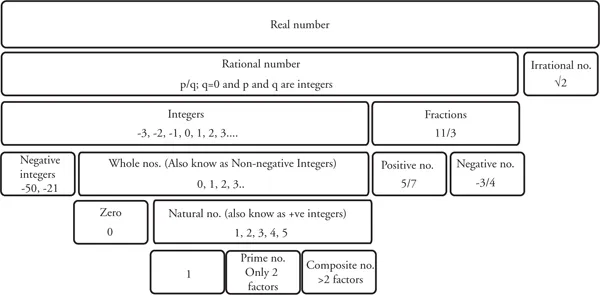
Notes - All the real numbers are either a rational number or an irrational number. No real number can be both a rational number and an irrational number.
Types of Rational numbers - (i) All the integers, (b) Terminating Decimals, (c) Recurring numbers.
All the real numbers other than Rational numbers are Irrational numbers.
Note - π is an Irrational Number, though  |
Some important properties related to numbers:
| 1. | Odd ± Odd = Even | Even ± Even = Even |
| Odd ± Even = Odd | Even ± Odd = Odd | |
| (Odd) Even = Odd | (Even) Odd = Even | |
| Odd × Even = Even | Odd × Odd = Odd | |
| Even × Even = Even |
2.All the prime numbers greater than 3 are of the format 6N ± 1. It means that all the prime numbers will give either a remainder of +1 or -1 when divided by 6.
3.(xy – yx) = 9 × (x-y) [where xy is a two digit number and yx is obtained by reversing it] For example, 51 – 15 = 9 × (5-1) = 36
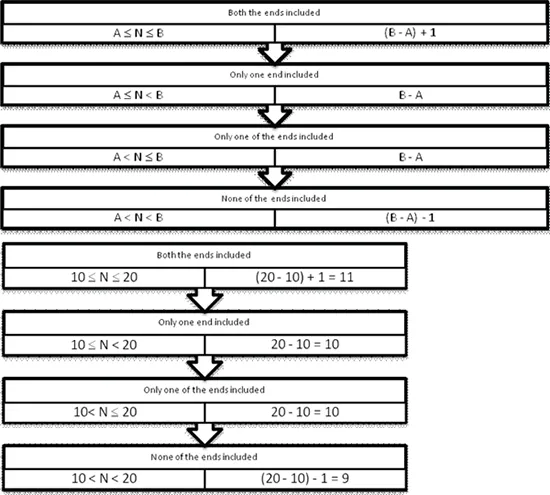
4.Counting of Numbers in any Range:
If N is a natural number, number of natural numbers in the range:
If N is a natural number, number of natural numbers in the range:
Divisibility Rules
Divisibility Rules:
Divisible by 2 – If unit digit of the number is 0, 2, 4, 6 or 8.
Divisible by 3 - If sum of digits of the number is divisible by 3.
Divisible by 4 - If last two digits of the number is divisible by 4.
Divisible by 5 - If last digit of the number is either 5 or 0.
Divisible by 6 - If last digit of the number is divisible by two and sum of all the digits of no. is divisible by 3.
Divisible by 8 - If last 3 digits of the number is divisible by 8.
Divisible by 9 - If sum of digits of the number is divisible by 9.
Divisible by 10 – If the unit digit of the number is 0.
Divisible by 11 - If the difference between the sum of the digits at the even places and the sum of the digits at the odd places is divisible by 11(zero is divisible by 11).
For example - 4553109 is divisible by 11 as the difference of 4 + 5 + 1 + 9 = 19 and 5 + 3 + 0 = 8 is 11.
Divisible by 12 – If the number is divisible by 3 and 4, then the number will be divisible by 12.
Divisible by 16 - if the number formed by the last 4 digits of the given number is divisible by 16.
Unit Digit
Following results are true for unit digit:
(i) (Any digit)4n+1 = Same digit will be obtained
Example – Unit digit of 853 = 8, or, Unit ...
Table of contents
- Cover
- Half Title
- Title Page
- Copyright
- Contents
- 1. Intro to Numbers
- 2. LCM and HCF
- 3. Percentage
- 4. Profit and Loss
- 5. Simple Interest and Compound Interest
- 6. Ratio Proportion and Variation
- 7. Average
- 8. Time and Work
- 9. Pipes and Cisterns
- 10. Boats and Streams
- 11. Trains
- 12. Time Speed and Distance
- 13. Equation
- 14. Permutations and Combinations
- 15. Probability
- 16. Geometry
- 17. Mensuration
- 18. Set Theory
- 19. Quantitative Aptitude – Year 2014
- Quantitative Aptitude – Year 2013
- 20. MOCK QA Test 1
- MOCK QA Test 2
- MOCK QA Test 3