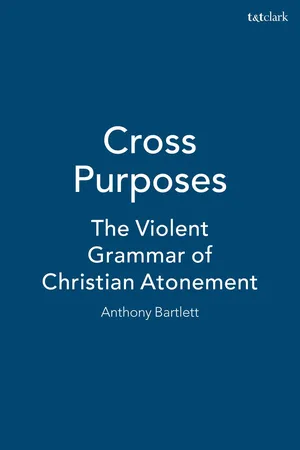
This seminal study of the Christian theory of the atonement examines the story of Christian violence. In Cross Purposes, Anthony Bartlett claims that the key Western doctrines of atonement have been dominated by a logic of violence and sacrifice as a means of salvation. Subsequently, the graphic suffering of the crucified in images and narrative has served to unleash a prolonged sacrificial crisis in which there is always a potential need to displace blame. These doctrines of atonement have sanctioned wide-spread violence in the name of Christ throughout history.
But Bartlett argues that a minority tradition also exists. He contends that the tradition of the compassion of Christ provides the possible way out of Christian violence. Bartlett's study gives this tradition a dynamic new reading, showing how it undoes both divine and human violence and offers a powerfully transformative version of atonement for the contemporary world. Cross Purposes provides a rich historical and theological overview of the evolution of various atonement theories, using literature, art, and philosophy to provide a creative and provocative reading of Christian atonement.
Anthony Bartlett is engaged in post-doctoral research and is an instructor in Religion at Syracuse University.
For: Seminarians; clergy; graduate students; professors
- 288 pages
- English
- ePUB (mobile friendly)
- Available on iOS & Android
eBook - ePub
About this book
Information
Chapter One
THE ABYSS THAT IS NOT YET LOVE
The scene is Thompson’s Children’s Home in the Episcopal Diocese of North Carolina. Robyn was there with the kids to celebrate their Children’s Sabbath. She had the opportunity to sit for dinner with some of the boys, between ages of seven and eleven. Usual dinner conversation, favorite games, favorite subjects in school, favorite books, favorite food, spaghetti of course! While they were talking Cameron, who sat on her right, took a copy of the New Testament out of his pocket and said, “That is my favorite book.” Then he looked up at Robyn and asked, “Do you know why Christ died?”
After a quiet pause, she responded, “Cameron, why did Christ die?” He said, “Because no one else but God’s Son could die for all the meanness, all the anger, all the hatred in the world.” Robyn later learned that Cameron had no one. Neither mother or father, nor aunts or uncles, not even his grandparents, could or would care for him. Cameron’s story also included the facts that he had been asked to leave ten public schools and he was only seven years old.
From the Rev. Robyn Szoke,
Episcopal Office of Children’s Ministries,
New York, N. Y.
What is the meaning of the cross? What is the nucleus of human and divine affairs represented there, out of which Christianity has always made the astonishing statement “Christ died for us.” Traditional answers deeply formative for Western culture—and formed themselves out of raw material that lie culturally prior to the Gospels—will be the subject of critique in the next chapter. Here let me immediately propose a nontraditional answer. My basis for this is twofold. First, theological tradition on this question is decisively not a matter of dogma, but rather a pith of cultural themes that crystallize around the cross and become, apparently, second nature to it. And, second, we are currently in a very nontraditional situation.
A way to express this contemporary situation, and therewith the possibility of a new, radical understanding of the cross, is via a metaphor, a term, a reference that seems at first sight negative, but will over the course of this work prove itself deeply positive. It is that of the abyss. Our modern or postmodern situation can justly be construed in and by the image of the abyss. The gospel event of the cross may be understood to take place in the human abyss—the depth of injustice, meaninglessness and horror it can sink to—indeed, to reveal it to humanity. And at the same moment a redemption by the cross may be glimpsed to arise in the abyss, to change it from within into a place of radically new possibility, to effect an absolute novelty of human selfhood. The final and true referent of this term, its resting place, therefore, is not a darkness, a chasm, a pit in the heart or the world. On the contrary, it is the active moment itself of the gospel, a moment, until then unimaginable, of life, of hope. It is the act or moment of abyssal compassion, much more a verb than a noun, in the sense of moment as movement. This is the real starting point of these reflections, and without it the concept of the abyss is of course intolerable.
A GEOMETRY OF THE ABYSS
Let me propose a kind of geometry of our contemporary abyss, composed of four cardinal points or headings. These headings are chosen with reason, and although I do not think it is impossible to describe things in any other way, I do believe they gather together most of what is urgently at issue in our contemporary Western world. They are abandonment, violence, philosophical postmodernism, and the gospel account of Jesus itself. This chapter will consist of a synoptic description of these points, followed by a theoretical background that then serves to bring them to a historical-cultural depth of remarkable force. Even as this picture takes shape the positive, creative role of the cross as a work of the abyss can begin to emerge. Here, then, is an understanding of atonement, of the work of salvation, that responds intimately to the crisis of the world and of the time in which we live.
Abandonment resonates with the experience of being left behind, of calling out and not being heard, of no longer playing a significant role in life socially, economically, or emotionally. It is that of a child who feels that her parents no longer hold her as visible and valuable. Or of a worker with no work, or whose job is oppressive and for whom there is no way out. Of a socially excluded group whose very skin is sick with exclusion and yet a terrible desire to restore itself in the face of the excluders. Of a partner whose beloved no longer accepts the offer of love, or for whom the emotion of love collapses, it seems, from within. Of the countless poor of the earth, the Third World or the South, whose faces of dereliction are paraded daily on our TV screens, but whose structural relationship with Western wealth and well-being is never a cause for serious reflection. And all this takes place within a world that presses ahead with irresistible force, displaying overwhelming technical and material mastery, as it releases a Babel of information and a jackpot of commodities, continually erasing reflection and memory, merging the cry of abandonment seamlessly with the voice-over of the car salesman.
Within the context of Western culture it is the experience documented by Douglas Coupland, the prophet of end-of-twentieth-century young adulthood, Generation X. Coupland inhabits a landscape of fractured and fragmented relationships, within a larger physical landscape that once had religious meaning but now seems to be empty. The evacuation of God from the world has of course being going on much longer at the level of philosophical culture, but one of the things Coupland registers is the way the material culture effectively deputizes for any sense of transcendent presence in the cosmos, and helps to establish its absence. Matthew Arnold’s “sea of faith” become a “long, withdrawing roar” has now been substituted by a storm of commodities, of electronic entertainment, of virtual communication. As the narrator of Life After God reports, the cascade of stations picked up by the car radio seek button surges with “those fragments of cultural memory and information that compose the invisible information structure I consider my real home—my virtual community.”1 The function of computers and the World Wide Web confirms again and deepens both the torrent of information and the disintegration of more traditional human memory. Fragments of memory are also in typical disjunctive continuity with fast food, fast cars, money, mobility. Fast military jets, each of which may carry the end of the world, puncture the sky with childhood fears jarred into the moment. War as the abolition of life itself forms an antistructure beneath the world. Solitude fills the heart.
There is no escaping a terminal loneliness at the bottom of the culture, the enigma of human time that seeks the wholeness of intimacy and yet is threatened by catastrophic interruption at every moment. It is not simply the physical fact of the bomb. Or the social fact of marriage relationships ending so frequently in divorce. Or then the threat of AIDS transforming sexual relations into a worldwide vehicle for fatal illness. It is the very possibility of relationship itself that for Coupland is in doubt. People come, people go. Couples “fall” out of love. They simply wake up and no longer love. Siblings disappear without a trace. Children are spread out over households divided sometimes by huge distances. And the past when there seemed to be love remains in memory as a ghost of itself. Only the car radio provides a constant; and that is also filled, alongside everything else, with fervent evangelism. It is the confident gospel of “Jesus saves” that confronts the culture with a literal (and here we should really read authoritarian) version of Scripture and takes its place without complication next to adverts for hair products, cars, and Jacuzzis. As the bumper sticker says, “Got Jesus?” But Coupland’s narrative is also affected by the sincere change that seems to have been worked in lives touched in this way. He poignantly asks himself, “What was it that these radio people were seeing in the face of Jesus?”2
We might therefore at once intuit that the figure of Jesus does in fact coexist with the abyss of human abandonment—at least as a question, and with that a possibility. But, before we move ahead too quickly, it is essential to underline that as far as the heading itself of abandonment is concerned, it is not to be interpreted morally, as if a generation, or any alienated individual, somehow culpably missed out on a vital element in becoming a person. What I have described is an objective condition of cultural history, one of profound human displacement or loss, something with analogies in any culture or period of history, including the time and place in which Jesus lived. What is special here is the way in which an intensely developed material culture both produces a mode of being in the world that appears to soak up the need for transcendence in the human soul, and simultaneously plunges the individual into an experience of utter helplessness, tantamount to not being at all. If the individual for one reason or another falls below the continuum of fragments, if he or she fails to make the next connection, the next deal, to inhabit the next virtual structure of meaning, then that person is in the abyss, without recourse. The abyss of nonrelationship lies just below the surface of contemporary Western culture.
When I was younger I used to worry so much about being alone—of being unlovable or incapable of love. As the years went on, my worries changed. I worried that I had become incapable of having a relationship, of offering intimacy. I felt as though the world lived inside a warm house at night and I was outside, and I couldn’t be seen—because I was out there in the night. But now I am inside the house and it feels just the same.3
Violence is the second heading in order. Here introductory comment is hardly necessary, for violence erupts with visceral force that does not so much stake out conceptual explanation in advance but seeks it in the shock of aftermath. This is particularly true of the exponential violence of the twentieth century, with its horrors that seem to exceed the frame of any possible rationality: the gulag, the Nazi holocaust, Hiroshima, and then, in its dying years, Bosnia and Rwanda. These names are invoked not at all for shock value, as if their mind-numbing power would precipitate of itself an apprehension of the abyss. On the contrary, they do indeed fit, in their very excessiveness, a theoretical background shortly to be outlined. To headline them here is to anticipate that understanding: it is to say that incommensurable violence is very much a human capacity, and the story of Western culture seems to have a terrible capacity to spark it into flame.
We can specify two instances that straddle a spectrum of Western experience. In 1994, close to one million people were killed in a planned and systematic genocide in the Central African country of Rwanda. How did this carnage occur when the world declared after World War II that it would never again allow such things to happen? And how did it take place in a country that since the early part of the century had been in the hands of Christian missionaries and educators, the White Fathers, under the aegis of Belgian colonial authorities? Without going into an extended account it seems evident, as Amnesty International claims, that the Belgian system of colonial rule sowed the seeds of Rwanda’s future discontent.4 Yet apart from divisions between Tutsis and Hutus entrenched and exacerbated by colonial adminstration, there is the sheer scale of the killings, involving careful planning, systematic propaganda, and organization and efficiency of execution, that somehow matched on the continent of Africa patterns set in Europe. How much of this was learnt, imitated? How much was the spontaneous result of hatred built up over the course of the century that exploded in such a “modern” way simply because the tools were at hand? And is there a real difference, at root, between sequential and parallel? Modern conditions that permit such enormities are a product of modernity, a Western cultural invention, and it is this very modernity, with its simultaneous expertise and loss of inherited boundaries, that is very much the environment of the abyss. Western political powers will always feel obliged to prevent this horror they know intimately from within, but even given the integrity and energy to do so, loss of attention is surely the pendulum swing of eternal vigilance. Perhaps the truly terrifying thing about Rwanda is that it suggests the unthinkable has become possible, again and again
The other instance is the events of Columbine, and the sequence of high school massacres in the United States over the last decade, for which they provide the horrifying emblem. In less than fifteen minutes on a sunny spring day in April 1999, two student gunmen killed thirteen and wounded twenty-one in a suburban high school in Jefferson County, Colorado, before they turned the guns on themselves—the most devastating school shooting in U.S. history. How could such things happen in the heartland of the most privileged country in the world, and among children who—typically in these instances—are not divided by race or class, and certainly not by inherited colonial grudges? Popular-media reporting in the U.S. frequently asks this helpless question as the terminus of comment. The formally excessive nature of the events makes it inadequate simply to point to civilian access to arms, disruption in the family, or violence in the media, although doubtless these are issues that play somehow into the larger question. Rather, these events stand as a surd in the cultural scene, a mark beyond which one cannot go, where explanation lapses into inarticulacy. The real point of significance is the inarticulacy and helplessness: that, parallel to the incommensurability of Rwanda, there is a home-grown incommensurability, smaller in scale but equal (and perhaps more than equal) in excess over cause. Are we not faced here with the possibility that violence is itself significant, not that it requires significance to be given it? That at certain points where abandonment, in one form or another, feels that it has lost all possibility of speech, of ordered social communication, then violence becomes a terrible new speech, a new foundation of meaning? Is there not the awful possibility that even at the expense of countless victims, or rather precisely because of these come-what-may victims—and including therein the loss of your own life—it is “worth it” in order to give birth to a new universe, your universe. Children and young people do not really need this to be taught them. Pushed to the edge of human reality by the processes of Western abandonment, they somehow “know” that transcendent violence is the only solution. Is this not a glimpse of the abyss?
A third heading or dynamic point is philosophical postmodernism, and its strategy known as “deconstruction.” A representative picture of what this implies is given by Mark C. Taylor. He summarizes the condition of philosophy arrived at in the contemporary era as “the death of God,” “the disappearance of the self,” “the end of history,” and “the closure of the book.”5 Probably an even more provocative way of stating this situation comes from the paladin of deconstruction, Jacques Derrida. It is the non-definable concept of “dissemination”: this metaphor of the working of a text, in itself a nonreference, illustrates both the way meaning is spread through a text as a kind of violent insemination of itself (with the sexual overtone intended), and simultaneously rendered void of its power by the very opening up of the word—dis-semination—to its (patriarchal) “seminal-semantic” content. The semen of meaning can never be recovered in a cup of truth, in some fixed holding of the substance of life. Its ejaculation is always sterile, always self-inseminating, disappearing with only the trace of its empty movement, never fertilizing a beginning or an...
Table of contents
- Cover
- Title Page
- Dedication
- Contents
- Introduction
- 1. The Abyss That Is Not Yet Love
- 2. Imitatio Diaboli
- 3. The Warrior Christ and His Pity
- 4. Repetition, Rhetoric, and Compassion
- 5. Cross Talk: Hermeneutics of the Death of Jesus of Nazareth
- 6. Jesus, Time and Again
- Conclusion
- Index
- eCopyright
Trusted by 375,005 students
Access to over 1.5 million titles for a fair monthly price.
Study more efficiently using our study tools.
Frequently asked questions
Yes, you can cancel anytime from the Subscription tab in your account settings on the Perlego website. Your subscription will stay active until the end of your current billing period. Learn how to cancel your subscription
No, books cannot be downloaded as external files, such as PDFs, for use outside of Perlego. However, you can download books within the Perlego app for offline reading on mobile or tablet. Learn how to download books offline
Perlego offers two plans: Essential and Complete
- Essential is ideal for learners and professionals who enjoy exploring a wide range of subjects. Access the Essential Library with 800,000+ trusted titles and best-sellers across business, personal growth, and the humanities. Includes unlimited reading time and Standard Read Aloud voice.
- Complete: Perfect for advanced learners and researchers needing full, unrestricted access. Unlock 1.5M+ books across hundreds of subjects, including academic and specialized titles. The Complete Plan also includes advanced features like Premium Read Aloud and Research Assistant.
We are an online textbook subscription service, where you can get access to an entire online library for less than the price of a single book per month. With over 1.5 million books across 990+ topics, we’ve got you covered! Learn about our mission
Look out for the read-aloud symbol on your next book to see if you can listen to it. The read-aloud tool reads text aloud for you, highlighting the text as it is being read. You can pause it, speed it up and slow it down. Learn more about Read Aloud
Yes! You can use the Perlego app on both iOS and Android devices to read anytime, anywhere — even offline. Perfect for commutes or when you’re on the go.
Please note we cannot support devices running on iOS 13 and Android 7 or earlier. Learn more about using the app
Please note we cannot support devices running on iOS 13 and Android 7 or earlier. Learn more about using the app
Yes, you can access Cross Purposes by Anthony Bartlett in PDF and/or ePUB format, as well as other popular books in Theology & Religion & Christian Theology. We have over 1.5 million books available in our catalogue for you to explore.