eBook - PDF
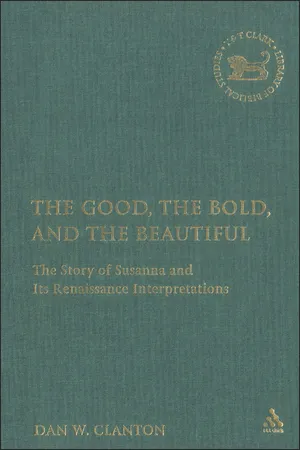
The Good, the Bold, and the Beautiful
The Story of Susanna and its Renaissance Interpretations
- 222 pages
- English
- PDF
- Available on iOS & Android
eBook - PDF
The Good, the Bold, and the Beautiful
The Story of Susanna and its Renaissance Interpretations
About this book
The story of Susanna and the Elders is one of the most interpreted and reproduced tales from the Apocrypha, and for good reason. In its compact narrative, it touches on attempted rape, female sexuality, abuse of power, punishment for the wicked, and voyeurism. The Good, the Bold, the Beautiful argues that the story of Susanna was written in the first century BCE, and Clanton provides a brief description of that century. He performs a narrative-rhetorical reading of Susanna and illustrates that the story uses sexual anxiety and desire to set up a moral dilemma for Susanna. That moral dilemma is resolved in two ways: Susanna's refusal to allow herself to be raped, and Daniel's intervention. Clanton argues that although the story has many mimetic features, it is the thematic function that is overriding, especially after Daniel's appearance. Put another way, the story's emphasis on Susanna, the Elders, and Daniel as "plausible people" is secondary to its stress on what those characters represent and the message it is relaying through those representations. Clanton analyzes chronologically selected aesthetic interpretations of the story found in the Renaissance. He shows that the prevailing artistic interpretation during the Renaissance focused on the mimetic, sexual aspects of the story because it deals with issues of patronage, and sex/gender that were current at the time. The Good, the Bold, the Beautiful argues that several Renaissance renderings provide counter readings that focus more on the value and themes in the story. These renderings provide models for readers to resist the sexually exploitative features of both the narrative and its interpretations. Clanton reflects on the need for the reader to resist potentially harmful interpretation, especially those that focus on the mimetic level of the story's rhetoric.
Information
Table of contents
- Contents
- List of Figures
- Acknowledgments
- Part I: SUSANNA IN BIBLICAL LITERATURE, CULTURE, AND HISTORY
- Part II: SUSANNA IN LITERATURE, ART, MUSIC, HISTORY, AND SOCIETY DURING THE RENAISSANCE
- Part III: CONCLUSION(S) AND APPENDICES
- Appendix 1 TRANSLATION OF SUSANNA (TH)
- Appendix 2 SELECTED WORKS BASED ON SUSANNA DURING THE RENAISSANCE
- Appendix 3 TRANSLATION OF "SUSANNE UN JOUR" BY GUILLAUME GUÉROULT
- Bibliography
- Index of References
- Index of Authors
Trusted by 375,005 students
Access to over 1.5 million titles for a fair monthly price.
Study more efficiently using our study tools.
Frequently asked questions
Yes, you can cancel anytime from the Subscription tab in your account settings on the Perlego website. Your subscription will stay active until the end of your current billing period. Learn how to cancel your subscription
No, books cannot be downloaded as external files, such as PDFs, for use outside of Perlego. However, you can download books within the Perlego app for offline reading on mobile or tablet. Learn how to download books offline
Perlego offers two plans: Essential and Complete
- Essential is ideal for learners and professionals who enjoy exploring a wide range of subjects. Access the Essential Library with 800,000+ trusted titles and best-sellers across business, personal growth, and the humanities. Includes unlimited reading time and Standard Read Aloud voice.
- Complete: Perfect for advanced learners and researchers needing full, unrestricted access. Unlock 1.5M+ books across hundreds of subjects, including academic and specialized titles. The Complete Plan also includes advanced features like Premium Read Aloud and Research Assistant.
We are an online textbook subscription service, where you can get access to an entire online library for less than the price of a single book per month. With over 1.5 million books across 990+ topics, we’ve got you covered! Learn about our mission
Look out for the read-aloud symbol on your next book to see if you can listen to it. The read-aloud tool reads text aloud for you, highlighting the text as it is being read. You can pause it, speed it up and slow it down. Learn more about Read Aloud
Yes! You can use the Perlego app on both iOS and Android devices to read anytime, anywhere — even offline. Perfect for commutes or when you’re on the go.
Please note we cannot support devices running on iOS 13 and Android 7 or earlier. Learn more about using the app
Please note we cannot support devices running on iOS 13 and Android 7 or earlier. Learn more about using the app
Yes, you can access The Good, the Bold, and the Beautiful by Dan W. Clanton, Jr. in PDF and/or ePUB format, as well as other popular books in Theology & Religion & Biblical Criticism & Interpretation. We have over 1.5 million books available in our catalogue for you to explore.