In the latest volume in the Emory Studies in Early Christianity series, the contributors seek a better understanding of how various biblical authors present their arguments, support their claims, and attempt to persuade their readers.
A century ago the rhetorical analysis of texts focused on the study of rhetorical figures in texts (elocutio). In the mid-twentieth century, scholars such as James Muilenburg, Hans Dieter Betz, and Wilhelm Wuellner introduced biblical scholars to the illustrious tradition of rhetorical study. These scholars tended to focus on the arrangement of the texts themselves (dispositio).
During the last ten years, however, interpreters have increasingly studied the rhetorical argumentation in texts. The authors in this volume examine rhetorical argumentation in the Hebrew Bible, the Gospels, the Pauline letters, and the Book of Revelation, offering striking new readings of these materials.
Contributors include: J. David Hester (Amador), Center for Rhetoric and Hermeneutics; R. Dean Anderson, Valkenburg, The Netherlands; Harold W. Attridge, Yale Divinity School; L. Gregory Bloomquist, St. Paul University, Ottawa; Michael R. Cosby, Messiah College; Rodney K. Duke, Appalachian State University; Frans H. van Eemeren, University of Amsterdam; Anders Eriksson, Lund University; Alan J. Hauser, Appalachian State University; Roy R. Jeal, William and Catherine Booth College; Manfred Kraus, Eberhard-Karls-Universität, Tübingen; John W. Marshall, University of Toronto; Roland Meynet, Pontificia Università Gregoriana; Thomas H. Olbricht, Emeritus, Pepperdine University; Carol Poster, Florida State University; Rollin A. Ramsaran, Emmanuel School of Religion; Vernon K. Robbins, Emory University and University of Stellenbosch; Russell B. Sisson, Union College; Jerry L. Sumney, Lexington Theological Seminary; C. Jan Swearingen, Texas A & M; Lauri Thurén, Univeristy of Joensuu; Johan S. Vos, Vrije Universiteit; and Duane F. Watson, Malone College.
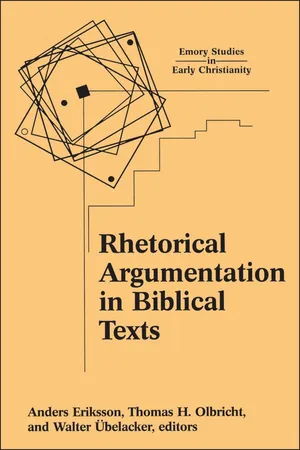
eBook - PDF
Rhetorical Argumentation in Biblical Texts
Essays from the Lund 2000 Conference
- 455 pages
- English
- PDF
- Available on iOS & Android
eBook - PDF
Rhetorical Argumentation in Biblical Texts
Essays from the Lund 2000 Conference
About this book
Information
Table of contents
- Cover
- Contents
- Preface
- Abbreviations
- Contributors
- Introduction
- Part One: Rhetorical Argumentation and Method
- Part Two: Historical Background
- Part Three: Rhetorical Argumentation in the Hebrew Bible
- Part Four: Rhetorical Argumentation in the Gospels
- Part Five: Rhetorical Argumentation in the Pauline Letters
- Part Six: Rhetorical Argumentation in Hebrews
- Part Seven: The Rhetoric of Apocalyptic and Romance
- Bibliography
- Index of Ancient Texts
- Index of Subjects and Authors
Trusted by 375,005 students
Access to over 1.5 million titles for a fair monthly price.
Study more efficiently using our study tools.
Frequently asked questions
Yes, you can cancel anytime from the Subscription tab in your account settings on the Perlego website. Your subscription will stay active until the end of your current billing period. Learn how to cancel your subscription
No, books cannot be downloaded as external files, such as PDFs, for use outside of Perlego. However, you can download books within the Perlego app for offline reading on mobile or tablet. Learn how to download books offline
Perlego offers two plans: Essential and Complete
- Essential is ideal for learners and professionals who enjoy exploring a wide range of subjects. Access the Essential Library with 800,000+ trusted titles and best-sellers across business, personal growth, and the humanities. Includes unlimited reading time and Standard Read Aloud voice.
- Complete: Perfect for advanced learners and researchers needing full, unrestricted access. Unlock 1.5M+ books across hundreds of subjects, including academic and specialized titles. The Complete Plan also includes advanced features like Premium Read Aloud and Research Assistant.
We are an online textbook subscription service, where you can get access to an entire online library for less than the price of a single book per month. With over 1.5 million books across 990+ topics, we’ve got you covered! Learn about our mission
Look out for the read-aloud symbol on your next book to see if you can listen to it. The read-aloud tool reads text aloud for you, highlighting the text as it is being read. You can pause it, speed it up and slow it down. Learn more about Read Aloud
Yes! You can use the Perlego app on both iOS and Android devices to read anytime, anywhere — even offline. Perfect for commutes or when you’re on the go.
Please note we cannot support devices running on iOS 13 and Android 7 or earlier. Learn more about using the app
Please note we cannot support devices running on iOS 13 and Android 7 or earlier. Learn more about using the app
Yes, you can access Rhetorical Argumentation in Biblical Texts by Anders Eriksson, Thomas H. Olbricht, Walter Übelacker, Anders Eriksson,Thomas H. Olbricht,Walter Übelacker in PDF and/or ePUB format, as well as other popular books in Theology & Religion & Biblical Criticism & Interpretation. We have over 1.5 million books available in our catalogue for you to explore.