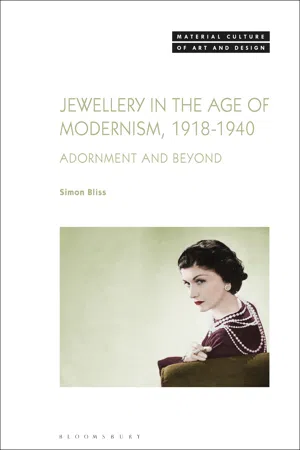
Why has jewellery and body adornment often been marginalized in studies of modernist art and design? This study explores the relationship between jewellery, modernism and modernity from the 'jazz age' to the second world war in order to challenge the view that these portable art forms have only a minor role to play in histories of modernism.
From the masterworks of the Parisian jewellery houses to the film and photography of Man Ray, this study seeks to present jewellery in a new light, where issues of representation and display are considered to be as important in the creation of a modern 'jewellery culture' as the objects themselves.
Drawing on material from museums, archives, contemporary journals, memoirs, literary and theoretical texts, this study shows how the emergence of modern jewellery began to seriously question conventional notions of body adornment.
- 232 pages
- English
- ePUB (mobile friendly)
- Available on iOS & Android
eBook - ePub
About this book
Information
1
Wearing (and Not Wearing) Jewellery in the 1920s
On 29 August 1928 the British Pathé company issued a short silent film entitled Jewels, introduced by the intertitle ‘Joys in Gems for Milady’ (Pathé 1928). The film was shot as a cameo in the form of three tableaux vivants featuring models wearing what appears to be antique jewellery. All three models are dressed in the fashionable clothes of the late 1920s. In the first scene, the model is seated on a stool and very deliberately draws on a cigarette and slowly blows out the smoke. Her raised left hand in which she holds the cigarette shows off the bracelet, the low neckline allows her necklace to be easily visible and, at the end of the shot, she turns her head slowly to reveal the pendant earrings. The scene is shot against a background split into two halves; on the right a William Morris style wallpaper and on the left what appears to be the back of a screen with crossed supports forming an asymmetrical geometric pattern (Figure 1.1).

Figure 1.1Still from Pathé film Jewels, 1928. © British Pathé Ltd.
This footage was probably meant to be spliced into a much longer piece of film, probably a newsreel. As such, it will have invited the audience to reflect on the fashions of the day, the freedoms associated with smoking (particularly new for women at this time) and, crucially, the role of jewellery in completing an outfit. We are to presume from the use of the word ‘milady’ in the intertitle that the model is playing the part of an aristocrat in an effort to associate the wearing of jewellery not only as something that comes naturally to the upper classes, but that wearing it is in itself a pleasure. Her pose and body language reinforce this idea. She is also performing the role of a modern woman who is up-to-date in her choice of clothing and accessories and, through her physical position situated between the reassuringly traditional wallpaper and the modern fragments of a set from a film studio, appears at ease with both the past and the present. It is not the individual pieces of jewellery that make this an image of a modern woman (the jewellery itself does not appear to be particularly modern or modernist) but the way it takes centre stage in the ensemble. Dress, coiffure, pose of the model and the setting all contribute to an attitude to jewellery wearing that, by the end of the 1920s, would have been familiar to a cinema-going audience.
In the decade following the First World War, a number of changes occurred in attitudes to wearing and thinking about jewellery. In France, Britain and America greater freedoms for women, partly brought about by the war itself, by the introduction of universal suffrage and by the prospect (however distant) of greater sexual equality, prompted a re-examination of how and when jewellery should be worn, what it meant to the wearer and what it should be made of. What makes these discussions interesting is not that they are peculiar to the 1920s (they are not) but that they took place against a backdrop of social, economic and cultural change that was increasingly an international phenomenon. Furthermore, the impact of modernist culture and technological progress meant that the consumer of jewellery was increasingly targeted as someone who was meant to be in tune with their time, aware of the latest developments in style, taste and modes of behaviour in dress and adornment. This included, in the case of women, taking more control over their jewellery buying and having greater flexibility in their jewellery wearing.
The phenomenon of the ‘new woman’, normally discussed in relation to literature, dress and changing social mores, can be usefully examined in relation to the wearing of jewellery in the 1920s. In particular, it is worth considering how jewellery was ‘performed’ by the new women of the 1920s. An examination of contemporary magazines, consumer guides, designers’ work and literary sources of the period reveal a shifting set of attitudes to the wearing of jewellery. In a decade conventionally defined by excess (the ‘Jazz Age’; les années folles; the ‘Roaring Twenties’; and so on) there are also some more subtle forces at work and it is useful to consider the strategies of jewellery wearing on the part of women and men of the 1920s and the relationship between this and the politics of gender.
The garçonne and the modern woman
The representation of the new woman has been extensively discussed in recent years from a variety of perspectives, social, political, sexual and cultural and attention has recently been drawn to this as a global phenomenon (Otto and Rocco 2012). Although initially a manifestation of the late nineteenth century, her image in fashion, advertising, film, painting and a variety of literary forms was, from the middle of the 1920s, ubiquitous. Always controversial, as well as being an object of ridicule and often the subject of satire, she is also known by the pejorative term ‘flapper’ or, in French, garçonne. French novelist Victor Margueritte’s 1922 novel La Garçonne originated the term, used with subsequent abandon to loosely describe any young, rebellious, androgynous, fashionably dressed and coiffured woman. Although opinion remains divided on Margueritte’s feminist credentials, the novel’s depiction of the protagonist Monique Lerbier’s sexual experimentation and overt challenge to existing social mores provoked such controversy that the author’s Légion d’honneur was withdrawn by the French government. The impact of the garçonne on post-war cultural life in France has been thoroughly assessed (Roberts 1994; Bard 1998) but Linda Nochlin has produced one of the best concise characterizations of the new woman:
In general, the New Woman, wherever she might be, was a beacon to the adventurous and a threat to the upholders of traditional values. To female youth, the New Woman offered a paradigm of liberation and agency: liberation from corsets, long hair, and bulky skirts; bodily freedom through participation in sports and dance; and equally important, liberation in the even more encumbering realm of ideology. (Nochlin 2011, viii–ix)
The ‘liberation’ referred to by Nochlin was achieved not just through changes in clothing and fashion. Along with the fairly swift rejection of pre-war attire, which included all the common physical restrictions mentioned above, came a new attitude to jewellery and accessories.
The role of the accessory is important in any attempt to describe the new relationship between adornment and the body that came about in the 1920s. Even if sometimes classified as a secondary item, the accessory wields power as part of a wider set of relationships set up by its configuration with a particular mode of dress. As Cristina Giorcelli has argued, the accessory occupies a position of ‘decentred centrality’ in its ability to ‘crown’ an outfit, yet also indicate status, social class, formality or informality. Furthermore ‘whether the accessory is an absolute sine qua non (like shoes) or a non-essential item (like a brooch), it has ended up becoming the quintessence of fashion and market forces’ (Giorcelli 2011, 4). The author cites Jacques Derrida’s account of Kant’s discussion of parerga (decorative, ornamental embellishments in Greek art and architecture) in which these ‘accessories’ are considered as something extra, peripheral and yet important to the overall understanding of the relationship between interior and exterior in a building. Hence ‘neither inside nor outside, neither superfluous or necessary, the accessory is thus almost indispensible, particularly to any investigation into identity through dress’ (4).
A clear train of thought emerges in the 1920s that sought to directly link jewellery with dress. Indeed, this seems to have been a dedicated strategy for many jewellery designers concerned with a demonstrably modern outlook. French jeweller Georges Fouquet looked back at the work of his firm from the 1920s and commented that jewellery should always be chosen to compliment the wearer’s outfit. This way, an unthinking approach to accessorizing could be avoided (Fouquet 1942, 93–4). He goes further, to describe a precise relationship between jewel and wearer: ‘The quality of a jewel is not only in manufacturing, it is also in its artistic value, it is not enough that it is pretty in itself, seen in isolation, it is necessary that its destination harmonizes with the context in which it is called to live . . . And this context is the woman who wears it, this is the dress on which it is hung, the neck on which it is suspended, the head on which it rests’ (96).
In 1928 Roger Nalys, regular contributor to L’Officiel de la couture et de la mode de Paris, commented that French jeweller Raymond Templier always considered his pieces as having a strong relationship with dress. Although his view of what constitutes an accessory is at odds with Giorcelli’s contemporary reading, Nalys suggests that Templier ‘never thinks of a jewel isolated in space’, but that he places it ‘in its proper frame: fashion, and makes of it what it ought to be; not an accessory but an essential element in the actual feminine silhouette, sober and neat for day-wear, imponderable and sumptuous at night’ (Nalys 1928a, 50). Fouquet and Nalys are keen to stress that one of France’s biggest exports in the 1920s (particularly to the United States) was fashion, if not the whole idea of style. For them, jewellery had a key role to play in exporting the idea of Paris as a place where a coherent look could be either physically bought or consumed in mediated form.
The decade also saw a demonstrably clear pattern of contrasting what was worn for the day and for the evening. Though not new in itself, this practice was given a different emphasis that would have been alien to many pre-war practices. In an article in The New York Sun in January 1929, columnist Dorothy Dayton in an interview with Franco-American fashion designer Yvonne Davidson makes the point that ignoring the difference between practical day-wear and evening-wear was becoming unacceptable. At the start of the year that was to see the Wall Street Crash, she writes, ‘It is rather like a punch in the face of the proletariat, and women of wealth these days are too sensitive and too understanding to flaunt themselves. No well bred woman wears her jewels or her sables or too ornamental clothes in the daytime these days’ (Dayton 1929, 22). This is a sentiment endorsed by contemporary entertainer Josephine Baker. In an interview for La femme de France, Baker refers to a shoulder piece made for her by Jean Després in 1931: ‘She was delighted with the idea of wearing a piece of jewelry made by one of the great designers. “Something that’s not over the top”, she specified however, “[because] in town I hardly wear any jewelry, and then only simple things”’ (Gabardi 2009, 55).
In her book Civilisation without Sexes, Mary Louise Roberts is clear about how fashion had changed in the early 1920s. Accessories were no exception: ‘In the somber spirit of the war years, the old ornamental frou-frous and decorative accessories were put away, and neutral colours adopted . . . Even after the war, large jewelry or ornaments of any kind that drew attention to itself remained out of fashion’ (Roberts 1994, 68). Although this situation was not as clear-cut as Roberts suggests, there were indeed practical reasons for rethinking how to accessorize. Women were undertaking more active pursuits in the day as well as in the evening, or at least there were a growing number of options for activity available. Dressing differently for a more active life was a necessary consequence of changes in behaviour and constituted a significant challenge to the norms of pre-war society. Christine Bard notes that the garçonne occupied a flexible position in relation to dress and accessories by being ‘androgynous by day, ultra-feminine by night’ while also pointing out that she was ‘forever associated with luxury ac...
Table of contents
- Cover
- Half Title
- Dedication
- Series Information
- Title Page
- Contents
- List of Figures
- Acknowledgements
- Introduction
- 1 Wearing (and Not Wearing) Jewellery in the 1920s
- 2 New Women: The Jewellery of Charlotte Perriand and Nancy Cunard
- 3 Modernism and Modernity
- 4 Representing Jewellery: Photography and Film
- 5 Displaying Jewellery 1920–1939
- Conclusion
- References
- Index
- Copyright Page
Trusted by 375,005 students
Access to over 1.5 million titles for a fair monthly price.
Study more efficiently using our study tools.
Frequently asked questions
Yes, you can cancel anytime from the Subscription tab in your account settings on the Perlego website. Your subscription will stay active until the end of your current billing period. Learn how to cancel your subscription
No, books cannot be downloaded as external files, such as PDFs, for use outside of Perlego. However, you can download books within the Perlego app for offline reading on mobile or tablet. Learn how to download books offline
Perlego offers two plans: Essential and Complete
- Essential is ideal for learners and professionals who enjoy exploring a wide range of subjects. Access the Essential Library with 800,000+ trusted titles and best-sellers across business, personal growth, and the humanities. Includes unlimited reading time and Standard Read Aloud voice.
- Complete: Perfect for advanced learners and researchers needing full, unrestricted access. Unlock 1.5M+ books across hundreds of subjects, including academic and specialized titles. The Complete Plan also includes advanced features like Premium Read Aloud and Research Assistant.
We are an online textbook subscription service, where you can get access to an entire online library for less than the price of a single book per month. With over 1.5 million books across 990+ topics, we’ve got you covered! Learn about our mission
Look out for the read-aloud symbol on your next book to see if you can listen to it. The read-aloud tool reads text aloud for you, highlighting the text as it is being read. You can pause it, speed it up and slow it down. Learn more about Read Aloud
Yes! You can use the Perlego app on both iOS and Android devices to read anytime, anywhere — even offline. Perfect for commutes or when you’re on the go.
Please note we cannot support devices running on iOS 13 and Android 7 or earlier. Learn more about using the app
Please note we cannot support devices running on iOS 13 and Android 7 or earlier. Learn more about using the app
Yes, you can access Jewellery in the Age of Modernism 1918-1940 by Simon Bliss in PDF and/or ePUB format, as well as other popular books in Art & Art General. We have over 1.5 million books available in our catalogue for you to explore.