When World War II ended, Americans celebrated a military victory abroad, but the meaning of peace at home was yet to be defined. From roughly 1943 onward, building a postwar society became the new national project, and every interest group involved in the war effort—from business leaders to working-class renters—held different visions for the war's aftermath. In Postwar, Laura McEnaney plumbs the depths of this period to explore exactly what peace meant to a broad swath of civilians, including apartment dwellers, single women and housewives, newly freed Japanese American internees, African American migrants, and returning veterans. In her fine-grained social history of postwar Chicago, McEnaney puts ordinary working-class people at the center of her investigation.
What she finds is a working-class war liberalism—a conviction that the wartime state had taken things from people, and that the postwar era was about reclaiming those things with the state's help. McEnaney examines vernacular understandings of the state, exploring how people perceived and experienced government in their lives. For Chicago's working-class residents, the state was not clearly delineated. The local offices of federal agencies, along with organizations such as the Travelers Aid Society and other neighborhood welfare groups, all became what she calls the state in the neighborhood, an extension of government to serve an urban working class recovering from war. Just as they had made war, the urban working class had to make peace, and their requests for help, large and small, constituted early dialogues about the role of the state during peacetime.
Postwar examines peace as its own complex historical process, a passage from conflict to postconflict that contained human struggles and policy dilemmas that would shape later decades as fatefully as had the war.
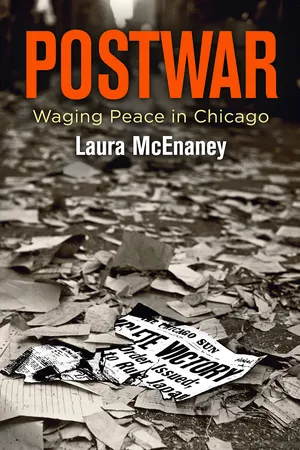
- 285 pages
- English
- PDF
- Available on iOS & Android
eBook - PDF
About this book
Information
Publisher
University of Pennsylvania PressYear
2018Print ISBN
9780812250558
9780812250558
eBook ISBN
9780812295443
Table of contents
- Cover
- Contents
- List of Abbreviations
- Introduction: The End
- Chapter 1. Bathrooms, Bedrooms, and Basements: War Liberalism in the Postwar Apartment
- Chapter 2. Japanese Americans on Parole: The Perils and Promises of a Postwar State
- Chapter 3. Living the GI Bill: Postwar Prosperity Through Government Dependency
- Chapter 4. “I Would Not Call This the More Abundant Life”: Working- Class Women Get Their Peace
- Chapter 5. After the Double V: African Americans Demobilize for a “Real Peace”
- Conclusion: Writing the History of What Happened After
- Notes
- Archival Collections Consulted
- Index
- Acknowledgments
Trusted by 375,005 students
Access to over 1.5 million titles for a fair monthly price.
Study more efficiently using our study tools.
Frequently asked questions
Yes, you can cancel anytime from the Subscription tab in your account settings on the Perlego website. Your subscription will stay active until the end of your current billing period. Learn how to cancel your subscription
No, books cannot be downloaded as external files, such as PDFs, for use outside of Perlego. However, you can download books within the Perlego app for offline reading on mobile or tablet. Learn how to download books offline
Perlego offers two plans: Essential and Complete
- Essential is ideal for learners and professionals who enjoy exploring a wide range of subjects. Access the Essential Library with 800,000+ trusted titles and best-sellers across business, personal growth, and the humanities. Includes unlimited reading time and Standard Read Aloud voice.
- Complete: Perfect for advanced learners and researchers needing full, unrestricted access. Unlock 1.5M+ books across hundreds of subjects, including academic and specialized titles. The Complete Plan also includes advanced features like Premium Read Aloud and Research Assistant.
We are an online textbook subscription service, where you can get access to an entire online library for less than the price of a single book per month. With over 1.5 million books across 990+ topics, we’ve got you covered! Learn about our mission
Look out for the read-aloud symbol on your next book to see if you can listen to it. The read-aloud tool reads text aloud for you, highlighting the text as it is being read. You can pause it, speed it up and slow it down. Learn more about Read Aloud
Yes! You can use the Perlego app on both iOS and Android devices to read anytime, anywhere — even offline. Perfect for commutes or when you’re on the go.
Please note we cannot support devices running on iOS 13 and Android 7 or earlier. Learn more about using the app
Please note we cannot support devices running on iOS 13 and Android 7 or earlier. Learn more about using the app
Yes, you can access Postwar by Laura McEnaney in PDF and/or ePUB format, as well as other popular books in History & North American History. We have over 1.5 million books available in our catalogue for you to explore.