This collection presents a critical dialogue on managerialist forms of government between philosophy, political thought, organisational and management theory. The volume brings together essays that are concerned with technologies of government that are articulated as different iterations of managerialism.
The hallmark of managerialist discourse is value, considered as a quantifiable abstraction, where the intention is to always 'add value'. The central question addressed here by a team of international expert authors from across a range of disciplines is this: in what ways has this abstraction of value impacted on the substantive work and ethical integrity of government and the public sector, and, more broadly, of the professions (including that of management itself)? Has it displaced this work, or simply recast it? The volume addresses audiences in social sciences, philosophy, management, business, and organisational studies.
eBook - ePub
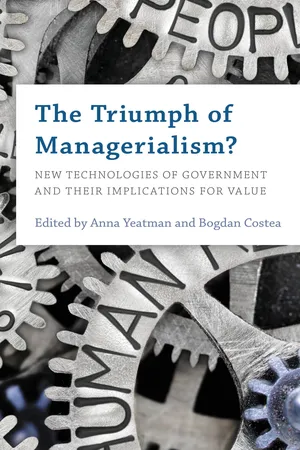
The Triumph of Managerialism?
New Technologies of Government and their Implications for Value
- 282 pages
- English
- ePUB (mobile friendly)
- Available on iOS & Android
eBook - ePub
The Triumph of Managerialism?
New Technologies of Government and their Implications for Value
About this book
Information
Chapter 1
Introduction
THIS COLLECTION AND ITS THEMES
This collection had its origin in a workshop held at the Copenhagen Business School in June (23–24) 2016. The workshop was called ‘New Technologies of Government and Their Implications for Value’. One overarching theme marked out the context of this workshop: the way in which global structures of public-private networks of governance are subordinating government and its distinctively public responsibilities and tasks – securing and attending to the welfare of a national-political community of citizens. The activity of government is articulated as a specific set of responsibilities for a legally constituted jurisdiction, a public place, including the multifaceted (historical, cultural, social and ‘natural’) ecology of relationships that mark out the topography of this place. It is this set of responsibilities, and the sovereign power required to sustain them, that has come under question by the imposition on national governments of a global institutional order that is designed to secure private capital rights. Governments have been required to redefine their work within the parameters of governance such that specific public policies addressing specific areas of need pertaining to a place-specific public collectivism are abandoned, and these areas of governmental responsibility are reframed in terms of the abstractions of governance: performance, efficiency, productivity, competitiveness and profit. More and more of the operational work of government is delivered via mechanisms of government contracting (on a commercial in-confidence basis) to private agents, including multinational capitalist corporations such as Serco, Pearson Education and ISS.
As Isabelle Stengers (2015, 54) points out, when the work of government is reframed by governance, politics cedes place to management:
Governance is well named. It describes well the destruction of what is implied by a collective responsibility with regard to the future, that is to say, politics. With governance, it is no longer a matter of politics but of management, and, in the first place, the management of a population that must not meddle with what concerns it.
Curiously enough the British Brexit referendum was held on the first of the two days of the Copenhagen workshop, and by its second day, the news was coming through of just what had happened: a vote against Britain staying in the European Economic Community. Quinn Slobodian (2018) significantly extends the archival histories of how the neoliberal project was successfully organised in the course of the twentieth century to reframe the work of government. Alongside the histories of the Mont Pèlerin Society and the Chicago and Virginia Schools of neoliberal economics, Slobodian shifts focus to the Geneva School which ‘was less a discipline of economics than a discipline of statecraft and law’ (Slobodian 2018, 11). The Geneva neoliberal thinkers, who included Hayek from 1962, focused their attention on a legal and institutional framework for the rights of capital that could constrain national sovereignty and the public collectivism that such political autonomy makes possible. They scaled up the ordoliberal idea of an economic constitution for the nation to the global level. In the European case, this is the economic federation that is the European Economic Union. Their intention was not to dispense with bounded territorial states, but to have them sign up to a global order of law and rules such as those that are embodied in free trade agreements: ‘What neoliberals seek is not a partial but a complete protection of private capital rights, and the ability of supranational bodies like the European Court of Justice and the WTO to override national legislation that might disrupt the global rights of capital’ (Slobodian 2018, 12–13). Thus, the question was one of balancing state power ( imperium) with private capital rights ( dominium), with the latter accorded a constitutional right to trump the former (see Slobodian 2018, 10–11, for how these neoliberal thinkers appropriated Schmitt’s distinction between imperium and dominium):
The nation could be useful insofar as it provided services of stabilization (which would often include restrictions to migration) and cultivated legitimacy in the political sphere. But like democracy, it also bore the risk of tipping into excess. Thus, it needed to be constrained just as democracy did. (Slobodian 2018, 15)
What Slobodian (2018, 15) emphasises is how the neoliberal project deliberately scaled up the idea of institutional order: ‘Neoliberals were proponents of an institutional framework in which the world economy would survive threats to its holistic integrity’. It is this scaling up, the substitution of a non-place-responsive institutional ordering for one that is located in place, that distributes power and authority away from the public officialdom of a particular nation state in the direction of ‘faceless’ technocrats whose conduct and language is managerialist. In this context, the Brexit vote signals a growing problem for the legitimacy of the supranational global order: when entire regions of a nation find themselves locked out of opportunities for regular employment of a kind that enables people to enjoy self-worth, contribute to the building and sustaining of civil community life and believe in their children’s future, it is little wonder that they declare their loss of trust in the existing governing order. At the same time, notwithstanding this signal, the British government has no intention of exiting the broader neoliberal global constitutional framework, busying itself with finding alternative forms of supranational free trade agreements to that of the European community. There will have to be a more direct calling to account of this order than can be achieved by revanchist populist projects of nationalism before anything changes.
This collection addresses the present historical conjuncture, one where there is a practical and organisational convergence of several historical forces: the intellectual force of neoliberalism as this offers a blueprint for a global institutional order that secures the rights of corporate capital; a global, corporate and financialised capitalism that gleefully affords itself the licence to operate that this order grants it; a scientific technologism that is oriented within an ethos of adaptive and manipulative problem-solving conduct, unfettered by ‘mere’ opinion (culture, politics, history); and, managerialism, the ideology of let the managers manage.
The triumph of managerialism, then, in the title of this collection, refers not to managerialism considered as a phenomenon on its own, but to managerialism considered as the mode of governance of the entire system of relationships that is constituted by the synthesis of neoliberalism, capitalism and technologism. The a-political value neutrality, the technical form of rationality, the ‘fixer’ mentality and the a-contextual elitism of managerialist discourse are the lingua franca that hold the system of governance together.
There is something further to be said about the historical conjuncture of this collection. Until relatively recently, at least in constitutional democracies, the state and the wider public sector of organisations funded by the state operated in terms of the political rationality of public administration. The central values in this discourse are rule of law, political accountability and transparency, service to the public, public interest and – with reference to how the public is served – an idea of citizenship that is practically specified in terms of how state services make it possible for people to enjoy and share the status of citizen. In this frame of reference, it was possible to call the distinct sectors of the welfare state – prisons for example – to an ethical-civic ideal, in this case, to ask of prison administration that it engage with the practical question of how to re-integrate prisoners into a civil-civic mode of being (the idea of rehabilitation). The neoliberal project was intended to undo ‘the administrative state’ associated with the twentieth-century project of the democratic welfare state: specifically, to undo the political rationality of public administration. In the name of efficiency, cost-containment and national competitiveness, it offered an alternative: the reconstruction of the relationships between policy agencies and service delivery organisations as private forms of contractual relationships between business enterprises. The New Public Management (NPM) was the ‘managerialist’ discourse that was the practical vehicle of this profound institutional and cultural transformation (for suggestion of the NPM as an historically evolving phenomenon, see Considine and Painter 1997). Certainly, there is a difference between the neoliberals, who provided the intellectual justification for this broad shift, and the practically minded practitioners who carried it out, but there can be no doubt that the NPM would never have occurred if ‘the neoliberal thought collective’ (see Mirowski and Plehwe 2009) had not successfully transformed how the state and its role are thought about.
The NPM represents the extension of managerialism, already long established as the modus operandi of twentieth-century capitalist corporate organ-isation, to the state and the public sectors. From this historical vantage point, then, managerialism becomes a ‘general’, non-sector-specific, phenomenon. Thus, it becomes possible to think about what the phenomenon of managerialism is . This is what occurs in the literature on managerialism. For example, consider these two recent definitions of managerialism:
The central doctrine of managerialism is that the differences between such organisations, as for example, a university and a motor-vehicle company, are less important than the similarities, and that the performance of all organisations can be optimised by the application of generic management skills and theory. It follows that the crucial element of institutional reform is the removal of obstacles to ‘the right to manage’. (Quiggin 2003)
. . . there is no generally accepted definition of managerialism, but as a working definition it can be said that management is an ideology based on the belief that optimisation of the productivity and outcomes of all organisations can be achieved through the application of managerial expertise, theories and techniques; this applies to both private and public organisations. (Doran 2016, 81)
Reflecting the current historical vantage point as one where managerialism extends to all kinds of organisation, in both public and private sectors, Doran comments: ‘Analysing managerialism is of crucial importance because in the last twenty years this ideology has risen to a position of intellectual and social prominence, if not dominance, impacting decision making in both the private and public sectors, as well as social policy more broadly’. From this vantage point also it is possible to look back and to consider the precursors of managerialism: the utopian socialist and Marxist ideal of replacing ‘the government of men’ with ‘the administration of things’; the managerial society of Soviet communism, German and Italian fascism (as discussed by Doran 2016, 88); the idea of total mobilisation in relation to the development of twentieth-century mass society (discussed by Hemming, chapter 3, this volume); the managerial structures of mass production and mass consumption (discussed by Costea, chapter 4, this volume); the development of a professional scientific technocracy focused on predictive methods of controlling society thought of as a vast cybernetic system of information flows and networks (discussed by Shalbak, chapter 5, this volume); and the iteration of this technocratic systems utopia in the neoliberal conception of market society as an information processor on a global scale (see Slobodian 2018, chapter 7; Mirowski and Nik-Khah 2017).
From this vantage point, too, it is meaningful to ask, was management always already managerialist, or are we to make a distinction between management and managerialism? This question is not settled by this collection. Costea (chapter 4) suggests that these two phenomena are not separable – they both exemplify a distinctly modern will to power – but Malpas (chapter 1) suggests that we might want to sustain a distinction between management and managerialism, the real question perhaps being one of at what point does the scaling up of social ordering require management to morph into managerialism.
The question of ‘the role and interests of managers as a class’ (Quiggin 2003) is an important one. The chapters in this collection rather skirt this question, although it might be said that they obliquely broach it. All of this collection’s writers are practicing academics who have positioned themselves in a relationship of critique of managerialism. Yet, theoretically at least, at this historical juncture, all of them have had experienced, or will experience, opportunities to participate in managerialist organisational roles in academe or beyond. If they say no, what is the status of this refusal? The power and status of the managerial class is organisationally based; recruitment is based on ‘merit’ so this class can celebrate its inclusive ethic and ‘diversity’ (see Yeatman 1997); and entry into this class is marked by gaining ready access to a cross-sectoral set of managerial elites that operate both ‘locally’ and ‘globally’. The global managerial elite has its own insider patois and forms of civility, but virtually anyone with a higher education degree, the right point of access and making the right kinds of choices can join this club of insiders who disdain those who cannot, or will not, belong. Such insiders can be found running universities and trade unions and (in Australia at this time) the Labor Party’s organisational machine.
What then does it mean for those who might, if they want, have access to the club of global governance managers – to what Isabelle Stengers (2015, 29) calls ‘our guardians’ (in French, nos responsables) – to declare: no? I will return to this question at the end of this introduction. Let me turn now to the chapters in this volume: this collection should be taken as symptomatic of our current context. The contributors are not the only people thinking about and discussing managerialism, but they are just the people who were gathered on this occasion.
THE CHAPTERS IN THIS COLLECTION
The first three chapters are philosophical and theoretical, taking a long view of managerialism as an historical phenomenon, one that is bound up with the project of modernity itself. Jeff Malpas argues that managerialism and technologism are different aspects of the same phenomenon: technologism is itself managerial, and managerialism is part of a modern technological ordering. Malpas raises the question whether a distinction is to be made between management and managerialism. Management, he suggests, is involved in every activity: it is ‘the taking of things in hand’. But when management is associated with modern organisational life, it refers to a second-order activity, that directs, coordinates and facilitates other first-order activities, as when, for example, management coordinates the work of doctors, nurses, cleaners and cooks in a hospital. Malpas also suggests that we should be careful not to conflate managerialism with bureaucracy, considered as a hierarchical system of public office. Malpas proposes that management morphs into managerialism when it stops understanding itself as a second-order of activity, one that serves, in the sense of facilitating the first order of activity. With managerialism, all activities are appropriated to the sphere of the managerial. He has in mind the way in which computerised performance auditing techniques penetrate every level of an organisation, directly harnessing workers to managerial modes of conduct, dispensing with the layer of middle management and centralising the managerial regime in the executive layers of the organisation that purchases from private corporations the technological methods of its coordination. The two hallmarks of managerialism for Maplas are genericisation (dis-engagement with basic activities, values and ethos of an organisation) and quantisation. Once quantisation has occurred, a third hallmark enters the picture: monetisation. Malpas suggests that managerialism, considered as a technology, reflects the character of technology more generally: its systematicity. He argues that technology should not be understood instrumentally, as a means to an end. It is an entirely self-referential phenomenon: the only end of managerialism is managerialism. Malpas links technology so understood to the mathematical and spatial understanding of the world that is inaugurated by sixteenth- and seventeenth-century natural science. The spatial designates an unbounded and uniform phenomenon, one that can be expressed only quantitatively and numerically. It is something entirely different from ‘place’, which is always utterly distinct, and plural, for one place exists only as it relates to other places. Where place, being distinct, is inherently bounded or limited, space, being unbounded, is without limit. It is this absence of limit that Malpas sees as the quintessence of technology/managerialism. Even as the technological world view began with modern science, Malpas suggests that the idea of world that it promulgates is a contemporary phenomenon: place has been evacuated and replaced by ‘the idea of the world as a single integrated space – a space of flows and connections in which borders and boundaries are increasingly irrelevant’. This is the systematicity that Malpas attributes to technology/managerialism, expressed in the phenomenon of technological convergence, the reduction of everything to something that can be measured and manipulated within the same space. He points out that the form of contemporary capitalism is shaped by the convergence of the technological with the economic and financial. For Malpas, following Heidegger’s The Question of Technology, modernity represents the desire to escape from limit. From this point of view, then, technology/managerialism is inherent in modernity. Malpas suggests that critique of managerialism is ‘almost impossible’ because the all-encompassing (totalising) nature of managerialism means that t...
Table of contents
- 1 Introduction
- 2 ‘Taking Everything in Hand’: Managerialism and Technology
- 3 Managerialism as Will to Power: Technologies of Capital
- 4 Where Is Value Today?: Managerialism in the Age of Self-Assertion
- 5 The Birth of the Think Tank: RAND and the Development of a Technocratic World View
- 6 Competition Policy and the Destruction of the Welfare State
- 7 NAPLAN and the Role of Edu-Business: New Governance, New Privatisations and New Partnerships in Australian Education Policy
- 8 Compassionate Care: The Managerialisation of Virtue
- 9 Neoliberalism for the Common Good? Public Value Governance and the Downsizing of Democracy
- 10 Public Value and the Reframing of Citizenship
- 11 Reclaiming Professionalism in the Face of Productivism
- 12 Afterword
- Consolidated Bibliography
- Index
- About the Contributors
Trusted by 375,005 students
Access to over 1.5 million titles for a fair monthly price.
Study more efficiently using our study tools.
Frequently asked questions
Yes, you can cancel anytime from the Subscription tab in your account settings on the Perlego website. Your subscription will stay active until the end of your current billing period. Learn how to cancel your subscription
No, books cannot be downloaded as external files, such as PDFs, for use outside of Perlego. However, you can download books within the Perlego app for offline reading on mobile or tablet. Learn how to download books offline
Perlego offers two plans: Essential and Complete
- Essential is ideal for learners and professionals who enjoy exploring a wide range of subjects. Access the Essential Library with 800,000+ trusted titles and best-sellers across business, personal growth, and the humanities. Includes unlimited reading time and Standard Read Aloud voice.
- Complete: Perfect for advanced learners and researchers needing full, unrestricted access. Unlock 1.5M+ books across hundreds of subjects, including academic and specialized titles. The Complete Plan also includes advanced features like Premium Read Aloud and Research Assistant.
We are an online textbook subscription service, where you can get access to an entire online library for less than the price of a single book per month. With over 1.5 million books across 990+ topics, we’ve got you covered! Learn about our mission
Look out for the read-aloud symbol on your next book to see if you can listen to it. The read-aloud tool reads text aloud for you, highlighting the text as it is being read. You can pause it, speed it up and slow it down. Learn more about Read Aloud
Yes! You can use the Perlego app on both iOS and Android devices to read anytime, anywhere — even offline. Perfect for commutes or when you’re on the go.
Please note we cannot support devices running on iOS 13 and Android 7 or earlier. Learn more about using the app
Please note we cannot support devices running on iOS 13 and Android 7 or earlier. Learn more about using the app
Yes, you can access The Triumph of Managerialism? by Anna Yeatman,Bogdan Costea, Anna Yeatman, Bogdan Costea in PDF and/or ePUB format, as well as other popular books in Philosophy & Business Ethics. We have over 1.5 million books available in our catalogue for you to explore.