- 368 pages
- English
- ePUB (mobile friendly)
- Available on iOS & Android
eBook - ePub
About this book
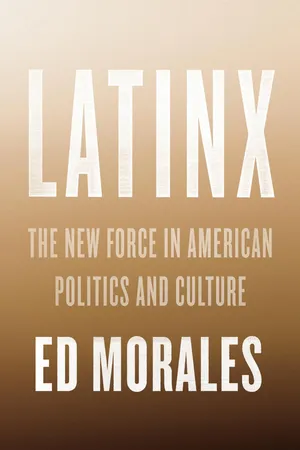
"Latinx" (pronounced "La-teen-ex") is the gender-neutral term that covers the largest racial minority in the United States, and the poorest but fastest-growing American group, whose political empowerment is altering the balance of forces in a growing number of states. In this groundbreaking discussion, Ed Morales explains how Latinx political identities are tied to a long Latin American history of mestizaje, translatable as "mixedness" or "hybridity", and that this border thinking is both a key to understanding Latinx cultures and a challenge to America's infamously black-white racial regime.
Information
1
The Spanish Triangle
The often-invoked reason that politically progressive Latinx prefer Latin over Hispanic is that the latter seeks to identify us with Spain, embracing European whiteness and acceptability over our African and indigenous DNA. But while today Spaniards seem white and European, Iberia has always been the darkest corner of Europe. Having shifted from almost 800 years of Islamic occupation to initiating the conquest of the New World, Spain lives at the crossroads of European identity, straddling the space between colonized and colonizer.
The process through which Spain made itself white through the expulsion of the Jews and Moors has always been haunted by the legacy of its “appropriated” dark side. The techniques by which the country used race and culture as forms of social control persist today in Latin America and in Latinx America. When Stuart Hall muses on a twentieth-century “globalized” subject permeated by the new rules of transnationalism, postcolonialism, and the advent of widespread digital information technology—“fragmented, multiple, unstable, and decentered”—he may well be talking about Spain (and by extension, Iberia) at the end of the fifteenth century.
It is from Spain that we get the word raza, the clear forerunner to the current conception of race which embodies the transition from its use as a classification tool for plants and animals to one for human beings. Raza was key to Spaniards’ self-definition when Spain became a nation-state, a Christianizing, whitening process that required the expulsion of two long-entrenched religious groups, Islam and Judaism, newly defining Spanishness by racial rather than religious purity.
The Islamic presence in Spain had begun in the eighth century and peaked near the beginning of the millennium, after which caliphate control gradually receded southward. Jews, Muslims, and Christians had coexisted for centuries under “an uneasy and anxious arrangement that often erupted into persecution, cruelty, and war,” as Ivan Hannaford argues. In the early 1200s, Christian rulers and clerics began to demand verifiable proof of the lineages of converted Jews and Muslims to determine their authenticity as Spaniards. The fever for blood purity climaxed with the Inquisition that began in the mid-fifteenth century, with its expulsion and conversion of Jews and Muslims in Iberia just as the conquest of the New World was beginning. Spain’s national identity was defined: it was not only Christian, but “white.”
Although this Spanish nation-building project took place long before Europe emerged from the feudal era into the modern one, neither Spain nor its Iberian neighbor Portugal were central to the formation of capitalism and the Enlightenment, and thus their processes are often seen more as prehistory than modern history. But the concepts of race and racism clearly began before slavery in the American colonies and the imposition of the black-white binary. Spanish racism was indeed driven by anti-black racism but not exclusively.
Despite employing walled cities or “barrios” to separate Christians, Jews, and Muslims, Spain’s state of convivencia tolerated cultural fusion through hybrid languages like Mozarabic and the translation of Arabic texts into neighboring Romance languages, creating a multicultural society that echoed the combination of ethnic groups in the Roman Empire. While this made Spain relatively “enlightened” compared to the rest of Western Europe, which was still in the Dark Ages, the pitfalls of convivencia and the Roman Catholic Church’s growing intolerance of Jews began to turn the tide in the early thirteenth century. At the same time, as they began to recoup territory lost to Muslim invaders, Spanish Christians began to consolidate their religious rule by exposing previously tolerated outsiders.
This is where the notion of raza begins, forming the basis of modern racism. Formerly used to classify wines, plants, horses, and the emblematic bulls of Spain, raza came to describe lineage and thereby impute desirability or undesirability to a citizen. It came into more widespread use to distinguish conversos and moriscos—Jews and Muslims who agreed to convert to Catholicism—from old-line, “pure-blood” Catholics. Buena raza and mala raza (good and bad race) were phrases used to describe inevitable biological afflictions that derived from common sense discourse about the nature of the social order. Spanish history scholar David Nirenberg quotes the early fifteenth-century book Arcipreste de Talvera, by Alfonso Martínez de Toledo, asserting a naturalness to race and the characteristics associated with it. Martínez describes a converso who held office in Toledo: “Thus you will see every day in the places where you live, that the good man of good raza or lineage, no matter how powerful or how rich, will always return to the villainy from which he descends.” Nirenberg also cites Sebastián de Covarrubias, who in the early seventeenth century made the connection between the original use of raza to categorize animals and its negative implications for humans. Once used for horses, which should be “marked by a brand so that they can be recognized,” it had then evolved to describe human lineages “negatively, as in having some race of Moor or Jew.” These examples illustrate that raza in Spain was not necessarily associated with color, particular since there were no stark phenotypical differences between many Christians, Jews, and Muslims. Since it was hard to tell by physical appearance who was a true “old Christian,” the negative “natural” qualities of a suspected convert needed to be revealed by investigating lineage (linaje) or caste (casta) and bloodlines.
As Ramón Grosfoguel describes it, the “re-conquest” of Spain was a “universalizing project” that rolled back Islamic resistance in their remaining region of strength in Southern Iberia, known as Al-Ándalus (Andalucía), where multiple identities and spiritualties were allowed to exist. The Spanish royal families of the northern province of Aragón wanted to create an uninterrupted correspondence between Catholic identity and their territory, swallowing up the peninsula with the Christian faith. In doing so, using religious critiques that had been building over centuries and that condemned Islam and Judaism as the “wrong religions,” the Spanish crown offered Jews and Muslims the choice of expulsion or conversion. In employing their own Inquisition, separate from the Vatican’s, the Spanish quest for religious and racial purity merged with the creation of an absolutist state.
Nelson Maldonado-Torres argues that as Spain’s discomfort with the Islamic caliphate increased, contemporary religious thinkers began to develop the idea that non-Christian believers were lacking in humanity because of their beliefs. This reflected the Roman Empire’s distrust of “pagans,” but was directed at a long-present resident population and used to encourage widespread conversion to Catholicism under threat of expulsion. One of the important precedents for this thinking, writes Maldonado-Torres, was, ironically, The Guide for the Perplexed, written by Maimonides, a Sephardic Jew who was fluent in Arabic and who lived in Córdoba, Spain, in the twelfth century. In one passage he writes that “people who … have no religion … are irrational beings … below mankind, but above monkeys, since they have the form and shape of a man and a mental faculty above that of a monkey.” Maimonides was arguing against Islamic theology, but eventually his argument was used against Jews and all non-Christians in Spain.
Hannaford imputes the emergence of racism in Spain to the post-Roman tensions between the role of the state and the church in society. “Racism was created out of an attempt to have political solutions in a church-state dialogue about diversity,” he writes, “because those who considered themselves to have ultimate authority and natural rights to power found it threatened by those they did not perceive to be part of their religion or in-group, and the outsiders were determined through biological lineage.”
Conversion efforts produced a large-scale culture of “passing,” in which some of the ostensibly converted remained deeply hidden, secretly practicing their faith. Many former Muslims and Jews were convincing enough as converted Christian moriscos that they began to ascend in Spanish society to the extent that their growing power necessitated a reinvigoration of the Inquisition nearly 100 years later. In sixteenth- and seventeenth-century Spain, in a manner evoking the conquest and designation of indigenous people as subhuman, Muslims were denounced as non-human and attacks on the undesirability of their bodies and appearance became common in oral and textual expressions. Ignacio de las Casas, a Jesuit morisco, wrote at the beginning of the sixteenth century:
The Christians have developed a hatred of them so deep that they do not even want to see them, and since that is not possible they take their revenge by insulting them, calling them “dog of a Moor,” and visiting on them every grave and frequent outrage that they can get away with.
The original policy of conversion, which evolved into a witch hunt for pure blood, created a kind of cognitive dissonance for Christian Spaniards, who had integrated much of Islamic culture into their own and continued to appropriate it subliminally even as they rejected actual Muslims. In her book Exotic Nation: Maurophilia and the Construction of Early Modern Spain, Barbara Fuchs makes the case that Moorish culture was fetishized even after their expulsion through mudéjar (hybrid Spanish–Moorish) architecture, caballería (horsemanship), derived from Moorish tradition, forms of dress and the practice of sitting on the floor on pillows, and juegas de cañas, Moorish jousting games. The concept of the “good moor,” which is found in several literary and poetic texts, draws a distinction between light and dark Moors and suggests that some may be successfully converted and not necessarily excised.
The concealed presence of former Muslims in society also made Spain’s “pure” whiteness in reality a kind of “off-whiteness,” one perpetually susceptible to racialization in Europe, through the infamous Black Legend writings of the nineteenth century, and then Anglo-America. During the second Inquisition in the sixteenth century, all Spaniards were forced to prove their pure Christian lineage and were in effect under suspicion at any point in time to be “passing” for Christian. Citing Etienne Balibar’s theory that “fictive ethnicity” helped construct a nation-state, Fuchs suggests that passing was accomplished through a “border-crossing transvestism” in which changing forms of dressing disguised not only gender but national, racial, and ethnic identity as well. She quotes Covarrubias, writing at the height of anxiety over blood purity, suggesting as much. Even though he doesn’t directly address religious passing, it seems to be embedded in his observation.
All nations have had their own dress, which distinguishes them from others, and many have preserved their costume for a long time. In this regard, Spaniards have been noted as fickle, because we change habit and dress with such ease. And so a fellow who was mad or pretended to be, running around in rags with a cut of material over his shoulder, when asked why he did not have clothes made from it, would answer that he was waiting to see where fashion would end up.
The carnival of passing that is said to have occurred in the sixteenth and seventeenth centuries is even referenced in Don Quixote, considered to be the first modern novel, where several sequences conflate Moorish/Christian passing with male/female passing. Fuchs describes a sequence in the novel in which a Spanish viceroy interrogates an apparently Moorish captain of an invading corsair who stands before him with a noose around his neck, who appears “so beautiful, so brave, so humble”:
“Tell me, captain, are you of the Turkish nation or a Moor or a renegade?”
To which the lad answered, in the self-same Spanish tongue, “I am neither of the Turkish nation nor a Moor nor a renegade.”
“Then what are you?” countered the viceroy.
“A Christian woman,” answered the young man.
“A woman and a Christian and in such an outfit and in such straits? That is a thing rather to be marveled at than to be believed.”
In a few lines of dialogue, says Fuchs, the captain reveals “herself simultaneously as a transvestite and as an excluded Christian forced out of Spain into an uncomfortable allegiance with its enemies.” In this way, “passing reminds us that, along with repressive categories, there have always existed sophisticated strategies for escaping categorization” and that “narratives of national or religious cohesion are surprisingly vulnerable to creative imitation.”
As Spain was transformed by its expulsion or conversion of Jews and Moors, it was also competing with Portugal, hunting for gold, conquering the Americas, and encountering those continents’ inhabitants. The process of Iberian colonization was shaped by the shift from religious exclusion to one based on race, reinforced by the presence of a new, completely exterior other. When Columbus, whom Sued-Badillo claims was a converted Jew, arrived in Hispaniola in 1492, he was motivated to find justifications to enslave the local inhabitants to make the extraction of gold easier. In a text attributed to Columbus and dated to his first encounter with the indigenous population on October 12, 1492, he writes:
They all go naked as their mothers bore them … I supposed and still suppose that they come from the mainland to capture them for slaves. They should be good servants and very intelligent, for I have observed that they soon repeat anything that is said to them, and I believe that they would easily be made Christians, for they appeared to me to have no religion.
Maldonado-Torres asserts that Columbus’s continued observation that the inhabitants of the Caribbean islands had no religion—not just the “wrong religion”—laid the grounds for the dehumanization of indigenous people and later African slaves that would be the basis for modern racism. While allowing for their “intelligence,” which here does not necessarily indicate humanity, Columbus is at once declaring their fitness for slavery and for the Christianizing process that had fostered national unity in Spain.
Sylvia Wynter observes that Columbus saw the world through Spain’s religious categories, with Christians at the apex, Muslims and Jews as “infidels,” and idolaters, who were pagans and non-believers. But, Wynter argues, Columbus considered the indigenous population not as idolaters but as akin to “the Aristotelean concept of the natural slave.” In this way, the conquest of the New World and its transformation of the world economy fused Spain’s religious mission to a political-economic one, where the moral guidelines shaping interactions with this new non-human escaped the boundaries of religious debate.
The correct view of the indigenous people was also the subject of debate between two clergymen, Gines Sepulveda and Bartolomé de las Casas, in the mid-sixteenth century. Sepulveda argued that indigenous people were without religion or “soul,” essentially uncivilized, and by virtue of natural law should be enslaved and subjugated by a superior moral force, writing in his Treatise on the Just Cause of the War Against the Indians:
It will always be just and in conformity with natural law that such [barbaric] peoples be subjected to the empire of princes and nations that are more cultured and humane, so that by their virtues and the prudence of their laws, they abandon barbarism and are subdued by a more humane life and the cult of virtue.
A significant element of his argument was that the indigenous were idolaters because they practiced human sacrifice. He felt the Spanish crown must intervene not only because it was just, but to save the indigenous from themselves by putting an end to the “great injury” of “the many innocent mortals that these barbarians sacrificed every year.”
De las Casas, on the other hand, was the first to allow that indigenous people were human. “Are they not men?” he asked. “Do they not have rational souls? Are you not obligated to love them as you love yourselves?” He argued that the indigenous people’s moral-religious view of the world included sacrificing humans, and that they should be taken seriously as reasoning beings. The Spaniards were then morally responsible for crafting a compelling argument that would convert the indigenous people to Christianity.
Enrique Dussel cites de las Casas’s intervention as the first critique of modernism. According to Dussel, the Jesuit friar was arguing “the first anti-discourse of Modernity.” He, at once refuting “the claim of superiority of Western culture,” grants the “Other” the “universal claim of his truth”; and “demonstrates the falseness of the last possible cause justifying the violence of the conquest, that of saving the victims of human sacrifice, as being against natural law and unjust from all points of view.”
Despite de las Casas’s appeals, Sepulveda’s exclusionism helped solidify Spain’s intolerance at home, which culminated in the fascist Franco state of the twentieth century. But de las Casas’s argument would heavily influence Spanish policy in the New World toward indigenous people, ending their widespread enslavement in favor of a heavy-handed acculturation process, and set into motion the dominance of the nascent Atlantic slave trade of sub-Saharan Africans.
The Indigenous Reprieve and the Condemning of Blackness
Ramón Grosfoguel observes that the outcome of the fifteenth-century Sepulveda–de las Casas debate changed the fate of indigenous people in the Americas from literal enslavement to colonial subject-hood through conversion to Christianity and the highly exploitative encomienda system. The two sides of the argument, he argues, were predecessors to the two contemporary views of racism, biological and cultural. Cultural racism asserts that the subject of racism is not less than human, but in need of acculturation to the rational normalcy of the West. The insistence on American norms (including, for example, a pro-business economic system, exclusive use of English, and embrace of pop cultural models) and the need for conversion to them, while “humanistic” in a sense, does not go far enough to acknowledge “difference” and the validity of the cultural traditions and religious practices of marginalized groups.
At the dawn of the colonization project, Spain and its neighbor Portugal needed to look no further for a group to be enslaved than the emerging slave trade on the West Coast of Africa. Historian James Sweet argues that Spaniards and Portuguese inherited the historical roots of racist views toward sub-Saharan Africans thr...
Table of contents
- Cover Page
- Halftitle Page
- Title Page
- Copyright Page
- Dedication
- Contents
- Introduction
- 1. The Spanish Triangle
- 2. Mestizaje vs. the Hypo-American Dream
- 3. The Second Conquista: Mestizaje on the Down-Low
- 4. Raza Interrupted: New Hybrid Nationalisms
- 5. Border Thinking 101: Can La Raza Speak?
- 6. Our Raza, Ourselves: A Racial Reenvisioning of Twenty-First-Century Latinx
- 7. Towards a New Raza Politics: Class Awareness and Hemispheric Vision
- 8. Media, Marketing, and the Invisible Soul of Latinidad
- 9. The Latinx Urban Space and Identity
- 10. Dismantling the Master’s House: The Latinx Imaginary and Neoliberal Multiculturalism
- Epilogue: The Latin-X Factor
- Acknowledgements
- A Note on Sources
- Index
Trusted by 375,005 students
Access to over 1.5 million titles for a fair monthly price.
Study more efficiently using our study tools.
Frequently asked questions
Yes, you can cancel anytime from the Subscription tab in your account settings on the Perlego website. Your subscription will stay active until the end of your current billing period. Learn how to cancel your subscription
No, books cannot be downloaded as external files, such as PDFs, for use outside of Perlego. However, you can download books within the Perlego app for offline reading on mobile or tablet. Learn how to download books offline
Perlego offers two plans: Essential and Complete
- Essential is ideal for learners and professionals who enjoy exploring a wide range of subjects. Access the Essential Library with 800,000+ trusted titles and best-sellers across business, personal growth, and the humanities. Includes unlimited reading time and Standard Read Aloud voice.
- Complete: Perfect for advanced learners and researchers needing full, unrestricted access. Unlock 1.5M+ books across hundreds of subjects, including academic and specialized titles. The Complete Plan also includes advanced features like Premium Read Aloud and Research Assistant.
We are an online textbook subscription service, where you can get access to an entire online library for less than the price of a single book per month. With over 1.5 million books across 990+ topics, we’ve got you covered! Learn about our mission
Look out for the read-aloud symbol on your next book to see if you can listen to it. The read-aloud tool reads text aloud for you, highlighting the text as it is being read. You can pause it, speed it up and slow it down. Learn more about Read Aloud
Yes! You can use the Perlego app on both iOS and Android devices to read anytime, anywhere — even offline. Perfect for commutes or when you’re on the go.
Please note we cannot support devices running on iOS 13 and Android 7 or earlier. Learn more about using the app
Please note we cannot support devices running on iOS 13 and Android 7 or earlier. Learn more about using the app
Yes, you can access Latinx by Ed Morales in PDF and/or ePUB format, as well as other popular books in Social Sciences & Hispanic American Studies. We have over 1.5 million books available in our catalogue for you to explore.