City of Segregation traces the central role racism has played in shaping modern Los Angeles-as it has shaped all US cities. Andrea Gibbons documents one hundred years of struggle against the enforced separation of racial groups through property markets, constructions of community and the growth of neoliberalism. This movement history covers the decades of work to end legal support for segregation in 1948; the 1960s Civil Rights movement and CORE's efforts to integrate LA's white suburbs; and the 2006 victory preserving 10,000 downtown residential hotel units from gentrification enfolded within ongoing resistance to the criminalization and displacement of homelessness.
This is a story of state-supported segregation, violent grassroots defense of white neighborhoods, police oppression, and growing political and economic inequalities. In studying these conflicts-and their cycles of victory and retreat-City of Segregation reveals the shape and nature of the racist ideology that must be fought if we hope to found just cities.
eBook - ePub
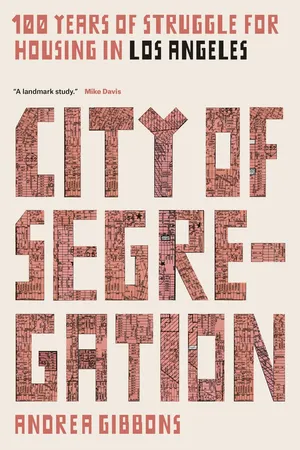
City of Segregation
One Hundred Years of Struggle For Housing in Los Angeles
- 240 pages
- English
- ePUB (mobile friendly)
- Available on iOS & Android
eBook - ePub
About this book
Information
Part I
The Long Road to 1948
Ending De Jure Segregation
Chapter 1
As Worthy As You
The Struggles of Black Homeowners Through the 1920s
The early history of “California” as a US territory consisted of decades of openly expressed white supremacy; this is the foundation of the state’s expanding geography after the area’s annexation through war with Mexico. Although the most violent US racism is almost always associated with the Deep South, California was founded on a policy of Native-American genocide to be a white, Anglo-Saxon state. At the time of US conquest, the indigenous population was around 72,000. By 1880 it had fallen to 15,000.1 Initially known as Californios, to separate them from the darker-skinned “Mexicans” laboring for them, the great Spanish landowners were initially respected as white. But this did not save the majority of them from losing most of their land. Despite the guarantees of the Treaty of Guadalupe Hidalgo, which incorporated California and much of the Southwest into the United States in 1848, Carey McWilliams estimates that the Californios were forced to sell at least 40 percent of their land just to pay the costs required to be in compliance with the Land Act of 1851.2
Over the next few decades, holdings of thousands of acres were forfeited for lack of cash to pay taxes. The steady despoiling of Mexican/Californio-owned land proceeded alongside a white supremacist and pro-Confederate stance during the Civil War, and bills were pushed in the state legislature to ban African Americans from the state entirely. A small Chinese population had been imported as menial labor and allowed to work on sufferance. Barred from citizenship, and with their immigration halted by the national government at the height of rhetoric around the “yellow peril,” they were targeted by white Angelenos, who lynched nineteen people in a single night in 1871 in one of the nation’s worst race riot known at the time.3 California would prove to be a dangerous place for anyone who wasn’t white.
The institutionalization of racial criteria in the appraisal of properties for federal government subsidies and mortgage finance through the 1930s has already been well documented.4 This process enshrined race as perhaps the primary factor in official evaluations of land’s exchange value, but the ways in which this national institutionalization took place in Los Angeles demonstrates the development of key political and economic aspects of the equation between land value and whiteness.
This is only part of the story, however. African Americans fought to break down institutional and legal barriers as they fought to live in their chosen homes. This book begins by charting some of the contours of this struggle, drawing on the point of view of Charlotta Bass, editor of the California Eagle. She was a driving force in the early movement to end segregation, and much of the material in these pages comes from her autobiography and editorials. Her newspaper served as a vehicle to instigate as well as document many of the campaigns aimed at breaking the power of white supremacy; the ongoing work to topple racial covenants was not the only resistance necessary. Still, for Charlotta Bass and the Eagle’s staff, it remained a central site of movement and struggle.
Until 1948, the preservation of white space rested primarily on de jure segregation enforced through racial covenants written into property deeds, white hegemony enshrined in both custom and law with little need of consent from those whom the forces of the state constrained. African Americans and other groups forced the ghetto walls back in two ways: through an unorganized but constant pressure by individuals buying and occupying property against great odds, and through local attempts to organize wider campaigns against covenants. While individuals worked to challenge white boundaries from the beginning, the first organized attempts to do so occurred in the late 1920s. It paralleled the homeowner associations of discriminatory whites, but fell apart in the face of continued hostility and defeat in the courts. It was then left to largely individual efforts again until the context of World War II’s fight against fascism; the backdrop of growing militancy renewed local organizing, which combined with a national legal campaign to successfully outlaw racial covenants and force major policy changes onto the federal government around the use of race in appraisals.
Those campaigning believed that this victory would end segregation in LA. If segregation had been maintained simply through institutional and legal methods, this might have been the case. Of course, it was not.
This chapter begins in the early twentieth century and illuminates the ways in which the value of property became firmly linked to the race of its occupants. It moves into the 1940s and ’50s, when the legal and—to some extent—moral victory against racial covenants forced a rearticulation of strategies and rationalizations for the maintenance of a hegemonic white and privileged spatiality during the decline of Jim Crow. While violence in defense of white neighborhoods was nothing new, its increase following efforts by Blacks to move into previously covenanted areas underlined that they had failed to win any kind of support among whites for integration. Even as bombs exploded and homes burned, segregationists’ rhetoric turned toward increasingly “race-neutral” arguments that emphasized segregation as simply a natural outcome of economics and market forces. This language obscures the reality of the choices made about where and how the “Black Belt” would expand, realized by a combination of individual judges deciding cases, organized realtor groups and individuals dealing in real estate, banks and other lenders, the Federal Housing Administration, organized homeowner groups, and individual homeowners.5
While the movement in part spearheaded by Charlotta Bass initially had little impact on national housing and mortgage policies, the voice of the California Eagle did have national reach. Loren Miller, who began writing for the paper in 1930 and would come to own it in 1951, was NAACP chief counsel in the Supreme Court case that overturned racial covenants across the country.6 At a local level, collective struggle was fundamental in shaping both white and Black strategies in acquiring and defending homes, and their attitudes toward the meanings of home, citizenship, and community. The results of this contest inscribed a pattern of segregation into the urban fabric that persists today. White responses went on to feed capital’s development of the suburbs and an increasing privatization of space, and mapping these responses geographically delineates the white privileges at risk—privileges once taken for granted. These are the rights and privileges African Americans fought to enjoy, sometimes alongside and sometimes at the cost of other peoples of color in the city.
Charlotta Bass, born Charlotta Spears in Sumter, South Carolina, arrived in LA in 1910 at the age of twenty-nine or thirty. She had traveled there from Rhode Island on advice from her doctor, although as a cure for what illness remains unknown.7 In fact, very little is known about her life before she arrived—her autobiography Forty Years: Memoirs from the Pages of a Newspaper is almost exactly what it calls itself: the autobiography of the Eagle and its central role in Black struggle in LA. Her private life remains very much her own in its pages, but elsewhere she writes (speaking of herself in the third person) with a lingering sense of surprise about the chance that helped put her at the center of Black struggle:
the paper miraculously passed into the hands of a militant young woman, a new arrival to Los Angeles, Charlotta Spears, who together with her husband, Joseph Bass, waged a ceaseless battle for all the principles laid down by the Eagle for a period of forty years. Twenty of those years, following the death of Joseph Bass in 1934, this lone woman, Charlotta Bass, carried the responsibility of waging the militant fight for freedom and equality through the publication of the Eagle, until ill health forced her to retire.8
Big Joe Bass, as he was known, had come to work with Charlotta Spears as an editor in 1913. They were soon married and worked closely together in what seems to have been a remarkable partnership throughout which she remained sole owner and lead editor of the paper as a whole. She would continue to document and campaign throughout her life against both the legal challenges and physical violence faced by African Americans, and increasingly over the years the violence against other communities of color crossing the geographic boundaries set by whites. Upon her retirement she became the first Black woman to run for national office in 1952, on the Progressive Party ticket, as candidate for vice president.9
As a woman, Charlotta Bass continues in many ways to elude us. Her public voice was heard strong and true through her many articles and regular editorials, but she maintained a strict distance between her public persona and both her past and private life.10 These chapters have to glean what they can from her public face, her general prioritization and focus on race over other struggles such as gender, and the various coalitions and organizations she formed while working and strategizing within the changing political conjunctures of a pivotal forty years in US history. Within these parameters, however, much can be uncovered about how her understanding grew alongside a more collective understanding of what the Black community in LA faced, and the key strategies they employed in transforming their city to a place where all could flourish. A rich tradition of community discussion and debate already existed upon Charlotta Bass’s arrival in LA, in institutions such as the LA Forum—established in 1903 as an organization to promote discussion and debate on key issues of the times—along with a rich tradition of women’s clubs that filled the Eagle’s back pages throughout Bass’s tenure.11 She would build on this and embody what Melina Abdullah and Regina Freer describe as a tradition of “womanist” leadership that grew up organically in LA, marked by “group-centered leadership, and the use of traditional and non-traditional methods.”12 Such a practical tradition is demonstrated clearly in these pages—a drive to achieve concrete changes through collective action, and within that a willingness to draw from multiple sources and employ multiple strategies to do what was needed.
It is no surprise, then, that Charlotta Bass begins her book reframing the history of LA and highlighting the importance of Black women in that history. She opens with the original founding of LA in 1781 by “forty-four individuals … there were only two Caucasians among the founders, but there were sixteen Indians and twenty-six Negroes.”13 She details their history, describes the ways in which textbooks, history books, and journalists reproduced this story with representations of the founders as white, and their refusal to bow to the romanticized myths of the European Californios. She writes that, particularly in education, still “to date white supremacy rules supreme on this subject.”14 Six streets in downtown LA were named after these founders: Lara, Navarro, Mesa, Camero, Quintero, and Moreno. Not one of these streets fully remains; there is only a fraction of Lara Street in East LA as a last asphalt whisper of how much has been erased. The newspaper’s earliest articles, and Bass’s description of them, drive the feeling that LA’s Black history always needed to be written and actively recovered, as an ongoing act of resistance from passive silences as well as active silencing.15
Charlotta Bass’s description of the city’s incorporation in 1850, and its tremendous jump in population with the arrival of the railroad, focuses on the key roles played by Black settlers in the early city, as documented by her predecessor, John J. Neimore. Principal among these was another Black woman, Biddy Mason, born into slavery in 1818 in Georgia. She escaped first to Missouri and then to California. She invested wisely in real estate and owned a number of properties in downtown Los Angeles: Bass lists them, a tally of the property owned by a Black woman along Third and Spring, Second and Broadway, and Eighth and Hill. Mason used her wealth to establish the first day nursery for orphans.16 She died in 1881; five generations of her descendents had already grown up in the Black community by Bass’s time.
Mason was sixty-one when Neimore founded The Owl in 1879—the paper that would become The Advocate, and then The Eagle. It would be renamed the California Eagle in 1913 by Charlotta Bass, a year after she took it over at Neimore’s request.17 Bass describes her predecessor’s vision for the paper as a publication that would “stand as a watchtower, pointing the way for freedom and progress for his people, the Negroes of Los Angeles and of the State of California.”18 This is the tradition that she carried on in her own forty years of owning, editing, and writing for the newspaper, all of which substantiates her claim that “The history of Los Angeles and the Negro people’s role in its making is inseparable from the establishment and growth of THE CALIFORNIA EAGLE.”19
Anchoring the Eagle’s story in this early history frames its news within a much longer history of Black struggle. Bass never forgets this,...
Table of contents
- Cover Page
- Halftitle Page
- Title Page
- Copyright Page
- Dedication
- Contents
- Maps
- Acknowledgments
- Introduction
- Part I: The Long Road to 1948: Ending De Jure Segregation
- Part II: 1960s: Bringing Down the Hate Wall
- Part III: Into the 2000s and Back to the Center: The Racial Cleansing of Skid Row
- Map Credits
- Notes
- Index
Trusted by 375,005 students
Access to over 1.5 million titles for a fair monthly price.
Study more efficiently using our study tools.
Frequently asked questions
Yes, you can cancel anytime from the Subscription tab in your account settings on the Perlego website. Your subscription will stay active until the end of your current billing period. Learn how to cancel your subscription
No, books cannot be downloaded as external files, such as PDFs, for use outside of Perlego. However, you can download books within the Perlego app for offline reading on mobile or tablet. Learn how to download books offline
Perlego offers two plans: Essential and Complete
- Essential is ideal for learners and professionals who enjoy exploring a wide range of subjects. Access the Essential Library with 800,000+ trusted titles and best-sellers across business, personal growth, and the humanities. Includes unlimited reading time and Standard Read Aloud voice.
- Complete: Perfect for advanced learners and researchers needing full, unrestricted access. Unlock 1.5M+ books across hundreds of subjects, including academic and specialized titles. The Complete Plan also includes advanced features like Premium Read Aloud and Research Assistant.
We are an online textbook subscription service, where you can get access to an entire online library for less than the price of a single book per month. With over 1.5 million books across 990+ topics, we’ve got you covered! Learn about our mission
Look out for the read-aloud symbol on your next book to see if you can listen to it. The read-aloud tool reads text aloud for you, highlighting the text as it is being read. You can pause it, speed it up and slow it down. Learn more about Read Aloud
Yes! You can use the Perlego app on both iOS and Android devices to read anytime, anywhere — even offline. Perfect for commutes or when you’re on the go.
Please note we cannot support devices running on iOS 13 and Android 7 or earlier. Learn more about using the app
Please note we cannot support devices running on iOS 13 and Android 7 or earlier. Learn more about using the app
Yes, you can access City of Segregation by Andrea Gibbons in PDF and/or ePUB format, as well as other popular books in Social Sciences & African American Studies. We have over 1.5 million books available in our catalogue for you to explore.