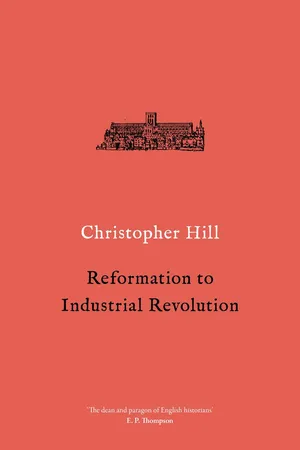
In 1530 England was a backward economy, yet by 1780 she possessed a world empire and was just about to become the first industrialized power in the world. This book deals with the intervening 250 years, and tries to explain how England won her unique position in the world.
This is a story that opens with the break with Europe and charts the tumultuous period of war, revolutions, and the a cultural and scientific flowering that made up the early modern period. Yet, during this period Britain also become the home to imperial ambitions and economic innovation. Hill excavates the conditions and ideas that underpin this age of extraordinary change, and shows how, and why, Britain became the most powerful nation in the world.
- 304 pages
- English
- ePUB (mobile friendly)
- Available on iOS & Android
eBook - ePub
Reformation to Industrial Revolution
About this book
Information
Topic
HistoriaSubtopic
Historia británicaPart One
INTRODUCTION
1
ARGUMENT
This is the reward I look for, that my labours may but receive an allowance suspended until such time as this description of mine be reproved by a better. – SIR WALTER RALEGH, History of the World (1614)
I HAVE tried in this book to isolate and explain some of those features which differentiate English history from that of the rest of Europe in the years between 1530 and 1780. Movements of population and prices were roughly similar all over Europe during this period; but the Netherlands and England were unique in having successful political revolutions which led to greater commercial influence over governments; England was unique in her Industrial Revolution at the end of our quarter of a millennium. The sixteenth-century price revolution was accompanied by industrial decline in Spain, industrial advance in England. Some historians have explained the lowered living standards of the sixteenth-century English peasantry solely by rising population; but in fifteenth-century Czechoslovakia a fall in peasant standards of living accompanied a declining population. Rising population contributed to industrial revolution in eighteenth-century England; it probably increased poverty in Ireland, China and elsewhere.* Since a great deal of arable land in Britain was still uncultivated in the eighteenth century, we might well ask, Why did the increasing population not lead to an extension of peasant farming?
Nor can we attribute political crisis to demographic or monetary changes. The years 1530–1620 in England saw an inflation and what some historians refer to as a population explosion: they were years of relative social and political stability. The ensuing half century of political crisis was one in which inflation tailed off and the population increase is believed to have slowed down. In the eighteenth century, when institutions and social relations were again relatively stable, prices were stable too but population is believed to have increased faster again. Neither demography nor monetary factors furnish a single key to the understanding of historical change. The seventeenth-century economic crisis which affected the whole of western Europe led to a strengthening of absolutism in most continental countries, and in the Netherlands to the consolidation of a trading oligarchy; in England alone it created a political system within which commercial and industrial capital had freedom to develop.* The connexion between economics and politics is not simple.
Social history is therefore, in my view, not what G. M. Trevelyan called it, ‘the history of a people with the politics left out’. Politics affected the social structure and so the economic and social life of the people. In this book I have stressed the significance of the seventeenth-century political revolution in transforming English social and economic life, in making possible what historians are beginning to recognize as the agricultural and commercial revolutions of the seventeenth century,† and preparing for the eighteenth-century industrial revolution: though of course the political revolution itself had economic causes too. My aim has been all through to emphasize interaction between politics and economics, seeing neither as a sufficient cause in itself. Some historians, for instance, are prepared to attribute far-reaching effects to the freedom to buy and sell land which prevailed in England between 1530 and 1660. This is harmless enough provided we recognize that the open land market was no act of God; its beginning and end were the result of legal changes made by men – the statutes of the Reformation Parliament and the strict settlement evolved by interregnum lawyers. Pressure from potential purchasers lay behind these changes, and this in its turn began and ended for reasons which can be analysed.‡ When we observe what Professor Wilson has called ‘the drunken hopelessness’ of the West Country weaver in the eighteenth century, which was cause and effect of his economic decline, and contrast it with the sober independence of his prospering West Riding counterpart, we may well wonder whether the catastrophic defeat of Monmouth’s rebellion in the West in 1685, the last kick of the Good Old Cause, may not have had something to do with it.
One way of appreciating the impact of politics on economic development is to ask whether the course of English history could have been different. Such a question is worth asking now that we can see western imperialism as a brief interlude in human history. Suppose the little England of the early years of Elizabeth had continued; suppose the outcome of the English Revolution had been a victory for the radicals who so nearly captured control of the army in 1647–49; that in consequence the proletarianization of small masters in industry, the disappearance of the yeomanry, had been very much slowed down; that Leveller opposition to the conquest of Ireland had prevailed in 1649; suppose the author of Tyranipocrit (also published in 1649) had persuaded his fellow-countrymen that it was wrong for merchants to ‘rob the poor Indians’, to make slaves, or for governments of the rich to use the poor to fight their battles for them. Suppose there had been no Navigation Acts, no powerful navy, no colonial monopoly empire, no commercial revolution. Dutch merchants would have continued to carry our trade, capital accumulation would have been far slower, there would have been no industrial revolution in England in advance of the rest of the world. The worker who in 1530 could earn his yearly bread by fourteen–fifteen weeks labour might not have had to work fifty-two weeks to earn the same amount two centuries later.
But let us not sentimentally conclude that all would have been gain if England had pursued the relatively peaceful path of a Denmark, or Switzerland, and had not become a world power. Milton’s poetry, Newton’s astronomy, Locke’s philosophy, Watt’s steam engine, Adam Smith’s economics – all these would no doubt disappear too if we wished out of existence the relationship of social forces which made the English revolution go the way it did. The long-term factors which in England fostered economic growth also brought about the seventeenth-century revolution. This by hindering hindrances to the expansion of capitalism created the conditions for that uniquely favourable balance between population and resources in England from which the Industrial Revolution was to result.* We cannot change one variable without affecting all the others. That, in fact, seems to me the ultimate lesson to be learnt from history: that fair is foul and foul is fair. ‘Perhaps this is that doom which Adam fell into of knowing good and evil, that is to say of knowing good by evil.’ History, as Engels once said, is ‘about the most cruel of all goddesses, who drives her triumphal chariot over heaps of the slain’.
2
1530–1780
Before 1640 [mercantilism] had been a policy imposed by the government on business interests; after it, it became, to an increasing degree, a policy imposed by business interests on the government. – R. H. TAWNEY, review in Economic History Review, ν (1935)
WHEN I was a boy at school my text-books of English history used to give the impression that one fine day in 1485 Englishmen woke up and said with surprise, ‘The Middle Ages are over. Modern times have begun.’ This view now seems naïve and silly. We know that the passing of the crown from one dynasty to another is not an epoch-making event. But we must be careful not simply to transfer the silliness from one date to another – to 1461, or 1529, or even to the fifteen-thirties as a whole. There was no sudden break in most people’s lives at any of these dates: only the historian looking backward can see, or think he sees, decisive transformations.
But there is a better case than most for taking the fifteen-thirties as the beginning of modern English history.
Hops, Reformation, bays and beer
Came into England all in a year,
the old rhyme tells us. As we shall see, lighter cloths (bays) were to be very important in transforming the major English export industry. That near-contemporaries should associate new developments in the clothing industry with a new industrial crop and the beginnings of a brewing industry – and with the Reformation – is interesting. But the Reformation itself was not merely the legislation of the Parliament of 1529–36. If by the Reformation we mean a change in men’s outlook upon themselves, society and the world, it had begun over a century earlier, with the Lollards, if not earlier still; and the Reformation was not complete until protestantism became the dominant religion among English men and women (some time in the seventeenth century, perhaps), or until the Toleration Act of 1689 gave freedom of worship to protestant dissenters, or until the final abolition of political disabilities on dissenters, well on in the nineteenth century – or indeed until that future date when the Church of England will be disestablished.
But the very conception of a dividing line between ‘the Middle Ages’ and ‘Modern Times’ is debatable. What do we mean by either phrase? Clearly, if we compare 1967 with 1367, the differences in economic activity, social and political structure, and in modes of thought, are immense. But what are the crucial points at which change has taken place? Medieval society was overwhelmingly agrarian: modern society is industrial. If we take this as our criterion the decisive change came with the Industrial Revolution of the late eighteenth and nineteenth centuries. If we look at social structure, medieval society was dominated by great landowners: so was England in 1780, when this book ends. If we look at political structure, England in 1530, in 1780 and in 1967 was governed by the crown in Parliament: between the first and last dates the franchise has been extended, but this change too took place long after our period ends.
Finally, in more elusive ‘ways of thought’, modern society is much less superstitious (or at least its superstitions are different: belief in magic, in direct divine intervention in everyday life, has virtually disappeared); the assumptions of modern science, however little understood by most of us, are rational and demonstrable in a sense in which the assumptions of medieval catholicism were not (and the more philosophic of them were equally little understood by the mass of the population). Modern society is tolerant (or indifferent) about things of which medieval society was intolerant. In these respects English society by 1780 was clearly modern: witches and heretics were no longer burnt, ‘sin’ was no longer punished. The most important book published around 1530 was William Tyndale’s The Obedience of a Christian Man, which assumed that religion was the cement of society, and that the crucial questions of politics were internal subordination and external sovereignty. The comparable books around 1780 were Adam Smith’s The Wealth of Nations, which assumed (almost for the first time) that the economic structure and politics of a society were what mattered most and should be the first concern of its citizens; and Thomas Paine’s Common Sense, one of the foundation documents of modern democracy.
These two books may make us reflect again about the apparent continuity of English social structure and political institutions. For the landowners who ruled England in 1780 were very different from those who ruled in 1530. Their power was no longer measured principally by the number of their followers, the men who would fight for them: it was determined by their wealth. The transformation was beginning by 1530, when moralists were already denouncing depopulating enclosure, the eating up of men by sheep. By 1780 it had been virtually completed: smaller tenant farmers were giving place to agricultural labourers. Great landowners still rode off to county elections with ‘their’ freeholders; but in fact money dominated politics too. A West India trader could buy his way into Parliament if he was rich enough. 1549 saw the last large-scale peasant revolt in England;* by 1780 we are in the world of urban radical discontent.
Parliament too is only in a formal sense the same institution in 1780 as it had been in 1530. In our first decade Henry VIII seemed more powerful than any English king, before or since, and he used Parliament for his own governmental purposes. Two hundred and fifty years later the rule of the ‘Whig oligarchy’ was at its zenith, and Parliament gave the king pocket money. A motion in the House of Commons in 1780 suggesting that ‘the influence of the crown has increased, is increasing’ naturally went on to conclude ‘and ought to be diminished’. At the beginning of our period the House of Lords was still the dominant chamber; at its end real power lay with the House of Commons. In the fifteen-thirties the church was subordinated to the crown; by 1780 it was subordinated to the Parliamentary politicians in office. Merchants were of little social significance in 1530; by 1780 the Bank of England and the East India Company were two of the most important institutions in the country.
This book then is concerned with the making of modern English society. We shall be looking for those elements of the new which are emerging. This is sometimes criticized as a ‘Whig’ approach – as though the historian of successful change necessarily approves of all aspects of all the changes which he records. It seems to me on the contrary the only possible historical attitude: anything else involves the dangers of sentimental antiquarianism. It is interesting to discover survivals of villeinage in early seventeenth-century England, but leasehold and wage labour were of greater importance, just as in the eighteenth century the City of London was more important than Tory backwoods squires. Catholicism continued to exist in England after the reign of Bloody Mary, and must not be ignored: but protestantism is the general historian’s main concern, and catholicism for its effect on the fortunes and outlook of protestants. Any historian has to select, especially a historian trying to cover 250 years in as many pages. But it is desirable that he should declare the assumptions which lie behind his selection.
These two and a half centuries are a period of social transition. In 1530 the majority of English men and women lived in rural households which were almost economically self-sufficient: they wore skins, sackcloth, canvas or leather clothes, and ate black bread from wooden trenchers: they used no forks or pocket handkerchiefs. By 1780 England was being transformed by the factory system: brick houses, cotton clothes, white bread, plates and cutlery were becoming accessible even to the lower classes. But throughout there are some permanent features of what today we should call a ‘backward economy’. It is a good reason for treating these 250 years as a unity. Men’s lives were dominated by harvests and the weather to an extent inconceivable in modern England. (This had consequences for aesthetic theory: in a predominantly agricultural society, where most of the working population was exposed to sun and wind, to be interestingly pale was the fashionable thing for girls: the craze for sunburn develops only in a highly industrialized society, well after our period ends.) In the sixteenth century up to one-third of the corn harvested was required as seed. In a year of crop failure starving men and women would eat some of the seed corn. So one bad harvest tended to produce another until the run was broken by unusually good weather. Good harvests similarly tended to follow one another.
Down to the eighteenth century, it has been well said, manufacture may be seen more significantly as processing the harvest than as something divorced from it.* Bad harvests led to shortage of purchasing power, and so to a fall in demand for cloth; abundant harvests stimulated a boom in the clothing industry and in wool production. Much of the population was in the technical sense of the term ‘underemployed’. That is to say, it was not rationally disposed in the most economic way. There were long periods of unemployment, in industry as well as in agriculture. Bad communications made for an intense regionalism. Bishop John Bale in 1544 thought that northern Englishmen would not be able to understand his language. He planned to rewrite one of his books so that northerners and Scots could read it without difficulty. Inadequate communications slowed down the development of a national market, and protected small household production; the Industrial Revolution was ushered in by the canal age and led to the railway age. In our period a national market was created, and the economic and cultural dominance of London over England was established.
It is instructive to compare Leland’s Itinerary (written within fifteen years of the beginning of our period) with Defoe’s Tour (published in 1724, fifty-six years from its end). For Leland the important features of the human landscape are castles – mostly ruinous by now, except in the North and Wales – religious houses, gentlemen’s seats, forests, market towns: landlords dominate, trade is local. For Defoe gentlemen’s seats still matter, but castles, monasteries and forests have mostly disappeared, market towns are far less important: almost all trade that matters is with London. Both writers are concerned with transport and communications. Leland records the charitable bridge-building of the fifteenth century, as for instance at Burford and Culham, which diverted the trade route from London to the West away from Wallingford. Responsibility for building bridges was taken over by J.P.s from 1531, and came to be financed by parish rates rather than by private charity. Leland’s interest in forests and rivers was also part of a concern for the opening up of the nation’s trade routes: he observed that food was cheap in Wakefield because the town was well served with wate...
Table of contents
- Cover Page
- Halftitle Page
- Title Page
- Dedication
- Copyright Page
- Contents
- Preface
- Part One: Introduction
- Part Two: From Reformation to Revolution
- Part Three: The Revolution
- Part Four: From Political to Industrial Revolution
- Part Five
- Notes
- Books for Further Reading
- Index
Trusted by 375,005 students
Access to over 1.5 million titles for a fair monthly price.
Study more efficiently using our study tools.
Frequently asked questions
Yes, you can cancel anytime from the Subscription tab in your account settings on the Perlego website. Your subscription will stay active until the end of your current billing period. Learn how to cancel your subscription
No, books cannot be downloaded as external files, such as PDFs, for use outside of Perlego. However, you can download books within the Perlego app for offline reading on mobile or tablet. Learn how to download books offline
Perlego offers two plans: Essential and Complete
- Essential is ideal for learners and professionals who enjoy exploring a wide range of subjects. Access the Essential Library with 800,000+ trusted titles and best-sellers across business, personal growth, and the humanities. Includes unlimited reading time and Standard Read Aloud voice.
- Complete: Perfect for advanced learners and researchers needing full, unrestricted access. Unlock 1.5M+ books across hundreds of subjects, including academic and specialized titles. The Complete Plan also includes advanced features like Premium Read Aloud and Research Assistant.
We are an online textbook subscription service, where you can get access to an entire online library for less than the price of a single book per month. With over 1.5 million books across 990+ topics, we’ve got you covered! Learn about our mission
Look out for the read-aloud symbol on your next book to see if you can listen to it. The read-aloud tool reads text aloud for you, highlighting the text as it is being read. You can pause it, speed it up and slow it down. Learn more about Read Aloud
Yes! You can use the Perlego app on both iOS and Android devices to read anytime, anywhere — even offline. Perfect for commutes or when you’re on the go.
Please note we cannot support devices running on iOS 13 and Android 7 or earlier. Learn more about using the app
Please note we cannot support devices running on iOS 13 and Android 7 or earlier. Learn more about using the app
Yes, you can access Reformation to Industrial Revolution by Christopher Hill in PDF and/or ePUB format, as well as other popular books in Historia & Historia británica. We have over 1.5 million books available in our catalogue for you to explore.