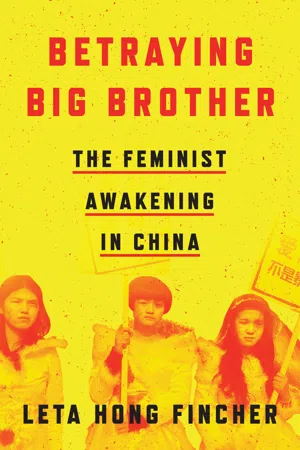
On the eve of International Women's Day in 2015, the Chinese government arrested five feminist activists and jailed them for 37 days. The Feminist Five became a global cause c?l?bre, with Hillary Clinton speaking out on their behalf, and activists inundating social media with #FreetheFive messages. But the Feminist Five are only symbols of a much larger feminist movement of civil rights lawyers, labor activists, performance artists and online warriors that is prompting an unprecedented awakening among China's urban, educated women. In Betraying Big Brother, journalist and scholar Leta Hong Fincher argues that the popular, broad-based movement poses the greatest threat to China's authoritarian regime today.
Through interviews with the Feminist Five and other leading Chinese activists, Hong Fincher illuminates both the challenges they face and their "joy of betraying Big Brother." Tracing the rise of a new feminist consciousness through online campaigns resembling #MeToo, and describing how the Communist regime has suppressed the history of its own feminist struggles, Betraying Big Brother is a story of how the movement against patriarchy could reconfigure China and the world.
- 240 pages
- English
- ePUB (mobile friendly)
- Available on iOS & Android
eBook - ePub
About this book
Information
1
China’s Feminist Five
When Chinese authorities arrested feminist activist Wei Tingting in Beijing on March 6, 2015—just before International Women’s Day—they confiscated her glasses so she could no longer see. Severely visually impaired, Wei was only able to tell people apart by their voices. State security agents took away her cellphone and laptop and demanded her passwords. They led her to a dimly lit, underground area of a police station, took her warm snow boots and put her in a small, unheated room about five square meters wide, as the temperature outside fell to below freezing.
Then the interrogations began.
“Why are you engaged in subversive activities about sexual harassment?”
“Who is collaborating with you in your women’s rights activism?”
“Which foreign agencies are funding your actions?”
Wei told the blurry figures in front of her that she wanted to call a lawyer before answering any questions.
“You can’t call a lawyer now. Don’t you get it? Don’t you understand the law?”
Wei made it through one round of interrogations and thought it would be over, but in the middle of the night—she had no idea what time it was because she had no watch—the agents took her out for another interrogation. This time, someone videotaped her as she spoke. Even when she went to the toilet, a female agent observed her.
For the first time in her life, Wei Tingting—just twenty-six years old at the time of her detention—began to think about escaping abroad. She felt disoriented and overwhelmed by a mounting sense of powerlessness. Then she heard some indistinct murmurs seeping through from outside and put her ear up against the wall of her cell to listen more closely. With astonishment, she recognized the voice of one of her feminist sisters, Wang Man, who had taken part in some activist campaigns with her, in the adjacent room.
My God! Wang Man is in here too! she thought. Wei yelled out to a guard that she was thirsty and needed a drink of water, then put her ear up against the wall to listen again. She made out the voices of other feminist activists who had been arrested along with her: besides Wang Man she could hear Li Maizi; Li’s girlfriend, Teresa Xu; and several other university students who had volunteered for feminist campaigns in the past.
Wei later described how she overcame her feeling of helplessness in an online essay (later deleted) she called “Prison Notes,” which she posted on WeChat under a pseudonym. “I decided I must resist this feeling of sorrow and take action, so I started to do a lot of different things: my room was freezing and I was only allowed to wear slippers, so I began doing leg exercises, such as kicks and squats; then I did deep meditation exercises; other people before me had scratched words onto the old walls, so I squinted my eyes up close to the walls to examine them; then I spun around in circles, singing songs,” she wrote.
Wei sang out loud, both to cheer herself up and to let the other detained women hear her voice and know that they were not alone—that she, too, was in there with them. Li Maizi also sang back “A Song for All Women,” the anthem of China’s feminist movement:
Protect my rights, don’t keep me down
Why must I lose my freedom?
Let’s break free from our heavy shackles
And reclaim our power as women!
Her spirits buoyed, Wei Tingting writes, she recovered her sense of defiance: “Even as I heard two guards walking back and forth, making clanking noises outside, I felt a kind of joy in betraying Big Brother.”
The women jailed in Beijing that night and for the subsequent thirty-seven days have come to be known as the Feminist Five, but the movement they are part of is much larger.
Zheng Churan, at twenty-five, was one of the younger activists. A recent university graduate, she still lived with her parents in Guangzhou, the major port and manufacturing hub located in southern China. While the parents of many other Chinese feminists were openly antagonistic toward their daughters’ work, Zheng’s parents respected her independence. She was very close to them and talked with them about everything, including her feminist activism. Although they did not always agree with her, they supported her efforts to bring about social change and she did not want them to get hurt.
Zheng had been deeply involved in feminist activism since she was a student in sociology and archival science at the prestigious Sun Yat-sen University in Guangzhou. It was there that she became interested in feminism and LGBTQ rights and adopted the nickname Da Tu (Giant Rabbit). She made friends with some lesbians (lala) at university and joined an LGBTQ student group. Zheng identified as queer; though she also dated men, she found women to be much more fun.
Then she realized that her LGBTQ group was sexist. “The male organizers looked down on us, even though they gave lip service to gender equality, and they never gave any funding to women in the group,” says Zheng, who believed that any LGBTQ rights group must have a feminist perspective. So she, her lesbian friend Liang Xiaowen, and other lalas decided to split off from the main LGBTQ group and form their own queer feminist group, called Sinner-B (b for bitch). Its members, mostly students, collaborated on acts of feminist performance art.
They joined up with the Gender Equality Work Group run by the activist Wu Rongrong and affiliated with the more established nongovernmental civil rights organization Yirenping (meaning “public interest, humanity, and equality”) in 2012. The Gender Equality Work Group was planning its Occupy Men’s Toilets protest, calling for more public toilets for women. There Zheng met other activists—including Li Maizi—who were to become prominent figures in the feminist movement. They took over a men’s public lavatory in downtown Guangzhou and invited women into the vacated stalls to shorten their typically long wait.
The feminist activists chose to focus on gender parity in public toilets because they believed it was a campaign that could not be seen as politically sensitive or even remotely opposed to the Communist Party. Everyone could easily relate to the overly long lines for women using public toilets, so they were able to win widespread support for their cause. They used it to highlight the underlying problem of systemic sexism and the constant devaluation of women’s lives in Chinese society. Their campaign even received media attention from official Chinese news outlets, including Xinhua News Agency and People’s Daily. Members of the public quoted in state media reports expressed support for the action, and Guangdong provincial officials later promised to provide more toilets for women.
In 2012, Zheng Churan worked on the “Bloody Brides” Valentine’s Day action against domestic violence, in which activists Li Maizi, Wei Tingting, and Xiao Meili paraded down a Beijing street wearing white wedding gowns smeared with faux red blood. They carried signs with slogans like “Love is No Excuse for Violence” in a visually shocking protest against the absence of a nationwide law against domestic violence in China. (China subsequently enacted its first such law in 2016.) They also shaved their heads in public in their “Bald Sisters” action in Guangzhou to protest blatant discrimination against women in university admissions: many programs require women to score higher than men on their entrance exams to be accepted. (After Lü Pin and feminist lawyer Huang Yizhi wrote a formal letter of complaint to the Ministry of Education, they received a response saying that the policies—basically affirmative action for men—had been introduced “to protect the national interest.”)
When Zheng graduated from university, she began working for the Gender Equality Work Group in Guangzhou. Shortly before International Women’s Day in 2015, she thought that it would be a good idea to highlight the pernicious problem of sexual harassment on public transportation. The Chinese government does not release reliable statistics on sexual assault; this lack of transparency disguises the true extent of sexual violence. But sexual harassment on public transportation is seen as less politically sensitive and one survey by the state-run China Youth Daily in August 2017 found rampant harassment, with over 53 percent of female respondents reporting they had personally been sexually harassed while taking the subway.
Zheng received a small grant from the Swedish embassy to print and distribute colorful stickers against sexual harassment to be handed out on subways and buses on International Women’s Day. One sticker showed a cartoon of a woman screaming, with blurbs on either side: “If you are sexually harassed, SCREAM!” and “Fight lechers!” Another, with pictures of police caps, said, “Catch sexual harassers. Police, go get them!”
Zheng’s idea was appealing, and volunteers—many of them university students—signed up in multiple cities, including Guangzhou and Xiamen in the southeast, the capital Beijing, the eastern city of Hangzhou, Nanjing, Wuhan, and the southwestern city of Kunming. She arranged for a store to print out the stickers and send them by express mail to the cities where volunteers had signed up to take part. “All of our actions are pretty fast and spontaneous,” Zheng says. “In each city, we only needed a small number of volunteers: mainly one person to show off the stickers and one person to take pictures. Then you sent out a press release and the whole event would be over.”
But late on the night of March 6, 2015, just after Zheng finished her shower and was relaxing in front of the TV with her parents, a loud knock came at her door. Zheng told her parents not to get up. She looked through the peephole and was startled to see a large group of around eight men in her crowded stairwell, with some standing on the stairs as well. Only the man knocking wore a police uniform.
“What is it?” Zheng asked through the closed door.
“We’re checking your household registration,” said one of the men.
“If you’re checking my registration, there’s no need to come inside, please just tell me what you want right here.”
Silence.
After a few seconds with no reply, Zheng knew that she was in trouble. She went back inside to tell her parents to go into their bedroom; she would take care of the men at their door. She quickly used her hands-free phone to dial her friend Liang Xiaowen and left the phone on without saying anything, so Liang could hear everything that happened next.
“Open the door,” demanded the men outside, as they started banging loudly.
“I’m not opening the door unless you have a search warrant,” said Zheng.
“If you won’t let us in, we have to take you with us to the police station.”
The men had no search warrant or other forms of identification and refused to say why they were there, so Zheng argued with them for a while, but finally agreed to go with them because she did not want them to enter her parents’ home. In the predawn hours of March 7, Zheng found herself being interrogated at a Guangzhou police station. After several hours, agents took her home to print out all her emails related to the anti–sexual harassment activity, as well as her agreement with the Swedish embassy. Then they brought her back to the police station and interrogated her again until dawn, before holding her at a hotel for the rest of the day. Around eight in the evening on March 7, the agents drove her to yet another police station, handcuffed her and made her stand as they read out a formal notice of her criminal detention on the charge of “picking quarrels and provoking trouble”—an all-encompassing charge increasingly being leveled at critics of the Chinese government. On March 8, the agents flew her to Beijing to begin her formal detention.
By that time, news of the arrests had already spread through China’s network of feminists. Wu Rongrong was visiting Shenzhen, the southern city that links Hong Kong to the rest of China, when she received a call at around eleven at night on March 6 from Liang Xiaowen, who described what she had heard over the phone. This was not the first call Wu had received that day. A state security agent had already sent her a message earlier that afternoon, telling her to cancel their International Women’s Day activity.
Late that same night, Li Maizi texted Wu from Beijing: “Damn, they’re knocking at my door.” Wu called her back immediately but got no response. Then she received several WeChat messages saying that security agents had detained other colleagues and university students who had volunteered to hand out stickers against sexual harassment.
Wu Rongrong, at thirty, was something of a veteran in the feminist movement: before founding the Weizhiming Women’s Center in Hangzhou, she had worked for many years on women’s rights at Yirenping in Beijing and elsewhere. Initially, she wasn’t worried: she had been called in for questioning multiple times over the years. She expected the others to be released by the following morning. But after the missives from Li Maizi and Liang Xiaowen, Wu became anxious and couldn’t sleep. At three in the morning she called a security agent she knew in Guangzhou. Zheng Churan had been taken for questioning, he said, and would be released very soon. But at four, Liang Xiaowen called again to say that security agents had taken Zheng home briefly to pick up some work files and were going to keep her at a hotel for the rest of the night.
As dawn broke, the women had still not been released, and Wu Rongrong discussed what to do with a colleague on the phone: return to Hangzhou, which her colleagues thought was unsafe, or stay in Shenzhen—just a short train ride across the border to safety in Hong Kong—until the situation calmed down? (The former British colony of Hong Kong returned to Chinese control in 1997 and is now a “special administrative region” with more freedoms than anywhere else in China, although those freedoms are being eroded.) Wu felt very conflicted. She had personally recruited Zheng Churan and Li Maizi for the Occupy Men’s Toilets action. Wei Tingting and Wang Man, in Beijing, were not even working full-time on women’s rights issues; they had just volunteered to hand out stickers on sexual harassment. If anyone should be held responsible, Wu thought, it should be her. She had been a feminist activist longer than any of them. She decided to fly back to Hangzhou. “I was so naïve. I thought if I could only get a chance to explain the whole situation to state security agents, I could clear up this misunderstanding and they would release the other women,” she said later.
Wu Rongrong grew up in a poor village in Shanxi Province, China’s coal country, where young girls were considered worthless and often forced to quit school and work while their brothers continued studying. At age six, she began plowing the fields with her father, since her mother was too sick to do farm work. As a teenager, Wu was diagnosed with chronic hepatitis B, and the doctor told her she would likely not become ill until she was twenty-eight. “I took this to mean that I had only ten more years to live, so from then on, I made a habit of trying to live each day to the fullest, and make sure each day was meaningful,” she writes.
Many of her relatives and fellow villagers tried to dissuade her from going to university and urged her to get married instead, but Wu was determined to break out of her stifling home environment. She moved to Beijing to study social work at China Women’s University. There she volunteered for public-interest nonprofit groups, working on issues such as poverty alleviation and HIV/AIDS as well as women’s rights.
When Wu applied for scholarships, she needed to obtain proof of residence from officials in her home village. Many of her village officials exploited her vulnerability and sexually harassed her. She had no one to turn to for support and felt powerless to speak out. “Had I tried to speak up for myself, it would have resulted in humiliating gossip and innuendo and made me unable to show my face in the village,” she says.
Another frightening incident happened when Wu was nineteen and looking for a job in Beijing over the Lunar New Year holiday. A man posing as an employer lured her into a car to the distant suburb of Shunyi and started to sexually assault her. She managed to escape, but the experience was terrifying and shook her profoundly. “I began to understand just how helpless I was … Like me, several of my female friends encountered harassment when looking for full-time or part-time work,” writes Wu. “As eighteen-or nineteen-year-old girls, all we could think of was buying a fruit knife for self-defense.”
These experiences left a deep impression on Wu. When she graduated with a B.A. in social work in 2007, she was eager to work on women’s rights and other social justice programs. She found jobs with the HIV/AIDS NGO Beijing Aizhixing Institute and with Yirenping on women’s and children’s rights. In 2009, Wu organized Yirenping’s first high-profile women’s rights campaign around the case of Deng Yujiao, a twenty-one-year-old woman working at a karaoke...
Table of contents
- Cover Page
- Halftitle Page
- Title Page
- Copyright Page
- Dedication Page
- Contents
- Introduction
- 1. China’s Feminist Five
- 2. The Internet and Feminist Awakening
- 3. Detention and Release
- 4. Your Body Is a Battleground
- 5. Jingwei Fills the Sea
- 6. Feminists, Lawyers and Workers
- 7. China’s Patriarchal Authoritarianism
- Conclusion: A Song for All Women
- Acknowledgments
- Notes
- Index
Trusted by 375,005 students
Access to over 1.5 million titles for a fair monthly price.
Study more efficiently using our study tools.
Frequently asked questions
Yes, you can cancel anytime from the Subscription tab in your account settings on the Perlego website. Your subscription will stay active until the end of your current billing period. Learn how to cancel your subscription
No, books cannot be downloaded as external files, such as PDFs, for use outside of Perlego. However, you can download books within the Perlego app for offline reading on mobile or tablet. Learn how to download books offline
Perlego offers two plans: Essential and Complete
- Essential is ideal for learners and professionals who enjoy exploring a wide range of subjects. Access the Essential Library with 800,000+ trusted titles and best-sellers across business, personal growth, and the humanities. Includes unlimited reading time and Standard Read Aloud voice.
- Complete: Perfect for advanced learners and researchers needing full, unrestricted access. Unlock 1.5M+ books across hundreds of subjects, including academic and specialized titles. The Complete Plan also includes advanced features like Premium Read Aloud and Research Assistant.
We are an online textbook subscription service, where you can get access to an entire online library for less than the price of a single book per month. With over 1.5 million books across 990+ topics, we’ve got you covered! Learn about our mission
Look out for the read-aloud symbol on your next book to see if you can listen to it. The read-aloud tool reads text aloud for you, highlighting the text as it is being read. You can pause it, speed it up and slow it down. Learn more about Read Aloud
Yes! You can use the Perlego app on both iOS and Android devices to read anytime, anywhere — even offline. Perfect for commutes or when you’re on the go.
Please note we cannot support devices running on iOS 13 and Android 7 or earlier. Learn more about using the app
Please note we cannot support devices running on iOS 13 and Android 7 or earlier. Learn more about using the app
Yes, you can access Betraying Big Brother by Leta Hong Fincher in PDF and/or ePUB format, as well as other popular books in Politics & International Relations & Asian Politics. We have over 1.5 million books available in our catalogue for you to explore.