- 464 pages
- English
- ePUB (mobile friendly)
- Available on iOS & Android
eBook - ePub
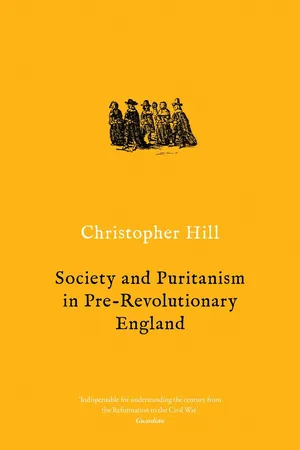
Society and Puritanism in Pre-Revolutionary England
About this book
In order to understand the English Revolution and Civil War we need to understand Puritanism. In this classic work of social history, Professor Hill shows Puritanism as a living faith, one that responded to social as well as religious needs. It was a set of beliefs that answered the hopes and fears of yeomen and gentlemen, merchants and artisans in the tribulations of early modern Britain, a time of extraordinary turbulence. Over this period, Puritanism, he shows, was interwoven into daily life. He looks at how rituals such as oath-taking, the Sabbath, bawdy courts and poor relief, became ways to order the social upheaval. He even offers an explanation for the emergence of the seemingly paradoxical - the Puritan revolutionaries.
Information
Notes
1. The Definition of a Puritan
1 This tract is sometimes attributed to John Ley, for whom see p. 131 below.
2 J. H. Hexter, Reappraisals in History (1961), pp. 163–84.
3 J. W. Allen, English Political Thought, 1603–1644 (1938), pp. 255–62, 302.
4 C. H. and K. George, The Protestant Mind of the English Reformation, 1570–1640 (Princeton, 1961), esp. pp. 6–8, 399–407. Although I cannot accept their main conclusion, that there was nothing in Puritanism significantly different from the position of the hierarchy before the Laudian innovations, there is much excellent material in this book.
1 Hastings MSS. (H.M.C.), IV, p. 330.
2 [Anon.], A parte of a Register (Middelburg, 1593), p. 129. Cf. the minister accused of Puritanism in 1574 who said that the Archdeacon of Nottingham ‘knoweth no more what a Puritan is than his old horse’ (R. Marchant, The Puritans and the Church Courts in the Diocese of York, 1560–1642, 1960, p. 135).
3 Owen Feltham, Resolves, Divine, Morall and Politicall (Temple Classics), p. 9. First published 1628.
4 N.R.S., IV, p. 63.
5 J. Udall, Diotrephes (ed. E. Arber, 1879), p. 9.
6 M. Marprelate, A Dialogue wherein is plainly layd open the Tyrannicall Dealing of the Lord Bishops over Gods Church (1640 reprint), Sig. C 4. This reprint includes the poem, The Interpreter, quoted on page 8 below.
7 Ed. J. Spedding, R. L. Ellis and D. D. Heath, Works of Francis Bacon (1872–74), XIV, pp. 448–9; cf. an anonymous pamphlet, Of the Name of Puritans (c. 1620–40), printed in Trans. Congregational Hist. Soc., VI (1913), pp. 76–88.
1 Ed. J. O. Halliwell, The Autobiography and Correspondence of Sir Simonds D’Ewes (1845), I, pp. 158–9. D’Ewes was summarizing Thomas Scott’s Vox Populi (1620).
2 C. Downing, A Sermon preached to the Renowned Company of Artillery, September 1, 1640, p. 29. (Published by order of the House of Commons.) The last phrase was in constant use: cf. the pamphlet, A Pack of Puritans, referred to on p. 278 below.
3 G. Wither, Juvenilia (Spenser Soc. reprint, n.d.), I, p. 299. First published 1622.
4 H. Parker, A Discourse concerning Puritans (2nd ed., 1641), pp. 58–60.
5 J. Taylor, The Water-Cormorant His Complaint (1622), p. 4; cf. his Mad Fashions, odd Fashions (1642), pp. 4–5.
6 Ed. J. Ayre, The Works of John Whitgift (Parker Soc., 1851–3), I, p. 172.
7 Bacon, Works, XIV, p. 449.
8 R. Sanderson, XXXV Sermons (1681), p. 16.
9 Sanderson, Pax Ecclesiae, in appendix to J. Hough, Sermons and Charges (1821), pp. 331–4.
1 W. M. Lamont, Marginal Prynne (1963), p. 44; Sir J. E. Neale, Elizabeth I and her Parliament 1584–1601 (1957), p. 151; Sir Walter Ralegh, History of the World (1820), VI, p. 97; S. R. Gardiner, History of England (1883–4), III, pp. 241–2, 337; V, p. 251; VIII, p. 85; IX, p. 88; C. H. and K. George, The Protestant Mind of the English Reformation, pp. 401, 404.
2 J. U. Nef, The Rise of the British Coal Industry (1932), II, pp. 280, 282; cf. Miss E. Rosenberg, ‘Leicester can be seen as a genuine “Puritan” if we abandon the nonconformist overtones of that word’ (Leicester Patron of Letters, Columbia University Press, 1955, pp. 196–7).
3 Giles Widdowes, The Schismatical Puritan (1631), Sig. A 3, quoted by Perry Miller, Orthodoxy in Massachusetts, 1630–50 (Harvard University Press, 1933), p. 21.
4 M. H. Curtis, Oxford and Cambridge in Transition, 1558–1642 (1959), p. 172. Cf. p. 9 below.
5 J. Udall, Diotrephes (1879), p. 9.
6 M. Marprelate, Hay any Work for Cooper? (1589), p. 25.
1 e.g. W. Bradshaw, English Puritanisme (1605); J. Wilkinson, An Exposition of the 13 Chapter of the Revelation (1619), pp. 34–5.
2 Ed. M. Sylvester, Reliquiae Baxterianae (1696), I, p. 3 John Geree, The Character of an old English Puritane (1646), passim.
3 The list is from Capel’s Remains (1658), with Life by Valentine Marshall, Sig. A 8. First published 1633.
4 Ed. E. B. Underhill, The Records of a Church of Christs meeting in Broadmead Bristol, 1640–97 (Hanserd Knollys Soc., 1847), p. 6.
5 For the social significance of swearing, see pp. 360–1 below.
6 J. Donne, LXXX Sermons (1640), p. 493.
7 L. Bayly, The Practice of Piety (55th ed., 1723), p. 115.
8 J. Dod and R. Cleaver, A plain and familiar Exposition of the Ten Commandments (19th ed., 1662), p. 7. Dod, a protégé of the Knightleys, had been a member of a classis in the fifteen-eighties. Cf. also H. Smith, Sermons (1675), p. 31. First published 1592.
9 Wither, Juvenilia, I, p. 264.
1 Cottoni Posthuma (1679), II pp. 61–3.
2 F. Quarks, Judgment and Mercy (1807), p. 302. First published 1644.
3 J. Rushworth, Historical Collections (1680), II, p. 224.
4 H. Parker, A Discourse concerning Puritans, To the Reader.
5 F. Osborn, Traditional Metnoyres on the Raigne of King James the First, in Secret History of the Court of James I (ed. Sir W. Scott, 1811), I, pp. 188–9.
6 Fuller, Church History (1842), III, p. 307. Contrast P. Heylyn, Cyprianus Anglicus (1671), p. 119.
7 Feltham, Resolves, p. 9.
8 R. Parr, Life of … James Usher (1686), p. 16.
1 Rutland MSS. Behoir (H.M.C.), IV, pp. 212–13.
2 Portland MSS. (H.M.C.), III, p. 13.
3 Osborn, Traditionall Mermoyres, pp. 187–8.
4 Parker, A Discourse concerning Puritans, p. 13.
5 Ed. J. Bruce and T. T. Perowne, Correspondence of Matthew Parker (Parker Soc., 1853), p. 478.
6 Gardiner, History of England, I, p. 178.
1 Parker, op. cit., p. 11.
2 The Interpreter, attributed to Thomas Scott, in E. Arber, An English Garner (1895), VI, pp. 235–6. Originally published, abroad, in 1622.
3 Bacon, Works, XIV, p. 449.
4 Ed. I. M. Calder, Letters of John Davenport (Yale, 1937), p. 13.
5 T. Scott...
Table of contents
- Cover Page
- Halftitle Page
- Title Page
- Copyright Page
- Dedication Page
- Contents
- Preface to First Edition
- Abbreviations
- One: The Definition of a Puritan
- Two: The Preaching of the Word
- Three: The Ratsbane of Lecturing
- Four: The Industrious Sort of People
- Five: The Uses of Sabbatarianism
- Six: Discipline, Monarchical, Aristocratical and Democratical
- Seven: The Poor and the Parish
- Eight: The Bawdy Courts
- Nine: The Court of High Commission
- Ten: The Rusty Sword of the Church
- Eleven: From Oaths to Interest
- Twelve: The Secularization of the Parish
- Thirteen: The Spiritualization of the Household
- Fourteen: Individuals and Communities
- Fifteen: Conclusion
- Notes
- Index
Trusted by 375,005 students
Access to over 1.5 million titles for a fair monthly price.
Study more efficiently using our study tools.
Frequently asked questions
Yes, you can cancel anytime from the Subscription tab in your account settings on the Perlego website. Your subscription will stay active until the end of your current billing period. Learn how to cancel your subscription
No, books cannot be downloaded as external files, such as PDFs, for use outside of Perlego. However, you can download books within the Perlego app for offline reading on mobile or tablet. Learn how to download books offline
Perlego offers two plans: Essential and Complete
- Essential is ideal for learners and professionals who enjoy exploring a wide range of subjects. Access the Essential Library with 800,000+ trusted titles and best-sellers across business, personal growth, and the humanities. Includes unlimited reading time and Standard Read Aloud voice.
- Complete: Perfect for advanced learners and researchers needing full, unrestricted access. Unlock 1.5M+ books across hundreds of subjects, including academic and specialized titles. The Complete Plan also includes advanced features like Premium Read Aloud and Research Assistant.
We are an online textbook subscription service, where you can get access to an entire online library for less than the price of a single book per month. With over 1.5 million books across 990+ topics, we’ve got you covered! Learn about our mission
Look out for the read-aloud symbol on your next book to see if you can listen to it. The read-aloud tool reads text aloud for you, highlighting the text as it is being read. You can pause it, speed it up and slow it down. Learn more about Read Aloud
Yes! You can use the Perlego app on both iOS and Android devices to read anytime, anywhere — even offline. Perfect for commutes or when you’re on the go.
Please note we cannot support devices running on iOS 13 and Android 7 or earlier. Learn more about using the app
Please note we cannot support devices running on iOS 13 and Android 7 or earlier. Learn more about using the app
Yes, you can access Society and Puritanism in Pre-Revolutionary England by Christopher Hill in PDF and/or ePUB format, as well as other popular books in History & 19th Century History. We have over 1.5 million books available in our catalogue for you to explore.