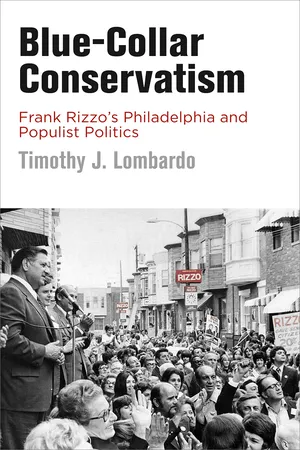
The postwar United States has experienced many forms of populist politics, none more consequential than that of the blue-collar white ethnics who brought figures like Ronald Reagan and Donald Trump to the White House. Blue-Collar Conservatism traces the rise of this little-understood, easily caricatured variant of populism by presenting a nuanced portrait of the supporters of Philadelphia Mayor Frank Rizzo.
In 1971, Frank Rizzo became the first former police commissioner elected mayor of a major American city. Despite serving as a Democrat, Rizzo cultivated his base of support by calling for "law and order" and opposing programs like public housing, school busing, affirmative action, and other policies his supporters deemed unearned advantages for nonwhites. Out of this engagement with the interwoven politics of law enforcement, school desegregation, equal employment, and urban housing, Timothy J. Lombardo argues, blue-collar populism arose.
Based on extensive archival research, and with an emphasis on interrelated changes to urban space and blue-collar culture, Blue-Collar Conservatism challenges the familiar backlash narrative, instead contextualizing blue-collar politics within postwar urban and economic crises. Historian and Philadelphia-native Lombardo demonstrates how blue-collar whites did not immediately abandon welfare liberalism but instead selectively rejected liberal policies based on culturally defined ideas of privilege, disadvantage, identity, and entitlement. While grounding his analysis in the postwar era's familiar racial fissures, Lombardo also emphasizes class identity as an indispensable driver of blue-collar political engagement. Blue-Collar Conservatism ultimately shows how this combination of factors created one of the least understood but most significant political developments in recent American history.
eBook - ePub
Blue-Collar Conservatism
Frank Rizzo's Philadelphia and Populist Politics
- 328 pages
- English
- ePUB (mobile friendly)
- Available on iOS & Android
eBook - ePub
About this book
Trusted by 375,005 students
Access to over 1.5 million titles for a fair monthly price.
Study more efficiently using our study tools.
Information
Publisher
University of Pennsylvania PressYear
2018Print ISBN
9780812224832
9780812250541
eBook ISBN
9780812295436
PART I

From Liberalism to Law and Order
CHAPTER 1
City of “Neighborhoods” and “Jungles”
In early 1957 investigative journalist Charles Shaw wrote an exposé about Philadelphia’s “jungle,” an area he described as running east from the Delaware River, north though parts of Kensington and North Philadelphia, and encompassing a large swath of the city’s urban core. To research his story, Shaw accompanied police officers on their patrols. He claimed Police Commissioner Thomas Gibbons asked him to write the story to let people know what cops were up against. The term “jungle,” Shaw said, came from Gibbons. Shaw relayed a story of destitution and decline, an area marked by blighted housing, a troublingly high crime rate, and a shamed population. Once a source of the city’s industrial infrastructure, Shaw’s “jungle” had joined the scores of midcentury American communities that had fallen into disrepair. Like the muckrakers of a half century earlier, Shaw told lurid tales of squalor and desperation. Unlike his Progressive-Era predecessors, however, Shaw had no interest in helping the denizens of Philadelphia’s “jungle.” He blamed them for their own poverty and called them drunks, thieves, and transients searching for instant gratification. Shaw’s true concern was the threat his “jungle” posed to the rest of the city. “The jungle is Philadelphia’s shame and sorrow, Philadelphia’s greatest menace and Philadelphia’s greatest challenge,” he wrote. Although he invited his readers to see it for themselves, he made sure they knew “the jungle” was a place to avoid.1
Parts of Shaw’s story rang false, however. The area he described did not sound like the blue-collar neighborhoods many Philadelphians knew. It especially baffled the working-class white ethnics that lived in those neighborhoods. Taking umbrage with the story, Philadelphia Evening Bulletin columnist Anne E. Hellyer revisited Shaw’s “jungle” in search of the other side of the story. Instead of unkempt houses, she found block after block of neatly kept row homes lining well-swept streets. Instead of dejected derelicts, she found proud, hardworking, and defensive residents of blue-collar neighborhoods like Kensington, Fishtown, and Port Richmond. Charles Shaw, she said, had misjudged the powerful sense of pride they had in their homes.2
Neither Hellyer nor the white, blue-collar Philadelphians she interviewed denied the reality of the city’s “jungle.” As many of them pointed out, however, Shaw had misidentified it. He based his neighborhood boundaries on Philadelphia Police Division maps and included the entire Twenty-Sixth District in his analysis. The North Central Police Division was one of the department’s largest. In addition to all of North Central Philadelphia, it included Kensington’s river ward neighborhoods, parts of Fishtown and Port Richmond, as well as the North Philadelphia neighborhoods of Brewerytown, North Penn, and Strawberry Mansion. The borders that separated these neighborhoods were never as fixed as police district boundaries. Indeed, it was these informal borders that maintained Philadelphia’s discrete communities and reputation as a “city of neighborhoods.” In pointing out Shaw’s error, Hellyer and her blue-collar sources claimed that “the jungle” strictly referred to the rundown parts of North Central Philadelphia. Kensington, Fishtown, Port Richmond, Brewerytown, North Penn, and Strawberry Mansion were separate neighborhoods, they said. Each was as distinct from the others as they were from “the jungle.” Together they were home to thousands of hardworking, white ethnic homeowners. North Central Philadelphia was almost entirely populated by African Americans, renters, and the unemployed. “We may be poor here,” said a Port Richmond woman, “but we don’t live in filth and crime. We are clean, decent, God-fearing people.”3
White, blue-collar residents of the Twenty-Sixth Police District roundly dismissed their neighborhoods’ inclusion in Shaw’s “jungle.” In disputing his characterization, they were also quick to point out that they would defend their neighborhoods from absorption. One “proud resident” of Brewerytown—where the shifting boundaries of North Central Philadelphia had already initiated white flight from the neighborhood—said that his family had lived there for years and they would not want to live anywhere else. “It is a good neighborhood, friendly and decent,” he continued. “It’s not a jungle, and we won’t let it become one either.” Proud blue-collar Philadelphians were determined to resist any threat to their neighborhoods.4
Like Anne Hellyer, countless reporters and other observers of the urban working class told the stories of proud residents of areas like Kensington, Fishtown, Port Richmond, and others. The people Hellyer interviewed were proud that they lived in the same neighborhoods that their parents and grandparents had settled in. They were proud to provide the skilled labor for the factories and warehouses that still lined the neighborhoods’ outer edges. They prided themselves on maintaining close-knit communities for generations. Parents were proud of the schools their children attended, which were often the same schools they had attended as children. Those that mortgaged their own homes took special pride in paying their own way toward homeownership. Blue-collar pride was more than a statement of loyalty or self-respect, however. It also distinguished urban spaces and established exclusivity.5 In the imagination of blue-collar white ethnics, white spaces were “proud neighborhoods” while black spaces were “urban jungles.” Their protest against Charles Shaw was directed at his conflation of distinct urban spaces.
These distinctions were artificial and steeped in the history of racist housing patterns and policies. In Philadelphia, as in cities throughout the urban North, “proud neighborhoods” and “urban jungles” grew together to erect the physical and social structures that shaped postwar politics. Both were products of the federal policies, local politics, and patterns of redevelopment that transformed urban space over the course of the twentieth century. Moreover, white, blue-collar neighborhood pride not only separated white and black spaces, it also led to the direct exclusion of African American residents from white spaces. Indeed, the jungle metaphor—long used to denigrate people of African descent as uncivilized or unfit for modern society—served as a reminder that the politics of neighborhood pride played out on deeply racialized terrain.6
Philadelphia’s proud neighborhoods would carry all these implications with them when they became the center of blue-collar life and politics in the long postwar period. Defense of neighborhood was at the root of nearly every conflict that contributed to the transformation in white working- and middle-class politics in the 1960s and 1970s. Frank Rizzo, as both police commissioner and mayor, drew his political strength from the city’s blue-collar neighborhoods. The formation and fortification of these neighborhoods—and their symbiotic relationship with the so-called “urban jungle”—created the parameters that allowed for Rizzo’s rise long before his law enforcement and political ascendancy. To be sure, the rise of Frank Rizzo and blue-collar conservatism were predicated on the postwar realignment of urban space.
Paradoxically, that realignment was indebted to a broader transformation in Philadelphia’s immediate post–World War II era, when urban liberals guided one of the most successful periods of reform in modern America. These reformers established a municipal liberal consensus based on commitments to “good government,” city planning, and economic growth through private-public partnership. While harkening back to the Progressive Era’s reliance on pragmatism and expertise, Philadelphia reformers also embraced the New Deal orthodoxy that had guided American liberalism since the 1930s.7 Just as importantly, they came to municipal governance with an almost unprecedented dedication to civil rights policy-making and local government’s responsibility to ensure equal opportunity. On a small scale, Philadelphia liberals recreated the New Deal coalition that had sustained the Democratic Party since the Great Depression and brought together the sometimes contradictory aims of good-government reformers, business leaders, intellectuals, civil rights activists, and organized labor.8 Reformers birthed a period of immense promise. At the same time, however, they oversaw the re-creation of structural inequalities that transformed the city as much as their reforms. The gulf between the promises and limitations of urban liberalism established the politics of the urban crisis that shaped Philadelphia’s long postwar period. The full emergence of blue-collar conservatism was still decades away, but the parameters on which it rose coalesced during the city’s reform era.
Reform and the Promise of Urban Liberalism
Hundreds of thousands of Philadelphians toured Gimbels Center City department store in the late summer and fall of 1947. Drawn as usual by the chain’s competitive prices and convenient location, they now came in droves to see one of the city’s latest attractions, the City Planning Commission’s “Better Philadelphia Exhibition.” Together with the Chamber of Commerce and Citizens’ Council on City Planning, the City Planning Commission (CPC) created the exhibit to showcase the promise of effective planning. The exhibition featured dioramas, aerial photograph maps, movies, cartoons, wall panels, and a built-to-scale model of Center City. Attendees viewed the planners’ vision for rejuvenating the Central Business District and redeveloping the historic sites around Independence Mall. Plans also called for removal of an obsolete and unused Pennsylvania Railroad viaduct just west of City Hall, known locally as the “Chinese Wall.” Outside of Center City, the Better Philadelphia Exhibition displayed plans for the highway system, the international airport, and large areas of still-undeveloped land in Northeast and Southwest Philadelphia. While the exhibit mostly focused on improving avenues of commerce and tourism, planners did not ignore the city’s neighborhoods. “Philadelphia has always been a city of neighborhoods,” one planner said, so it was imperative for the exhibition to communicate how they would benefit.9 Displays explained that city planning meant routing truck traffic away from residential areas as well as the creation of more recreation facilities, libraries, and community centers. It meant the removal of slum housing through substantial redevelopment and an expanded public housing program. Laying out their ideas in great detail, city planners drummed up support for a truly massive urban renewal program.10
The Better Philadelphia Exhibition was a resounding success. Nearly four hundred thousand people paid the one-dollar entrance fee to catch a glimpse at the promise of city planning. “The problem of new and improved public works was placed squarely before the citizens with price tags attached,” reflected one city planner. “Indicative of the interest aroused by the exhibition,” he continued, “60 per cent of the citizens attending replied ‘Yes’ to a question as to whether they would be willing to pay a little more in taxes in order to accomplish the improvements.”11
Three years after the exhibition, Philadelphia’s planning renaissance received a boost from an equally substantive political transformation. A group of business-oriented civic leaders united around the belief that the corrupt Republican machine that had ruled Philadelphia nearly unchecked for close to a century harmed the city’s reputation and economic future. Forming the Greater Philadelphia Movement (GPM), the new organization backed reform-Democrat efforts to wrest power from the Republican Party and remake municipal government. Key to that project was the creation of a new city charter that would grant city government more autonomy from the state and curtail corruption.12 The goal of charter reform was “good government,” especially the removal of the city’s notorious patronage system. Reformers wanted appointments based on professional qualification rather than political deal-making. The momentum from the Better Philadelphia Exhibition combined with GPM in 1951, when Philadelphians went to the polls and overwhelmingly approved a charter that established a strong mayoral government, limited the city council’s power, expanded the civil service system, and empowered the City Planning Commission. Reformers not only created a new city government, they laid the groundwork for a municipal liberal consensus based on the mutually reinforcing dictates of expansive urban renewal and public-private cooperation for economic growth.13
The new city charter was the lynchpin of Philadelphia’s municipal liberal consensus. The overall impact of charter reform was much broader, however. When it went into effect in 1952, the new charter fundamentally altered city operations. It established a strong executive branch in the office of the mayor, which now included a managing director, director of finance, and a city representative with the authority to oversee new and vital aspects of municipal government. The charter put checks on the newly powerful mayor by demanding an annual audit by the city controller and including a provision for mayoral recall, but it nevertheless ensured that postwar Philadelphia politics would be focused on the mayor’s office.14
Reform Democrat Joseph Clark, elected later in the same year that Philadelphians adopted their new charter, would be the first to use those expanded powers. Clark’s longtime collaborator and mayoral successor, Richardson Dilworth, was elected district attorney in the same election. Although their personalities often clashed, Clark’s and Dilworth’s commitment to liberal reform overshadowed their differences and accentuated their similarities. Both were from wealthy backgrounds, educated in the Ivy League; and both found their way into politics after successful legal careers. Importantly, neither had any meaningful connection to the city’s working-class neighborhoods. Dilworth had first run for mayor in 1947, but he ran headlong into the city’s Republican machine. The electoral loss was only a minor setback. When Philadelphia’s reform duo took aim at City Hall just months after voters approved the new charter, they captured the momentum of the Better Philadelphia Exhibition and Greater Philadelphia Movement. Clark, Dilworth, and a slate of Democrats won their electoral campaigns and began the process of remaking city politics.
Clark and Dilworth enshrined their place in the city’s development by overseeing the implementation of the Better Philadelphia Exhibition’s plans and the provisions of the city charter. The charter revamped city operations in a number of ways. It created ten new or restructured municipal departments under the supervision of the managing director, including the Departments of Public Health, Streets, Recreation, Public Welfare, Wate...
Table of contents
- Cover
- Half title
- Title
- Copyright
- Dedication
- Contents
- Introduction. Blue-Collar Conservatism and Frank Rizzo’s Philadelphia
- Part I. From Liberalism to Law and Order
- Part II. The Rise of Blue-Collar Conservatism
- Epilogue. Blue-Collar Conservatism and Modern America
- List of Abbreviations
- Notes
- Index
- Acknowledgments
Frequently asked questions
Yes, you can cancel anytime from the Subscription tab in your account settings on the Perlego website. Your subscription will stay active until the end of your current billing period. Learn how to cancel your subscription
No, books cannot be downloaded as external files, such as PDFs, for use outside of Perlego. However, you can download books within the Perlego app for offline reading on mobile or tablet. Learn how to download books offline
We are an online textbook subscription service, where you can get access to an entire online library for less than the price of a single book per month. With over 1.5 million books across 990+ topics, we’ve got you covered! Learn about our mission
Look out for the read-aloud symbol on your next book to see if you can listen to it. The read-aloud tool reads text aloud for you, highlighting the text as it is being read. You can pause it, speed it up and slow it down. Learn more about Read Aloud
Yes! You can use the Perlego app on both iOS and Android devices to read anytime, anywhere — even offline. Perfect for commutes or when you’re on the go.
Please note we cannot support devices running on iOS 13 and Android 7 or earlier. Learn more about using the app
Please note we cannot support devices running on iOS 13 and Android 7 or earlier. Learn more about using the app
Yes, you can access Blue-Collar Conservatism by Timothy J. Lombardo in PDF and/or ePUB format, as well as other popular books in History & North American History. We have over 1.5 million books available in our catalogue for you to explore.