A powerful analysis of events that helped galvanise resistance across civil society
The 2017 publication of Betrayal of the Promise, the report that detailed the systematic nature of state capture, marked a key moment in South Africa's most recent struggle for democracy. In the face of growing evidence of corruption and of the weakening of state and democratic institutions, it provided, for the first time, a powerful analysis of events that helped galvanise resistance within the Tripartite Alliance and across civil society. Working often secretly, the authors consolidated, for the first time, large amounts of evidence from a variety of sources. They showed that the Jacob Zuma administration was not simply a criminal network but part of an audacious political project to break the hold of whites and white business on the economy and to create a new class of black industrialists. State-Owned Enterprises (SOEs) such as Eskom and Transnet were central to these plans.
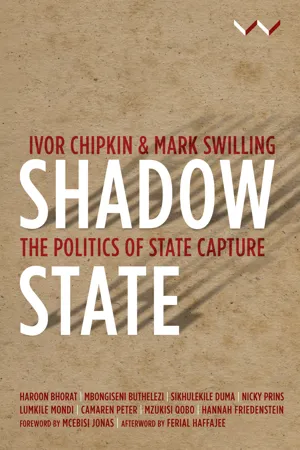
The report introduced a whole new language to discuss state capture, showing how SOEs were 'repurposed', how political power was shifting away from constitutional bodies to 'kitchen cabinets', and how a 'shadow state' at odds with the country's constitutional framework was being built. Shadow State is an updated version of the original, explosive report that changed South Africa's recent history.
eBook - ePub
Shadow State
The Politics of State Capture
- 186 pages
- English
- ePUB (mobile friendly)
- Available on iOS & Android
eBook - ePub
Shadow State
The Politics of State Capture
About this book
Trusted by 375,005 students
Access to over 1 million titles for a fair monthly price.
Study more efficiently using our study tools.
Information
1
Structuring the Capture of the State
The nexus between the constitutional and shadow states depends on the integration of a range of skills similar to those present in most international corporations. The composition of the Zuma-centred power elite is, in many respects, highly organised, following the structure of what, in academic terms, is called a ‘war economy’.1 In a war economy the ‘shadow state’ establishes a number of informal structures which produce systems of ‘profit, power and protection’2 that, in turn, serve to further their operations, making possible continued preferential access to resources and power through an exploitative economic system. The cycle can, therefore, continue.
One of the key requirements in establishing these shadow structures is the ability to secure a system of command and control over the way the resources are accessed, moved and distributed. At the outset, control must be established over the sources of extraction, including the ability to respond flexibly to any changes in the operating environment.3 Once access to the source of extraction is secured, networks of middlemen or brokers must be established that can move resources externally, usually transnationally, to sustain loyalty (this is critical to ensuring the survival of the network). The ability to transact within this network is facilitated by establishing political marketplaces where support is traded through the provision of access to resources.
The skills of this patronage network are localised within a number of groups. The networks consist of three elements: the controllers, the elites and the entrepreneurs (also known as brokers), as shown in Figure 1.1.
The controllers, or patrons, of resources sit at the apex and are usually the strongmen directly responsible for predation and exploitation. Their function is to secure access to and maintain control over resources.4 A patron or controller typically favours one group over another (or others), resulting in the exclusion of those who are out of favour. This sets up a competitive set of nodes around the patron or controller, which has the ultimate effect of rendering elites (the next layer down) unable to cooperate effectively as they fear being ousted by their partners, or falling out of favour with the patron. Jacob Zuma and the Guptas have been controllers.

Figure 1.1. Generalised model of a patronage network that extracts and administers rents
The elites are responsible for establishing and maintaining patronage networks, which facilitate the distribution of benefits. In the South African context the elites would be such players as Free State premier Ace Magashule, ministers Faith Muthambi, Malusi Gigaba and Mosebenzi Zwane, Eskom’s Anoj Singh and the ubiquitous Brian Molefe.
The entrepreneurs, who are also known as brokers, are middlemen who facilitate the movement of funds, information and/or goods both domestically and across transnational networks, using ‘recruitment networks, lending networks, remittance transfers and smuggling networks’.5 Examples are Transnet’s Iqbal Sharma; Eric Wood, CEO of Gupta company Trillian Partners; Gupta associate Salim Essa, a former partner of Sharma; and Ashok Narayan, former managing director of the Guptas’ Sahara Computers.
Networks of brokers secure domestic and cross-border operations through which resources can be moved to international clearing hubs and enter legitimate trade activities. Brokers are often of a different nationality or ethnicity from the controller or patron – usually a minority group – so that they cannot mount a significant challenge. They have commercial ties to different clusters of communities through which they are able to achieve networked competence, and they have access to ports of entry. Brokers and ports are ‘choke points’ for intervention in patronage networks.6 If brokers are identified and their ability to operate is significantly reduced, the patronage network is weakened and may collapse.
Dealers are groups that are able to move the money transnationally (for example, the professional money-laundering syndicates in Hong Kong, the United Arab Emirates and elsewhere).7
An essential requirement is to secure and establish cross-border networks to move illicit proceeds into international clearing hubs where they enter the legitimate trade and accrue value to the members of the network.8 In many instances the networks use clandestine methods to mask the origins of resources in order to protect their members from external scrutiny.9 From an operational perspective, these networks of brokers and dealers must perform a number of functions.

Ultimately, the key to realising the full potential of control over resources is the ability to strip assets and convert them into monetary resources – typically through money laundering – that can fund the patronage operations.11
The conversion of such assets also requires the existence of an appropriate infrastructure for handling and moving them. Such infrastructure includes banking and ‘alternative remittance systems … import-export firms that participate in false invoicing schemes, precious metal markets, and the use of trusts, international business companies, and non-transparent jurisdictions as mechanisms to hide funds’.12
Money-laundering procedures
Money laundering is the process of transforming illicit money into ostensibly legitimate assets. It typically follows a three-stage process: placement, layering and integration. Placement involves moving funds into activities or accounts from which they can be legitimised through layering (blending illegitimate with legitimate funds, recycling them through cash-based operations, moving them into ‘legitimate companies’ or moving them around in complex transactions, and so on). These funds are then integrated back into the revenue stream of the money launderer (often by purchasing property and other goods).
The laundering process usually requires a financial system with lax regulations and controls. Rents are also often distributed in cash and, indeed, this may be preferable in many instances, but there are limits t...
Table of contents
- Cover
- Title Page
- Copyright Page
- Contents
- List of figures and tables
- Acronyms and abbreviations
- Key terms
- Acknowledgements
- Foreword: Mcebisi Jonas
- Prologue
- Introduction
- Chapter 1: Structuring the Capture of the State
- Chapter 2: The Politics of Betrayal
- Chapter 3: Power, Authority and Audacity: How the Shadow State Was Built
- Chapter 4: Repurposing Governance
- Chapter 5: Conclusion
- Afterword: Ferial Haffajee
- Contributors
- Index
Frequently asked questions
Yes, you can cancel anytime from the Subscription tab in your account settings on the Perlego website. Your subscription will stay active until the end of your current billing period. Learn how to cancel your subscription
No, books cannot be downloaded as external files, such as PDFs, for use outside of Perlego. However, you can download books within the Perlego app for offline reading on mobile or tablet. Learn how to download books offline
Perlego offers two plans: Essential and Complete
- Essential is ideal for learners and professionals who enjoy exploring a wide range of subjects. Access the Essential Library with 800,000+ trusted titles and best-sellers across business, personal growth, and the humanities. Includes unlimited reading time and Standard Read Aloud voice.
- Complete: Perfect for advanced learners and researchers needing full, unrestricted access. Unlock 1.4M+ books across hundreds of subjects, including academic and specialized titles. The Complete Plan also includes advanced features like Premium Read Aloud and Research Assistant.
We are an online textbook subscription service, where you can get access to an entire online library for less than the price of a single book per month. With over 1 million books across 990+ topics, we’ve got you covered! Learn about our mission
Look out for the read-aloud symbol on your next book to see if you can listen to it. The read-aloud tool reads text aloud for you, highlighting the text as it is being read. You can pause it, speed it up and slow it down. Learn more about Read Aloud
Yes! You can use the Perlego app on both iOS and Android devices to read anytime, anywhere — even offline. Perfect for commutes or when you’re on the go.
Please note we cannot support devices running on iOS 13 and Android 7 or earlier. Learn more about using the app
Please note we cannot support devices running on iOS 13 and Android 7 or earlier. Learn more about using the app
Yes, you can access Shadow State by Ivor Chipkin,Mark Swilling,Haroon Bhorat,Mzukisi Qobo,Sikhulekile Duma,Lumkile Mondi,Camaren Peter,Mbongiseni Buthelezi,Hannah Friedenstein,Nicky Prins, Ivor Chipkin, Mark Swilling, Haroon Bhorat, Mzukisi Qobo, Sikhulekile Duma, Lumkile Mondi in PDF and/or ePUB format, as well as other popular books in Politics & International Relations & Politics. We have over one million books available in our catalogue for you to explore.