Road asset management is one of the top priorities of the Central Asia Regional Economic Cooperation (CAREC) Transport and Trade Facilitation Strategy 2020. The implementation of performance-based road maintenance contracts (PBCs)—an essential element of road asset management—promotes effective and efficient maintenance of road networks. Well-designed PBCs keep roads in predefined good condition at relatively low cost. This guide aims to help policy makers in CAREC member countries understand and implement PBCs. After a brief history of the development of PBCs, it discusses the various types of PBCs and their relative advantages and disadvantages. It highlights PBC implementation in selected developed, developing, and transitional countries, including CAREC member countries, to illustrate best practices.
- 72 pages
- English
- ePUB (mobile friendly)
- Available on iOS & Android
eBook - ePub
About this book
Information
1. Introduction
1.1 What Are Performance-Based Road Maintenance Contracts?
1. Road maintenance has traditionally been the realm of public road organizations. Many countries in the Central Asia Regional Economic Cooperation (CAREC) region are still performing road maintenance in-house, especially routine road maintenance.
2. However, there is now a global trend for such work to be contracted out to the private sector. The main reason for shifting to such contracts is to improve efficiency. Provided that there are qualified road maintenance contractors with adequate competition, cost savings of between 30% to 50% have been realized in other regions (Frost and Lithgow 1996; and Zietlow 2015). Thus, some countries have turned to contractors to deliver road maintenance.
3. There are three types of road maintenance contracts:
• Method based or conventional contracts with unit rates for work items and payments based on quantities of measured quantities of works completed, which is the traditional way of contracting out road maintenance;
• Performance-based road maintenance contracts (PBC) with performance levels defined for each road asset or service provided under the contract with fixed payments if performance levels are met, or payment reductions for noncompliance;
• Mixed or hybrid PBCs that contain elements of both contract types.
4. Most PBCs worldwide are mixed or hybrid PBCs, where most works and services are performance based. Emergency, major rehabilitation and improvement works are often paid on the basis of unit prices and quantities of works completed. Some PBCs contain output-based work items such as specified improvement or rehabilitation works (e.g., a number of kilometers (km) of a defined overlay per year), paid on a lump sum basis. These contracts are also referred to as Output- and Performance (Outcome)-Based Contracts.2 There is no common terminology for PBCs. Each country differs in the terminology that they use,3 as well as in the scope of the work, method of payments, duration of the contract, and management arrangements.
5. What all PBCs have in common is that the contractor needs to maintain the road assets in predefined good conditions or service levels during the entire contract period. Payments are based on how well the contractor manages to comply with the performance or service levels obligations defined in the contract, and not on the amount of works and services executed. It is up to the contractor how to achieve this. Therefore, work selection, design, and delivery are all the contractor’s responsibility. Hence, the choice and application of technology and the pursuit of innovative materials, processes and management are all up to the contractor as long as there is compliance with the relevant laws and regulations. Compared to conventional contract arrangements where the client determines work selection, design and delivery, PBCs allocate a higher risk to the contractor. At the same time, it opens opportunities for increased profit margins as improved efficiencies and effectiveness of design, process, technology or management can reduce the cost of achieving the specified service levels.
1.2 Brief History of Performance-Based Road Maintenance Contracts
6. The development of PBCs started in the late 1980s and early 1990s. In 1988, British Columbia in Canada started to contract out road maintenance to the private sector by introducing some performance levels for routine maintenance. Two years later, Argentina contracted out almost half of its national roads using performance levels for maintenance works and services including periodic maintenance and spot rehabilitations, with a penalty system for failures to meet response times for rectifying deficiencies.
7. During the 1990s, many countries in Latin America such as Brazil, Chile, Peru, and Uruguay started their first PBC pilot projects. At the same time, PBCs developed in Australia and New Zealand as well as in Denmark, Estonia, Finland, and the United States (US). Many other countries followed after the year 2000.
8. In some countries, such as Argentina and Canada, PBCs have almost entirely replaced the traditional way of contracting out road maintenance and have had a chance to evaluate the value-added benefits of using PBCs. The rapid adoption of PBCs worldwide indicates that such contracts deliver better value for money than conventional contracts and can guarantee good road conditions at the same time. It is expected that this trend will continue and PBCs will eventually replace the traditional way of contracting out road maintenance.
1.3 Advantages and Disadvantages
9. The main reason why developed countries have switched from conventional contracting out road maintenance to PBCs is the potential for cost savings. Reported savings are typically between 15% and 30% when compared with the same scope of works undertaken by conventional unit price contracts. Table 1 illustrates reported savings in select countries.
Table 1: Reported Savings of Performance-Based Road Maintenance Contracts against Conventional Unit Price Contracts
| Country | Reported Savings against Conventional Unit Price Contracts |
| Australia | 10% –40% |
| Brazil | 15%–35% |
| Canada | About 20% |
| Estonia | 20%–40% |
| Finland | 18% |
| The Netherlands | 30%-40% |
| New Zealand | 15%-38% |
| United States | 10%–15% |
Source: P. Pakkala et al. 2007.
10. Generally, cost reductions were largest when contractors faced strong competition and have gained experiences with PBCs. Since PBCs are fixed price contracts, contractors have an incentive to maintain the contracted service levels at the lowest cost possible. The longer the contract duration, the higher the incentive. Besides competition, modern management and work procedures, increased labor productivity, total life cycle costing, just-in-time maintenance, and better use of latest technologies have driven down costs. A well-documented case for demonstrating the importance of good competition in driving down costs is illustrated in Box 1. A word of caution however: when there is a lack of competition, the expected savings might not be realized.
Box 1: Case Study: Reducing Road Maintenance Costs per Kilometer through Competition and the Introduction of Performance-Based Road Maintenance Contracts in New South Wales
In 1990, the Roads and Traffic Authority (RTA) of New South Wales initiated a pilot road maintenance contract project in the Sydney region. The objectives of the pilot were to establish the feasibility of contracting road maintenance and to measure differences in cost, quality, and responsiveness between a private contractor and the RTA workforce. RTA choose two road sections each measuring 100 kilometers (km), and with similar road conditions. One section was given to an RTA team to maintain while the other was contracted to the private sector for 2 years and retendered for two additional 2-year terms. Both the RTA team and the private contractor were supervised by a consultant and were subject to the same service levels.
The box figure below illustrates how good competition can reduce maintenance costs over time. After the third tender round, maintenance costs had been reduced by 48%. In addition, the 5-year performance contract on urban roads in Sydney produced even more savings due to increased competition, extended road network and longer contract period.
This example demonstrates that (i) shifting from in-house works to contracting out based on conventional maintenance contracts with unit prices produces significant savings, and that (ii) further savings are possible by introducing PBCs. In this case, the total savings amounted to more than 60% compared to the cost of delivering maintenance services in-house.
Box figure: maintenance costs over time (% 1991 rates)
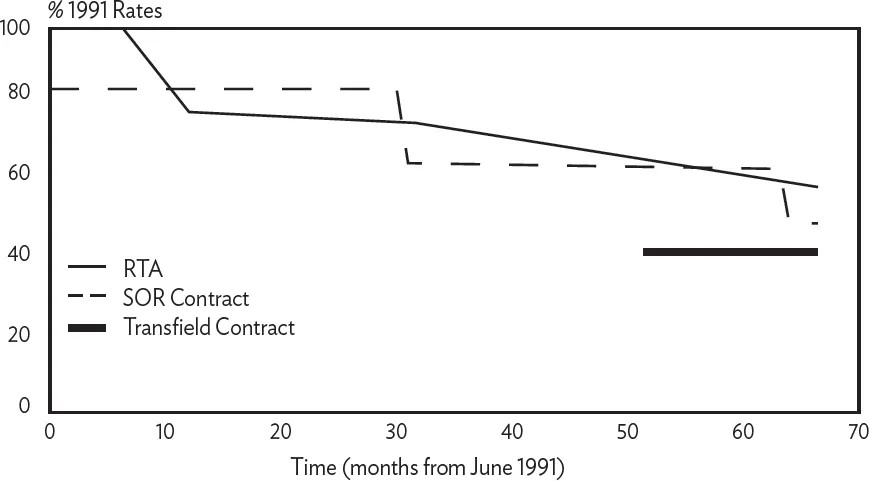
RTA = Roads and Traffic Authority, SOR = schedule of rates.
Source: M. Frost and C. Lithgow. 1996.
11. For developing countries, the main driving force to introduce PBCs is to secure sufficient long-term financing for road maintenance and guarantee better road conditions. The experiences of Argentina, Malaysia, and Uruguay provide good examples of this.
12. In 2000, Malaysia introduced area-wide PBCs with a 15-year term on all its national roads and was successful in securing sufficient road maintenance funds during the entire contract period. Argentina and Uruguay were similarly successful in their respective efforts.
Even during the 2002 economic crisis, both countries were able to honor their commitments towards all their respective PBCs.
13. Besides the potential to reduce road maintenance costs and secure long-term financing, PBCs help in the following manner:
Road Agencies
• Savings on rehabilitation costs, since roads in good condition avoid rehabilitation
• Safeguards against cost overruns from frequent claims and contract amendments to increase quantities of work
• Reduction in the workload of staff
• Improvement in the quality of works
• Improvement in control and enforcement of performance levels
• Improvement in road safety
Road Users
...Table of contents
- Cover
- Title Page
- Copyright Page
- Contents
- Tables, Figures, and Boxes
- Abbreviations
- Glossary
- Acknowledgments
- Executive Summary
- Objectives and Purpose
- 1. Introduction
- 2. Basic Concepts of Performance-Based Road Maintenance Contracts
- 3. Implementation Experiences
- 4. Lessons Learned
- 5. Performance-Based Road Maintenance Contracts Implementation Strategy in CAREC Member Countries
- 6. Recommended Options for Pilot Performance-Based Road Maintenance Contracts in CAREC Member Countries
- 7. Role of International Financial Institutions
- References
- Appendix 1: Different Types of Performance-Based Road Maintenance Contracts
- Appendix 2: Framework for the Analysis of Capacities of Road Organizations, Contractors, and Consultants
- Appendix 3: Sample List of Bidding Documents
- Appendix 4: List of Online Documents and Presentations on Performance-Based Road Maintenance Contracts
- Appendix 5: Management Services
- Footnotes
- Back Cover
Trusted by 375,005 students
Access to over 1.5 million titles for a fair monthly price.
Study more efficiently using our study tools.
Frequently asked questions
Yes, you can cancel anytime from the Subscription tab in your account settings on the Perlego website. Your subscription will stay active until the end of your current billing period. Learn how to cancel your subscription
No, books cannot be downloaded as external files, such as PDFs, for use outside of Perlego. However, you can download books within the Perlego app for offline reading on mobile or tablet. Learn how to download books offline
Perlego offers two plans: Essential and Complete
- Essential is ideal for learners and professionals who enjoy exploring a wide range of subjects. Access the Essential Library with 800,000+ trusted titles and best-sellers across business, personal growth, and the humanities. Includes unlimited reading time and Standard Read Aloud voice.
- Complete: Perfect for advanced learners and researchers needing full, unrestricted access. Unlock 1.5M+ books across hundreds of subjects, including academic and specialized titles. The Complete Plan also includes advanced features like Premium Read Aloud and Research Assistant.
We are an online textbook subscription service, where you can get access to an entire online library for less than the price of a single book per month. With over 1.5 million books across 990+ topics, we’ve got you covered! Learn about our mission
Look out for the read-aloud symbol on your next book to see if you can listen to it. The read-aloud tool reads text aloud for you, highlighting the text as it is being read. You can pause it, speed it up and slow it down. Learn more about Read Aloud
Yes! You can use the Perlego app on both iOS and Android devices to read anytime, anywhere — even offline. Perfect for commutes or when you’re on the go.
Please note we cannot support devices running on iOS 13 and Android 7 or earlier. Learn more about using the app
Please note we cannot support devices running on iOS 13 and Android 7 or earlier. Learn more about using the app
Yes, you can access Guide to Performance-Based Road Maintenance Contracts by in PDF and/or ePUB format, as well as other popular books in Technology & Engineering & Transportation Industry. We have over 1.5 million books available in our catalogue for you to explore.