Asia is graying rapidly: its share of senior population aged 65 and over will double from 9.2% in 2020, to 18% in 2050. Some countries will experience a drastic reduction of its working-age population (ages 15–64), as well as aging of the current workforce. This report explores the role and potential of technology in addressing economic and labor market opportunities and challenges posed by aging. It shows how technology can harness gains from the longevity dividend and draws together national and regional policy recommendations for countries in Asia and the Pacific.
- 40 pages
- English
- ePUB (mobile friendly)
- Available on iOS & Android
eBook - ePub
About this book
Information
SECTION 1
DEMOGRAPHIC TRANSITION IN ASIA
1.1 | Asia’s Demographic Transition: Progress and Outlook
It is a stylized fact that economic development is accompanied by lower mortality and birth rates due to improvements in public health and medical science while increasing the direct and indirect opportunity costs of having children.
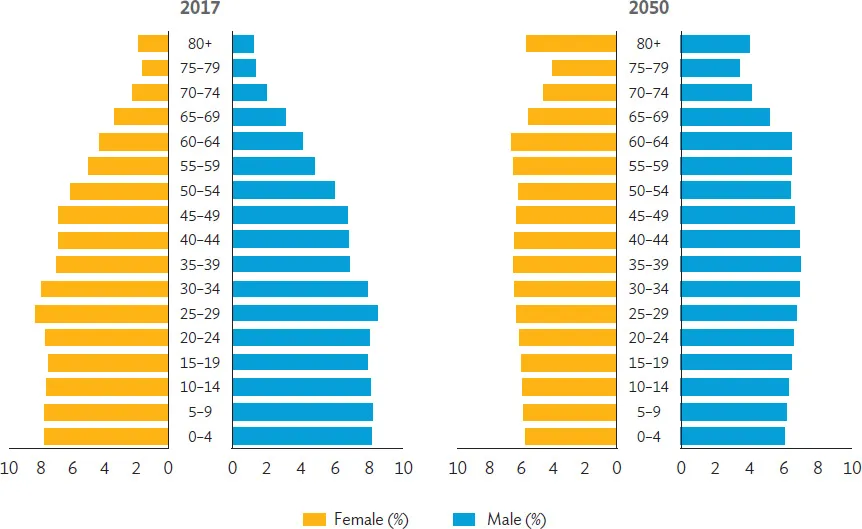
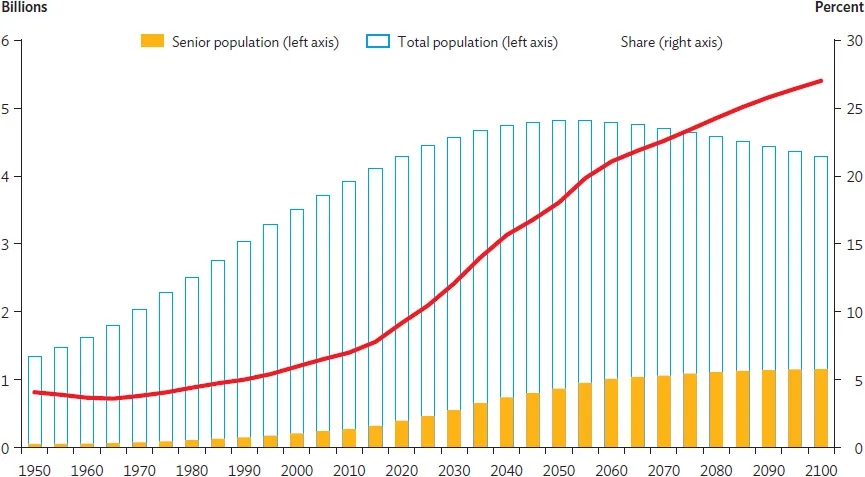
Asia and the Pacific has witnessed significant demographic transition (Figure 1). The region’s total population grew from 1.3 billion in 1950 to 4.2 billion in 2017 and is projected to reach 4.8 billion in 2050. The United Nations estimated that Asia’s population will grow until 2053 (4.8 billion), after which it will steadily decline, falling back by 2100 to 4.3 billion people, the same population as expected in 2020.1
Figure 1: Population Pyramid in Asia, 2017 and 2050
Source: ADB calculations using data from the United Nations, Department of Economic and Social Affairs, Population Division.
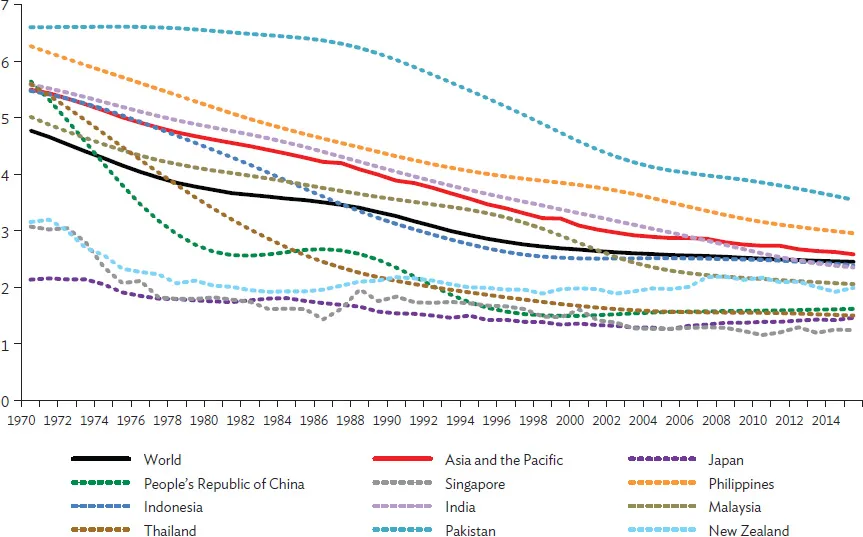
Low mortality and fertility rates are the two biggest contributors to longer life expectancy and increases in the share of seniors in the populations of countries across the region. Lower mortality rates are realized primarily due to the drastic reduction in the infant mortality rate—from 88 to 23 per 1,000 births between 1970 to 2015 (World Bank, World Development Indicators). In response, fertility rates in Asia and the Pacific have declined from 5.5 births per woman in 1970 to 2.6 in 2015, with significant variation across countries (Figure 2). On a global scale, the average fertility rate dropped from 4.8 to 2.5 in the same period.
Figure 2: Fertility Rates in Asia and the Pacific, 1970–2015
Source: ADB calculations using data from the World Bank, World Development Indicators (accessed March 2018).
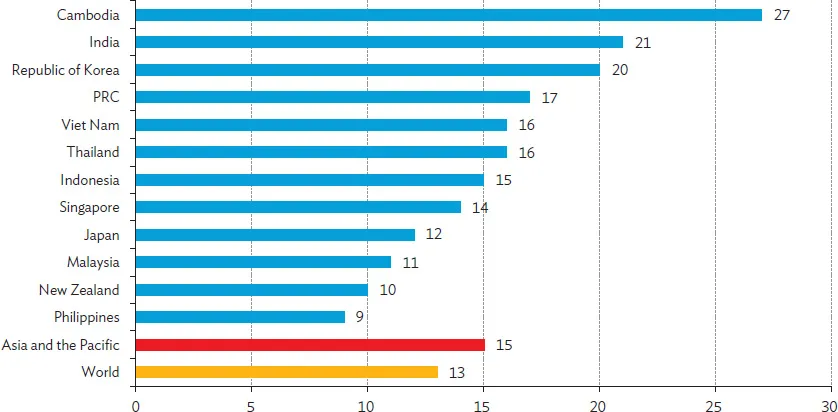
Low mortality and fertility rates along with further improvement in medical service and nutrition expanded the average life span from 57 years in 1970 to 73 years in 2015 in Asia. For Cambodia, India, and the Republic of Korea, life expectancy lengthened by at least 20 years (Figure 3). For the countries in advanced stage of aging—i.e., Japan, the Republic of Korea, New Zealand, and Singapore—life expectancy lengthened by at least 10 years in the same period.
Figure 3: Increase in Life Expectancy between 1970 and 2015
PRC = People’s Republic of China.
Source: World Bank, World Development Indicators (accessed March 2018).
Source: World Bank, World Development Indicators (accessed March 2018).
1.2 | Compressed and Accelerating Speed of Aging in Asia
Asia and the Pacific is graying at an accelerating speed (Figure 4). From 2020 to 2050, the region’s share of seniors (age 65 or above) to the total population is to double from 9.2% to 18%, while the pace of change was more moderate in the past (4.4% to 7.0% between 1980 to 2010). Increased availability of family planning that resulted in a sharp decline in fertility rates is one major contributor to the faster speed of aging in the populations of some countries.
Figure 4: Senior Population in Asia and the Pacific, 1950–2100
Source: ADB calculations using data from the United Nations, Department of Economic and Social Affairs, Population Division.
Rapid graying process results in compressed period of aging in which a country climbs from being “aging” economy (share of seniors in the total population reaching 7%), “aged” (14%) to “super- aged” (21% or above) society (Figure 5).2 It took many decades for Western nations to transition from aging to aged society (the United States 70 years, Australia 75 years, the United Kingdom 45 years), but it took Japan, the only country in Asia to have reached a “super aged” population as of now, 37 years to reach that point. For other countries, graying is expected to progress in an even shorter time. It is projected that it will take 35 years for the PRC to witness its share of seniors to increase from 7% to 21 %, and 27 years for the Republic of Korea. Thailand and Viet Nam will have less than 32 and 33 years left, respectively, to prepare for one in every five citizens being senior. The speed with which countries are aging relative to their pace of economic development concerns economists because a nation that ages before reaching high-income status can face a slew of challenges that may compromise economic growth.
Figure 5: Speed of Aging
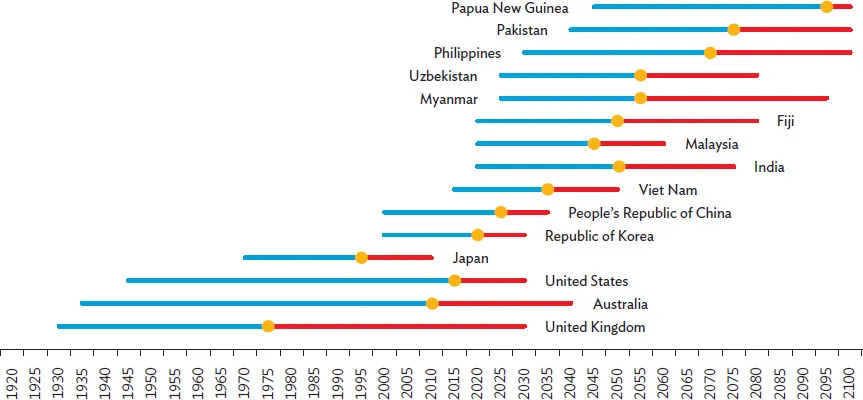
Note: The blue line refers to the projected number of years for the share of the population of age 65 and over to rise from 7% to 14%. The red line refers to the projected number of years for the share of the population of age 65 and over to increase from 14% to 21%.
Source: ADB calculations using data from the United Nations, Department of Social and Economic Affairs, Population Division.
Source: ADB calculations using data from the United Nations, Department of Social and Economic Affairs, Population Division.
1.3 | Demographic Shift and Labor Supply
Some economies in Asia will experience drastic reductions in working-age populations (ages 15–64). In Hong Kong, China and the Republic of Korea, the productive population will shrink by 10% (Figure 6) between 2017 and 2030. Japan, which has already reached an advanced stage of aging, will also witness further shrinkage of its working-age population by 8.7% in the same period. On the other hand, the workforce pool will continue to expand by at least 20% in Cambodia and the Philippines and over 30% in Papua New Guinea by 2030. Asia’s working-age population is expected to increase from 2.8 billion to 3.1 billion between 2017 to 2030, but its share of total population will no longer grow and plateau during this period at around 67% and decline to 64% by 2050.
Figure 6: Percentage Change in Population of Ages 15–64 between 2017 and 2030
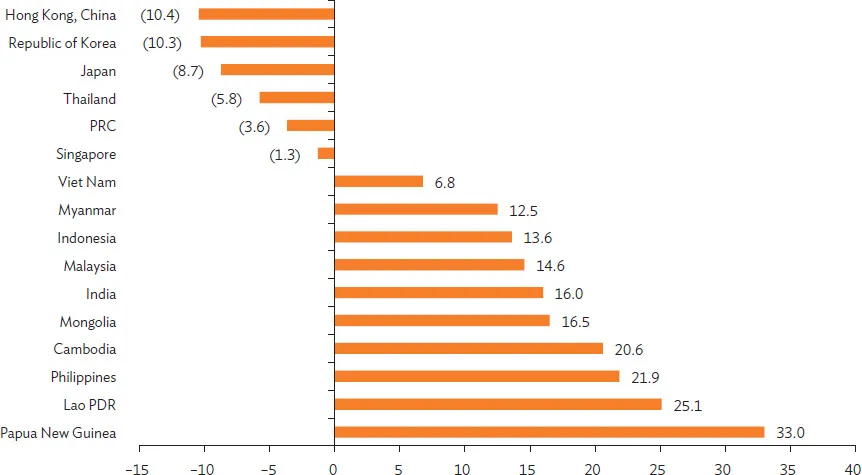
Lao PDR = Lao People’s Democratic Republic, PRC = People’s Republic of China.
Source: ADB calculations using data from the United Nations, Department of Economic and Social Affairs, Population Division.
Source: ADB calculations using data from the United Nations, Department of Economic and Social Affairs, Population Division.
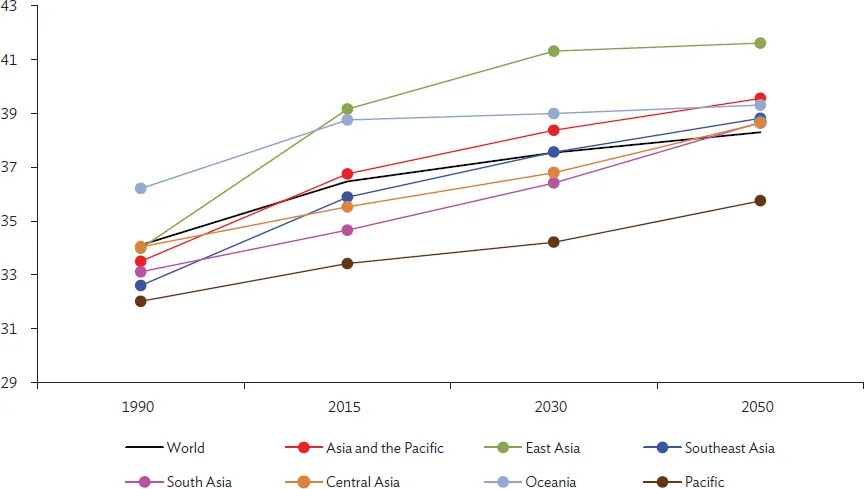
Aging also progresses within a workforce. Increases in the mean age of the working-age population are evident across all subregions in Asia. From 2015 to 2050, the average age is expected to increase from 37 to 40 in the region (Figure 7). The mean age was highest in East Asia (39) and lowest for the Pacific (33) in 2015. By 2050, these mean ages will increase to 42 and 36, respectively.
Figure 7: Mean Age of the Working-Age Population in Asia and the Pacific
Source: ADB calculations using data from the United Nations, Department of Economic and Social Affairs, Population Division.
The accelerating speed of aging is evident in many countries in the region, which has resulted in smaller and more aged workforces. Other countries are expected to continue experiencing demographic dividends for decades to come, but none are exempt from the force of demographic transition. Concern over the economic and social consequences of aging is growing as the era for reaping returns from the demographic dividend in the younger share of a population reaches its end. The next section explores the nexus between aging, economic development, and the economic implications of demographic transition. It collects evidence from aged countries with an aim of drawing policy implications for both aging and soon-to-be aging countries.
SECTION 2
AGING WORKFORCE, PRODUCTIVITY, AND THE ROLE OF TECHNOLOGY
2.1 | Aging, Productivity, and Growth
Demographic transition carries profound implications over the course of economic and social development of a country or a region. A bulge in the young workforce is closely associated with accelerating growth—a phenomenon known as the “demographic dividend.” As much as 33% of the growth in East Asia from 1965 to 1990 can be attributed to favorable demographics (Bloom, Canning, and Malaney 2000). Many parts of Asia which sustained low fertility rates are now facing a demographic transition, a shrinking working-age population and an aging workforce. Literature points to a possibility of demographic headwind that may fetter growth (Chomik, McDonald, and Piggott 2016; Flochel et al. 2015; Bloom, Canning, and Finlay 2010).
Aging and Aggregated Growth: The Macroeconomic View
Empirical evidence suggests that aging in advanced economies led to a decline in per capita product. In the United States, a 10% increase in the population share of those aged 60 and above is estimated to have led to...
Table of contents
- Front Cover
- Title Page
- Copyright Page
- Contents
- Tables, Figures, and Boxes
- Foreword
- Acknowledgments
- Highlights
- Introduction
- 1 Demographic Transition in Asia
- 2 Aging Workforce, Productivity, and the Role of Technology
- 3 Unlocking Technology Potential to Boost Productivity
- 4 Conclusion and Policy Implications
- References
- Footnotes
- Back Cover
Trusted by 375,005 students
Access to over 1.5 million titles for a fair monthly price.
Study more efficiently using our study tools.
Frequently asked questions
Yes, you can cancel anytime from the Subscription tab in your account settings on the Perlego website. Your subscription will stay active until the end of your current billing period. Learn how to cancel your subscription
No, books cannot be downloaded as external files, such as PDFs, for use outside of Perlego. However, you can download books within the Perlego app for offline reading on mobile or tablet. Learn how to download books offline
Perlego offers two plans: Essential and Complete
- Essential is ideal for learners and professionals who enjoy exploring a wide range of subjects. Access the Essential Library with 800,000+ trusted titles and best-sellers across business, personal growth, and the humanities. Includes unlimited reading time and Standard Read Aloud voice.
- Complete: Perfect for advanced learners and researchers needing full, unrestricted access. Unlock 1.5M+ books across hundreds of subjects, including academic and specialized titles. The Complete Plan also includes advanced features like Premium Read Aloud and Research Assistant.
We are an online textbook subscription service, where you can get access to an entire online library for less than the price of a single book per month. With over 1.5 million books across 990+ topics, we’ve got you covered! Learn about our mission
Look out for the read-aloud symbol on your next book to see if you can listen to it. The read-aloud tool reads text aloud for you, highlighting the text as it is being read. You can pause it, speed it up and slow it down. Learn more about Read Aloud
Yes! You can use the Perlego app on both iOS and Android devices to read anytime, anywhere — even offline. Perfect for commutes or when you’re on the go.
Please note we cannot support devices running on iOS 13 and Android 7 or earlier. Learn more about using the app
Please note we cannot support devices running on iOS 13 and Android 7 or earlier. Learn more about using the app
Yes, you can access Tapping Technology to Maximize the Longevity Dividend in Asia by in PDF and/or ePUB format, as well as other popular books in Technology & Engineering & Labour Economics. We have over 1.5 million books available in our catalogue for you to explore.